Monday was International Moon Day in commemoration of one of the least appreciated wonders of advancements in astronomy. Our Staff Reporter ALLAN NYASULU takes matters down to earth, chronicling what moonshine means to the Malawian child.
Nine-year-old Maranatha Liponje from Mzuzu has never sat beneath a full moon waiting for her grandmother to tell timeless tales.
Most evenings, after homework, she reaches for her mother’s smartphone or TV remote control.
“I watch cartoons. Grandma lives far away,” she says without regret.
After all, she has nothing to compare it with. The folktales, starring Kalulu the hare or the follies of Fisi the dumb hyena, once passed on from one generation to another have never belonged to her evenings.
Maranatha is not an exception. She belongs to a generation whose bedtime storytellers no longer sit beside the fire or in the glorious moonshine, but inside a screen.
For generations, a full moon was not just a dazzling piece of astronomy.
It marked the opening of an evening classroom without walls, where grandparents taught courage through folklore, patience through riddles, respect through proverbs and identity through stories carried only in memory.
Today, that classroom is disappearing.
In Chikwangwala Jere Village, Traditional Authority (T/A) Mpherembe in Mzimba, moonlight chases shadows, luring children to reed mats as Gogo Violet Nyirenda, 58, tells tales from the past.
“Kalulu won,” she tells the children, smiling as the youngest claps before the story is finished. “But not because he was stronger. He listened before he acted.”
Nyirenda recalls when moonlight tales were part of every child’s education.
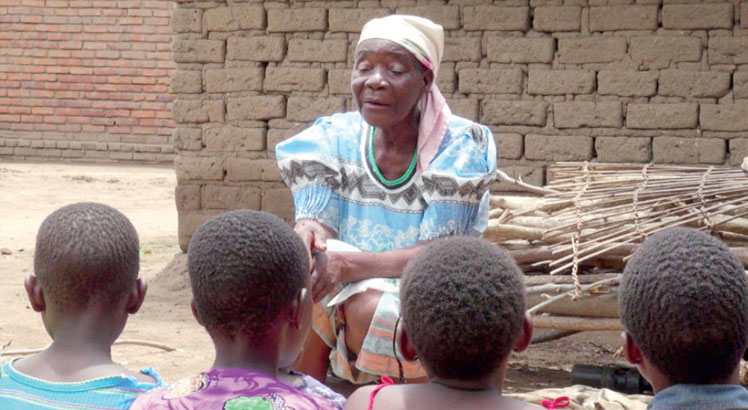
“Our grandparents taught us folktales and riddles,” she says. “The next day they would ask, ‘What did you learn yesterday?’ and we would repeat everything.”
The storytelling sessions reached beyond entertainment. Children learnt respect for elders, household responsibilities, farming and the values expected of them long before adulthood.
“Now things have changed greatly,” Nyirenda says. “Children have phones and watch televisions. They say what we are telling them is old-fashioned.”
But she refuses to let the stories disappear.
The fluent Ngoni granny still gathers children whenever they ask, using folklore to preserve both language and memory.
“If we stop, we will lose our culture and identity,” she says.
In Kumtiyani Village, T/A Kalembo in Balaka, Esther Petro, 91, remembers when children arrived uninvited every time the moon banished darkness.
“Folktales are still told, but not as much as before. I have several great-grandchildren, but I cannot get them to listen to folktales,” she says.
Ngoni culture warrior Aupson Ndabazake Thole, a former Mzuzu Museum curator of the culture of Malawians in the Northern Region, says the moonlight gatherings followed nature’s calendar just as Islamic time-telling depends on moon sightings.
He says: “Storytelling belonged to the dry season, after the harvest, when clear skies and full moons drew families outdoors.
“The stories were never direct. Nobody said, ‘Behave like this’. Instead, children learnt discipline, honesty, cooperation and respect through the behaviour of animals and the natural world.”
Those lessons, he argues, remain as relevant today as they were generations ago, even though the settings have changed dramatically.
“How can we say those stories are unimportant when we still want discipline, development and unity?” he asks. “Times have changed, but human beings have not.”
Malawi has expanded community-based childcare centres and kindergartens to give children a solid start in their first eight years.
Early childhood development (ECD) advocate Nase Chunga says it is sad that moon-lit classrooms are fading fast as many parents leave children to their devices—TVs, phones, tablets…
“There is a gap where parents are failing to pass down their values,” he says. “Children once expected a folktale after supper. Those stories nurtured them and helped them become good citizens.”
Parenting, Chunga argues, extends beyond providing food and paying fees.
“Spending time with children is more precious because you understand them, bond with them and shape their values,” he says.
Even inside classrooms, some teachers are trying to preserve that tradition.
At Sparrows Private Primary School in Blantyre, a teacher Lorraine Chinthenga often opens lessons for seven to nine-year-olds with a folktale
“They love the stories,” she says. “They help children listen and remember.”
Thole believes Malawi does not have to choose between tradition and technology. Instead of allowing oral traditions to disappear with ageing grandparents, he wants them transformed into cartoons, radio dramas and digital content.
“We can still recapture those moments,” he says. “Children will be happy to learn these stories through new platforms.”
The moon has always carried different meanings to various people.
On the shores of Lake Malawi, experienced fisher Zamadolo Kondowe of Mwandovi Village in Chilumba, Karonga, measures it not by its beauty, but shrinking catches.
“When the moon is bright, the fish go deeper or scatter where there is more light. Our catches become smaller. We wait for darker nights,” he says.
For fishing families, the full moon means lean incomes and biting hunger—nothing to smile about.
But the moon will keep returning. Whether the folktales and fishing blues return depends on those still willing to tell them.