Tchuwani Joseph, 40, has been farming since 2015. He grows diverse crops, especially maize, cassava and groundnuts.
Agriculture is the lifeblood of Malawi’s economy, with over 80 percent of the population relying on smallholder agriculture.
However, yields have been declining sharply due to unfavourable weather, pests and diseases caused by climate change.
“I have suffered heavy losses across many seasons due to pest and disease attacks,” Joseph says.
Experts in Malawi project that pests and diseases cause at least 40 percent of total crop losses.
For about 3.4 million smallholder farmers in the country, this worsens hunger and poverty.
Until recently, these farmers depended entirely on government extension workers to provide agronomic tips, including how to manage pests and diseases.
However, there is one extension officer for a staggering 3 000 farmers.
Consequently, pest and disease outbreaks ravage the fields faster than traditional advisories arrive on the farm.
“Extension workers live far from us,” says Kondwani Chimbalambe, a farmer from Malingunde in Lilongwe. “They live in town and they take a long time to visit our fields, inspect our crops and provide advice. This delays our response to pest and disease infestations.”
The 2025 National Census of Agriculture report, published by the National Statistical Office, only shows that 61.3 percent of crop-producing households did not receive any agricultural advice in the 2023/24 growing season.
“This means advisory delivery systems must become faster, real-time, efficient and reliable,” says Department of Agriculture Extension Services (Daes) director Pearson Soko.
Daes’ solution? Going digital.
Since 2022, the Ministry of Agriculture, Water and Irrigation has been piloting the Malawi Digital Plant Health Services project.
The initiative is building a digital hub for targeted, efficient pest and disease management across selected crops such as maize, bananas, cassava, tomatoes and groundnuts.
The digital assistant shares easily accessed messages farmers can use.
The platform bridges the gap between official research and the field, says project data manager Chikondi Mwakwiza, from Lilongwe University of Agriculture and Natural Resources.
“The project national client will be used to access advisories directly from Daes. The department has a wealth of information that can help farmers know exactly what to do when they encounter a pest or disease outbreak,” Mwakwiza explained.
The platform integrates existing digital systems, notably the Artificial Intelligence (AI)-powered PlantVillage mobile application and Viamo’s 3-2-1 Interactive Voice Response (IVR) service.
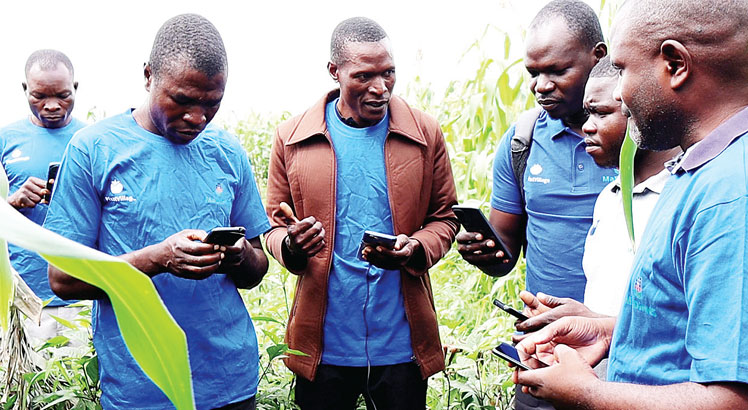
Joseph and Chimbalambe, who serve as lead farmers in their respective extension planning areas, have been using the PlantVillage app since 2023,.
The application leverages AI to analyse field surveys for accurate detection of crop pests and diseases, real-time data validation and imely solutions.
Joseph states: “As a lead farmer, I received an Android smartphone and installed the PlantVillage app. I use it to take pictures of infected crops.
“Within a few minutes, I get a notification with a written advisory explaining the problem and how to manage it. This is much faster than waiting for an extension officer who might not arrive in time.”
As many smallholders lack smartphones, Joseph uses his device to serve 280 neighbouring farmers.
He regularly visits their fields to conduct surveys and read out the app’s diagnostic advice.
PlantVillage country lead Rabecca Mwale says the data farmers collect is monitored by government experts through a centralised AI observatory system installed at the Daes headquarters in Lilongwe and the district agriculture office in Dedza.
To leave no one behind, the Viamo service allows farmers to call and listen to recorded advisories free of charge using basic phones.
“We went live with the audio messages in June 2025,” says Viamo’s senior programme manager Pearl Sallah. “By February this year, about 157 000 unique farmer listeners had accessed roughly 400 000 advisory messages.”
With digital tools, Joseph and his follower can now react swiftly to early-stage threats.
“The more we use these digital platforms, the easier it will become for Malawi to develop through agriculture,” he says.
To Madiphs natural coordinator Jonathan Mkumbira, the breakthrough in digitalising agricultural extension, which merges publicly owned digital systems into a single “national client” hub, provides critical data for farmers, policymakers and stakeholders alike.
He states: “The messages on Madiphs have been meticulously formulated and tested across six ethnic groups nationwide to ensure they are clear, accessible, and practical for farmers.
“This is a Malawian platform, and we want it to be sustainable for the long term.”
Project leader Dr Karl Hughes envisages farmers will get healthier crops, experiencing less damage and using fewer chemical pesticides.
“Ultimately, that means higher revenues from their hard work,” he said.
The Government of Malawi leads the implementation of the collaborative initiative funded by Norway through the Norwegian Institute of Bioeconomic Research.