In 2004, former president Bingu wa Mutharika outlined his vision to transform Malawi from a predominantly importing and consuming economy to a manufacturing and exporting nation.
Fast forward 22 years, Malawi remains stuck in that consumer cycle. Annual export revenues of $1 billion (about K1.7 trillion) fall heavily shy of the $3 billion (about K5.2 trillion) import bill. Recent trade data show Malawi lagging behind regional peers, trapped in a loop of exporting less and importing more.
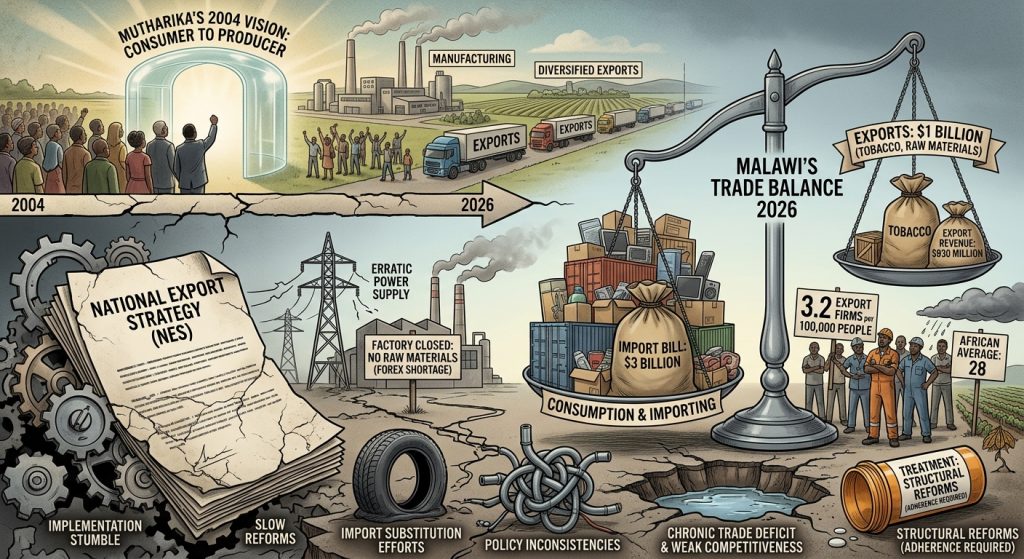
The National Statistical Office (NSO) confirms the trade deficit widened during the first half of 2026, jumping 18 percent in the first quarter to reach K1.3 trillion. This followed a grim 2025 performance where the annual deficit hit $2.67 billion (about K4.6 trillion). Our imports remain more than two-and-a-half times larger than exports.
Economists stress that this widening gap reflects chronic over-reliance on a few low-yield commodities, persistent underproduction and weak global competitiveness. Total exports barely touch $930 million (about K1.6 billion) annually. This imbalance feeds the severe foreign exchange shortages that block local factories from importing crucial raw materials.
International trade took centre stage earlier this year when the World Bank released its 22nd Malawi Economic Monitor (MEM). Over the years, this series has diagnosed our economic malaise through sharp, thought-provoking themes, perfectly capturing the exact tone of our economic stagnation.
The publication history reads like a progressive warning system. From ‘The rising cost of inaction’ to ‘Navigating uncertainty’ and the latest edition, ‘Getting reforms right: Reversing Malawi’s export decline’, the core message is clear: slow, incomplete, or reversed macroeconomic reforms are continuously outpaced by rising deficits.
Essentially, the World Bank provided a “gentle reminder” of challenges we have debated for a generation. We develop beautiful frameworks such as the National Export Strategy (NES) but consistently stumble at the implementation level.
The big question remains: What will it take for Malawi to reverse this trend and truly reap the rewards of international trade? From Kamuzu Banda’s ‘Best Buy Malawian’ campaign to Bingu’s manufacturing drive, Malawi has tried nearly every policy trick in the book. Where do we go wrong?
The World Bank’s assessment points directly to our heavy reliance on rain-fed agriculture—predominantly tobacco, which accounts for roughly half of total merchandise exports. This leaves the economy highly vulnerable to climate shocks and declining global demand. Compounding this is a crippling shortage of foreign currency, high production costs, erratic power supply and a lack of factory processing. Exporting raw or semi-processed goods severely caps our earning potential.
Successive administrations have rolled out strategies to stimulate local production and push import substitution, with very little to show for it.
When swearing in entrepreneur Simon Itaye as Minister of Industrialisation, Business, Trade and Tourism, President Peter Mutharika lamented Malawi’s failure to break into global markets. He repeated the familiar vision: turning the country from importing to exporting and from consuming to producing.
Minister Itaye’s initial remarks cut straight to the chase: “We have talked enough. Malawians and indeed the Presidency, are not looking for more talk. They are waiting for results.”
This echoes the President’s candid admission during the UK-Africa Trade and Investment Summit years ago, where he noted he had nothing to sell on the continental market because Malawi simply does not produce anything. The problem is not an ignorance of the facts; it is translating well-articulated strategies into tangible outputs.
The NES II sought to boost the share of Malawi’s exports to 20 percent of GDP by 2026. Instead, export volumes and the actual number of exporting firms have structurally declined. Today, Malawi has just 3.2 exporting firms per 100 000 people—contrasted against a regional African average of 28.
While the Special Economic Zones Act to facilitate industrial parks is a step forward, structural progress requires more than legal frameworks. It demands heavy, uninterrupted investments in power generation, road networks, and digital infrastructure.
Crucially, Malawi must fix domestic policy inconsistencies that favour speculative traders over actual manufacturers. Flooding local markets with cheap, unregulated imports creates unfair competition that completely frustrates local manufacturing efforts.
Medical prescriptions only work if the patient strictly adheres to the regimen. As a patient in the global marketplace, the Malawi economy still has a lot of effort to make before achieving its economic breakthrough.