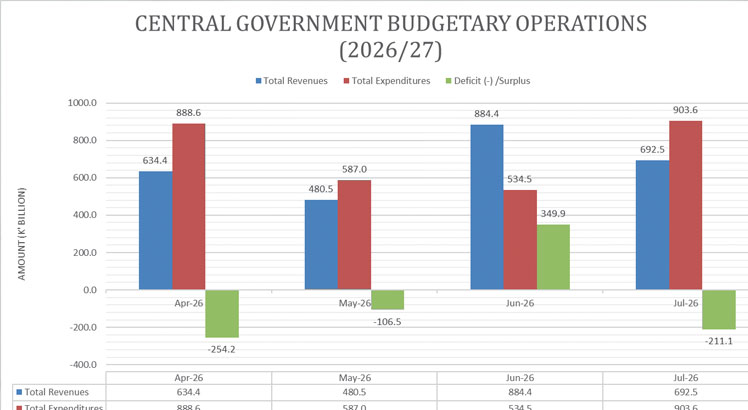
Treasury slipped back into a K211.1 billion fiscal deficit in July, reversing a K349.9 billion surplus recorded in June as a sharp rise in expenditure outweighed strengthening tax collections, Reserve Bank of Malawi (RBM) figures show.
The July outturn marks the first month of the second quarter of the 2026/27 financial year.
The Malawi Government recorded deficits of K254.2 billion in April and K106.5 billion in May before June’s surplus almost wiped them out, leaving the first-quarter cumulative deficit at just K10.8 billion.
According to RBM’s July 2026 Monthly Economic Review, total expenditure jumped 69 percent from K534.5 billion in June to K903.6 billion in July, the highest monthly expenditure in 13 month since July 2025.
Recurrent expenditure increased by K326.6 billion to K784.7 billion, accounting for about 87 percent of total expenditure, while development spending increased to K118.9 billion.
On the other hand, interest payments amounted to K214.3 billion, equivalent to 35 percent of the K607.7 billion collected in taxes. Domestic debt accounted for K203.7 billion of the interest bill.
The deficit came despite tax collections increasing by K104.7 billion from June to K607.7 billion, also the highest monthly tax revenue recorded during the 13 months from June 2025.
However, total revenues fell 21.7 percent to K692.5 billion, largely because non-tax revenues plunged from K313.7 billion to K19.8 billion.
RBM data show that June’s non-tax revenue included an unusually high K304.7 billion in other receipts, which subsequently fell to just K6.4 billion in July.
Scotland-based Malawian economist Velli Nyirongo said the swing from surplus to deficit should not by itself be interpreted as deterioration in government’s underlying fiscal position because monthly finances can fluctuate with the timing of receipts and payments.
“The key question is therefore whether the latest deficit reflects a temporary timing effect or a more persistent gap between government revenues and spending,” he said.
Nyirongo said the cumulative position and trends in domestic revenue, recurrent expenditure and interest costs would provide a better indication of whether fiscal consolidation is taking hold.
In a seperate interview, University of Malawi economics lecturer Edward Lemani agreed that June’s surplus should be treated cautiously.
Lemani said while government’s fiscal consolidation measures were commendable, recurring deficits could increase borrowing requirements and debt-service costs and crowd out private-sector borrowing.