Rising public spending on social sectors is failing to deliver better services or improved outcomes, an Oxfam in Malawi-commissioned study has established.
Conducted by University of Malawi Associate Professor of economics Winford Masanjala on behalf of Oxfam in Malawi, the study has cited weak budget execution, inflationary pressures and funding gaps as key factors limiting the impact of government expenditure.
Titled ‘Fiscal strategies and debt in Malawi’, the study examined whether public resources are reaching frontline services and vulnerable households.
It found that spending remains heavily concentrated in public services, debt repayments and transfers to local councils, which together absorb 56 percent of total expenditure, leaving limited fiscal space for sectors critical to human development and infrastructure investment.
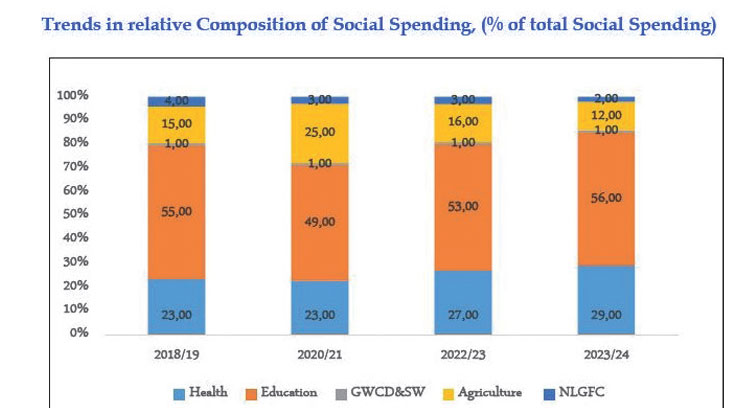
The findings of the study underscore a structural imbalance in that while allocations to social sectors have increased, inefficiencies in execution and the weight of debt servicing continue to dilute their effect.
Reads the study in part: “Although allocation for social sector spending has nominally grown over time, the social sector has averaged 30 percent of the total budget, with the education sector accounting for roughly half of all social spending.
“Social protection as a share of total government expenditure has been in decline over the period, falling from 15.8 percent in 2021/22 to 6.9 percent in 2025/26. It has also fallen as a share of gross domestic product, although by a smaller margin, from 2.9 percent to two percent.”
The study further shows that social protection spending has more than doubled from K315.9 billion in 2021/22 fiscal year to K636.3 billion in 2024/25 fiscal year before falling to K555.6 billion in 2025/26 financial year, but inflation has eroded much of the nominal increase.
Despite data showing that 25 percent of Malawians qualify as ultra-poor, social protection coverage is estimated at just 19.9 percent of the population as at 2022 and the coverage is projected to fall after 2027.
The study further shows that the education budget reached K884 billion in 2024/25 fiscal year, representing a 272 percent increase over the past decade, while budget utilisation declined from 95 percent in 2012/13 to 83 percent in 2023/24 fiscal year.
Despite the increased spending, the education system continues to face serious capacity and quality challenges, with an average of 105 primary pupils per classroom, only 44.5 percent completing primary education.
Health spending, on the other hand, has increased from K125 billion in 2017/18 fiscal year to K550 billion in 2023/24 fiscal year, but its share of the national budget declined to about 9.2 percent in 2024/25 fiscal year, which is below the 15 percent Abuja target, while government’s own health spending was only $16 (about K28 000) per person against $44 (about K77 000) estimated to provide the essential healthcare package.
Malawi’s per capita expenditure on health at $39.9 (about K70 000) falls short of the $86 (about K156 000) per capita expenditure recommended by the United Nations World Health Organisation for countries of Malawi’s economic capacity to achieve universal health coverage.
The Malawi Government’s per capita spending on health at $16 (about K28 000) is below regional peers and comparators at $141 (about K72 000).
Malawi Economic Justice Network executive director Bertha Phiri, in an interview yesterday, observed that declining social protection spending can exacerbate poverty, widen inequality and increase social unrest, urging economic diversification and supporting income-generating sectors.
“Lower social spending can also widen income inequality, potentially leading to social unrest and decreased economic growth,” she said.
Minister of Finance, Economic Planning and Decentralisation Joseph Mwanamvekha indicated in the 2026/27 Budget Statement that government will continue to mitigate the negative impact of economic downturns and price escalations on poor and vulnerable groups.
He said various interventions have been put in place to safeguard the underprivileged sections of society, including 58.6 percent increase in allocation to the social cash transfer programme.
However, debt servicing is nearing K2.5 trillion annually, with interest payments rising to 27 percent of government expenditure from about 15 percent five years ago, far outpacing health’s share of below 10 percent and education’s 15 to 17 percent.