Ministry of Finance, Economic Planning and Decentralisation says it has made progress on domestic debt reprofiling after sending proposals to commercial banks and financial institutions for consideration, with feedback expected following consultations with their respective boards.
In an interview on Tuesday, Minister Joseph Mwanamvekha said that government and its development partners have engaged Sovereign Debt Advisors, an independent firm to ensure that the debt reprofiling process is handled with independence and professionalism.
He said failure to reprofile domestic debt could increase the risk of default and destabilise the banking system, describing the exercise as a “necessary evil” whose alternative could have dire consequences.
Said Mwanamvekha: “This was a necessary evil. If not done, consequences would be dire. Treasury had conducted stress tests to assess the impact of the restructuring, assuring that no bank goes under as a result of the exercise.
“Where a bank has not performed well on stress test, the financial regulator will sort the issues with individual banks. We will make sure no bank goes under.”
The push to restructure domestic debt comes as government faces rising interest costs, with public debt standing at K23.9 trillion, equivalent to 90.9 percent of gross domestic product, at the end of December 2025. Domestic debt accounted for K16 trillion, or about 65 percent of the total debt.
Since the passage of the Reserve Bank of Malawi (RBM) Act of 2018, the composition of domestic financing has changed in terms of both creditors and instruments.
Treasury data showsthat Treasury notes accounted for K13.11 trillion, or 81.9 percent of the domestic debt stock while Treasury bills stood at K1.7 trillion, promissory notes at K320 billion and loans at K110 billion.
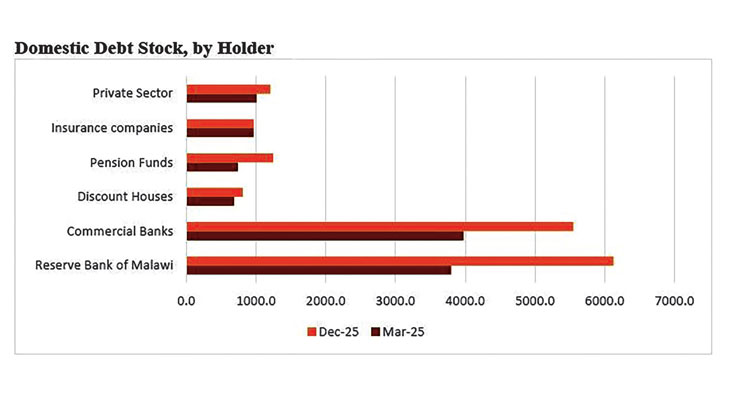
Commercial banks held K5 trillion in Treasury notes, making them the second-largest resident holders after the RBM, which held K6.13 trillion.
Other holders included pension funds at K1.24 trillion, the private sector at K1.21 trillion, insurance companies at K966.6 billion and discount houses at K807.4 billion.
Interest payments are projected to rise to K2.7 trillion in the 2026/27 financial year from K2.2 trillion in the previous fiscal year, adding pressure on government to reduce its borrowing costs.
Speaking separately, Bankers Association of Malawi president Phillip Madinga said banks were waiting for government to communicate its final position on the restructuring.
Nico Capital Limited chief executive officer Misheck Esau warned that the concentration of government securities on the financial-sector balance sheets could make the exercise particularly risky for Malawi.
He warned that implementing restructuring techniques used elsewhere without considering Malawi’s circumstances could result in “a melt-down and recovery will take a long time”.
“Due to high interest rates in Malawi which have subsisted for a very long time, our banks and financial sector balance sheets have been dominated by government securities,” he said.
Earlier, NBS Bank plc board chairperson Vizenge Kumwenda urged government to pursue a win-win restructuring model that avoids forcing banks to incur losses through write-downs.
The World Bank had also warned that Malawi’s domestic debt is on a “precarious trajectory” and called for transparent, rules-based reprofiling to avoid a disorderly default that could undermine financial stability, credit provision and economic growth.