What was sold to Malawians as free infrastructure is not free.
It has emerged that Malawi’s proposed partnership with the African Hero Foundation to deliver 450 facilities, clinics and vocational centres is a deferred-payment model where government pays after delivery—contrary to Second Vice-President Enock Chihana’s claim that it is “at zero cost to governments.”
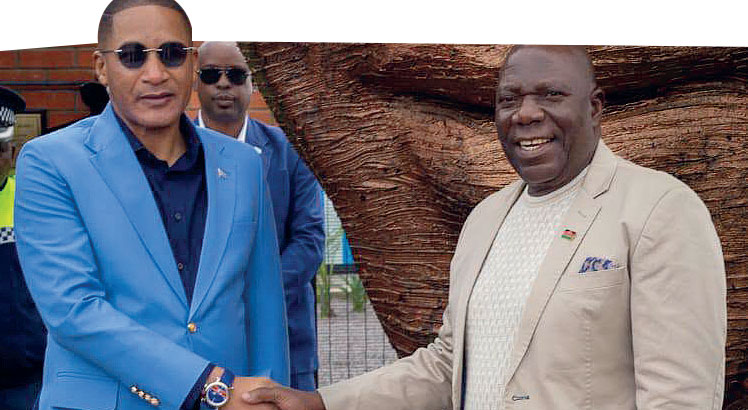
At the high-profile launch in Gaborone on September 6 2026, he announced Malawi would get 300 schools, 100 clinics and 50 vocational training centres.
“It is fully funded by the Jindal Power Group and Moti Group, at zero cost to governments. This directly supports President Professor Arthur Peter Mutharika’s vision of clinics, schools and laboratories in every village, constituency and district through the AGA Isago Initiative. Malawi was selected because of our political stability, peace and good governance,” Chihana said.
But a brochure from the same foundation, sent by Chihana’s office through spokesperson Davie Gadama when asked for clarity, shows that government still shoulders the financial burden.
The brochure says the foundation “is not a charity campaign, a conventional construction programme or a once-off donation model.”
Instead, it “assumes upfront responsibility for designing, manufacturing, constructing, furnishing and equipping facilities, with partnership payments activated only after delivery reaches an agreed stage.”
“Partners are not being asked to fund a promise on paper. Their commitment is linked to visible, tangible infrastructure.”
African Hero also said it is not designed to replace government responsibility, but rather to strengthen government delivery capacity by removing the infrastructure burden
“For governments, this helps reduce the upfront financial and execution burden usually associated with essential infrastructure delivery.”
Moti Group chairperson Zunaid Moti himself framed it as a proof-of-concept rollout: “Botswana has given us the first proof point, and Malawi is already showing us what comes next.”
The Botswana proof point is precisely what should worry Malawi.
There, where President Duma Boko is founding chairperson of the foundation, the opposition and other groups have raised concerns about rising costs to the government and are pushing their Parliament’s Public Accounts Committee to investigate the agreement amid claims that a project initially valued at P3.6 billion (K468 billion) for 100 prefabricated schools has ballooned to P20 billion (K2.6 trillion) over 20 years, according to Botwana news outlets.
The Botswana Public Employees Union (Bopeu) and Manual Workers Union, as reported by The Botswana Gazette, want government to disclose the African Hero partnership’s “financial, legal and contractual” details, including guarantees, staffing, ownership and future obligations, warning that development should not create hidden liabilities for workers and future generations.
That country’s The Monday Chronicle also reported that opposition Botswana Congress Party (BCP) called for an urgent parliamentary investigation into the African Hero schools-and-clinics initiative, arguing that the arrangement could leave taxpayers with a bill exceeding P20 billion.
On the other hand, Daily Mail quoted African Hero founder and South African businessperson Moti explaining that the foundation constructed projects upfront, absorbing initial costs and allowing donors or governments to pay flexibly only after delivery.
The model
Financial analyst Sylvester Malumba termed the African Hero Foundation model a deferred-payment/private-finance model, potentially incorporating elements of a Public Private Partnership (PPP) or lease-type arrangement.
“In financial terms, I would be cautious about calling it simply ‘free infrastructure’ until the full contractual arrangements are made public. The key issue is not only who finances the construction initially, but also who ultimately owns the facilities, when ownership transfers to government and what payments, if any, government will make after delivery,” he said.
Economist Marvin Banda said: “If zero upfront cost simply means Malawi starts paying later, then we have not eliminated the cost; we’ve moved it from today’s budget into tomorrow’s. And with Malawi already struggling under a heavy debt-service burden, that distinction is not semantics. It is the whole economic question.”
Malawi’s total public debt stands at more than 90 percent of gross domestic product, choking fiscal space and making it harder for government in capital formation.
Banda noted an earlier African Hero proposal in Botswana reportedly involved a 17-year lease-to-own arrangement, although the model has subsequently evolved and is now presented as privately funded.
What to consider
Public finance specialist Dalitso Kubalasa said Malawi cannot afford another Bridgin Foundation.
He was referring to the $6.8 billion ‘early Christmas’ in 2022 that President Lazarus Chakwera announced as free infrastructure that turned out to be unfinanced and unverified, leaving government quietly funding abandoned projects after due diligence failed.
It was a textbook case of dazzle-over-details: big numbers, mystery funders, no beneficial owners disclosed, no procurement—and Malawi left holding the bill.
“In plain words, we need to underscore unequivocally that we welcome investments, but we must guard against being dazzled by big numbers. Let’s verify, cost, and scrutinise like our budget depends on it, because it does.”
“A project of this scale could create obligations extending well beyond the current administration. No more blank cheques, no more closed-door promises. Malawi deserves better than another beautiful announcement that collapses into silence,” Kubalasa added.
University of Malawi macroeconomics lecturer Edward Leman said: “We have experienced some unfortunate and embarrassing incidents involving questionable deals in recent years, so we can only hope that thorough due diligence is conducted before government commits to this arrangement. In economics, we often say there is no such thing as a free lunch.”
Centre for Social Accountability and Transparency executive director Willy Kambwandira said: “We need more details of the deal, funding commitments, obligations, implementation arrangements and identities of the entities and beneficial owners involved.”
Treasury, education not in loop
Critically, the ministries that would pay for and run the facilities say they are not in the loop.
Minister of Finance, Economic Planning and Decentralisation Joseph Mwanamvekha said: “You should ask the same office that reported about this deal to provide details. I am not aware and the ministry is not involved.”
Spokesperson for the Ministry of Education, Science and Technology Lily Kampani said: “Until it’s officially handed over to us, it will be too early to comment.”