The African Sovereign Debt Justice Network has warned that Malawi’s deepening debt distress could undermine future debt sustainability unless authorities address the structural weaknesses driving the fiscal crisis.
In its September 2026 report on Malawi’s debt situation, the network, which comprises citizens, scholars, civil society actors and church groups, said securing a new International Monetary Fund (IMF) programme will not on its own resolve the country’s debt problems, calling for fiscal consolidation, stronger public finance management, improved governance, higher exports and increased foreign exchange generation.
Reads the report in part: “The country’s worsening debt profile has become a central concern among development partners and financial institutions, raising questions about future financing options and long-term economic sustainability.
“The success of future reforms will depend not only on technical policy design, but also on political commitment and institutional capacity to implement agreed measures consistently over time.”
The warning comes as Malawi’s public debt reached K23.9 trillion, about 90 percent of gross domestic product (GDP), by December 2025, putting further pressure on public finances and debt servicing.
The joint 2025 World Bank/IMF Debt Sustainability Analysis (DSA) continues to classify Malawi’s external and overall public debt as being in distress, consistent with its November 2023 assessment.
The DSA indicated that Malawi needs a primary deficit of about one percent of GDP to stabilise debt in the near-term, before moving to a surplus of about two percent over the medium-term
It said addressing unsustainable public debt was also a prerequisite for the four-year $175 million (about K306 billion) Extended Credit Facility, which was terminated on May 15 after running for 18 months without reviews, with debt restructuring and reducing the high domestic interest bill among the key outstanding challenges.
The IMF considers public borrowing sustainable when debt remains below 50 percent of GDP, with domestic and external borrowing not exceeding 20 percent and 30 percent of GDP, respectively.
Economics Association of Malawi president Bertha Bangara-Chikadza said in an earlier interview on Sunday that persistent fiscal deficits, driven by low revenues and high recurrent expenditure, particularly wages, subsidies and interest payments, remain central to the debt crisis.
She said reducing the fiscal deficit requires stronger revenue mobilisation and tighter control of recurrent spending.
Minister of Finance, Economic Planning and Decentralisation Joseph Mwanamvekha also earlier acknowledged that the high debt burden remains one of the fiscal challenges facing the economy and said the government will address it through the five-year National Economic Recovery Plan.
“We have indicated what needs to be done and how we will achieve that,” he said.
Last week, a global credit insurance firm Coface said the Malawi Government is at high risk of a new debt default as talks to restructure external commercial debt progress slowly.
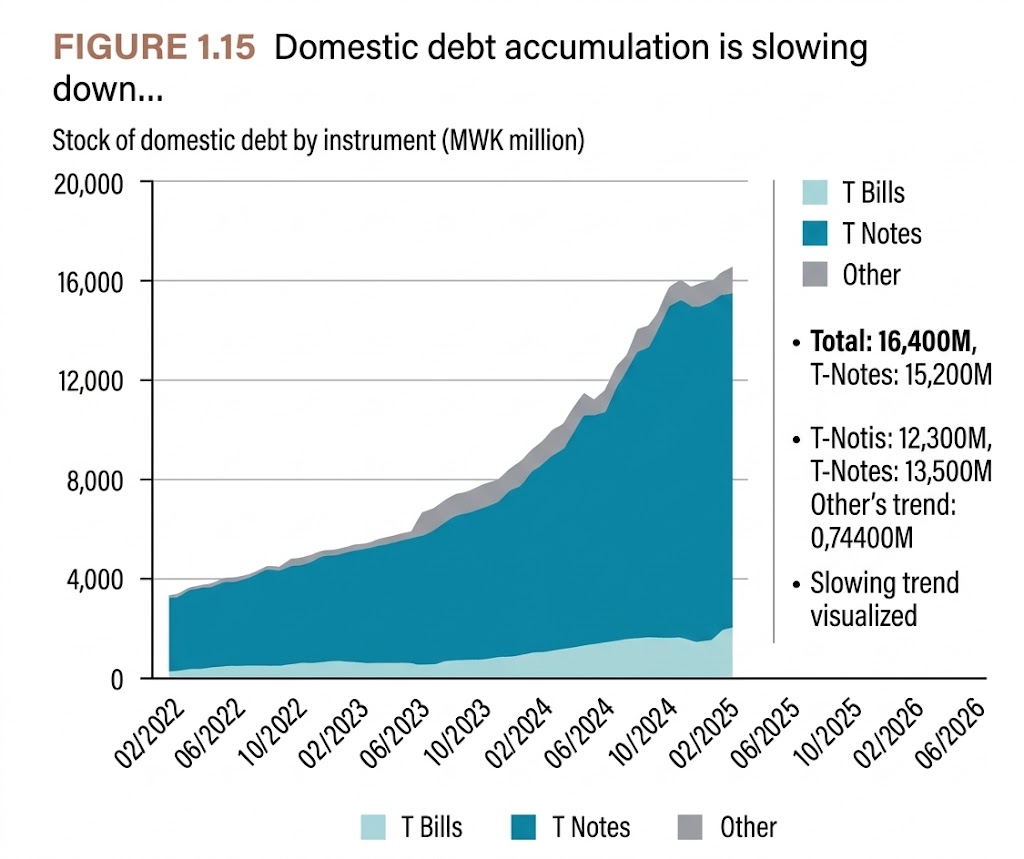
In its risk analysis for Malawi, the French firm, which offers credit insurance, debt collection and business information worldwide, said domestic debt, which accounts for about 60 percent of total public debt, is growing as the government increasingly turns to the domestic market after defaulting on external commercial creditors.