State-owned enterprises (SOEs) are steadily losing financial strength, with the value of their assets and revenues declining both in absolute terms and relative to gross domestic product (GDP), signalling a weakening role in the economy.
The 2024/25 Consolidated Report for State-Owned Enterprises, released by the Ministry of Finance, Economic Planning and Decentralisation, shows that although SOEs remain critical providers of key services, their overall economic footprint continues to shrink.
The report assesses the financial and operational performance of 23 commercial SOEs based on audited results for the 2024/25 financial year.
Its release follows renewed scrutiny of Malawi’s fiscal outlook after the World Bank Group warned a few weeks ago that weak governance, political interference and hidden liabilities in SOEs were undermining public finances.
Dated December 2025, the report notes that while SOEs’ total assets increased marginally from K2.37 trillion in 2024 to K2.50 trillion in 2025, their share of GDP fell from 22 percent to 20 percent.
“This moderation partly reflects slower asset growth relative to nominal GDP expansion, as well as the ongoing implementation of reforms within major SOEs aimed at improving operational efficiency and tightening investment portfolios,” the report states.
On the revenue side, audited results show a decline from K679.4 billion in 2024 to K561.6 billion in 2025. As a share of GDP, revenue fell from six percent to four percent.
According to the report, the performance mirrors challenges related to weak demand, cost recovery and tariff adequacy—particularly in utility sectors—as well as operational disruptions in some trading SOEs.
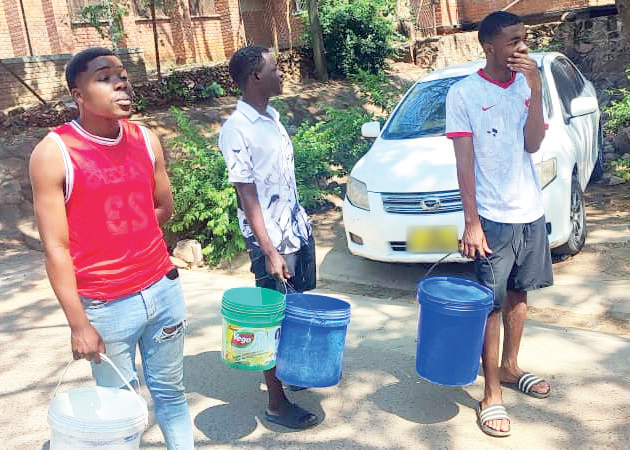
The revenue decline reflects subdued demand, unpaid bills, delayed tariff adjustments in power and water utilities, and interruptions in some trading enterprises that reduced sales and service delivery.
The report adds that the slowdown indicates SOEs are accumulating assets more slowly than the economy is growing, limiting their ability to support service delivery, borrowing and future investment.
The ministry has identified Blantyre Water Board (BWB), Electricity Supply Corporation of Malawi (Escom) and Electricity Generation Company (Egenco) as high-risk case studies.
The country’s key utilities face elevated financial risks characterised by heavy debt burdens, liquidity stress and reliance on government support—factors that threaten service delivery.
BWB is described as the worst-performing SOE and a significant fiscal risk, having recorded losses for several consecutive years, albeit with recent improvement.
During the 2024/25 financial year, BWB posted a net loss of K10.2 billion, an improvement from K37.8 billion the previous year. The board also recorded losses of K20.7 billion in 2022/23 and K8.2 billion in 2021/22, despite supplying about 86 million litres of water daily.
By the end of the 2024/25 financial year, BWB owed Escom more than K28 billion in arrears, further straining the power utility’s balance sheet.
The report notes that BWB’s solvency position deteriorated during the year, with liabilities rising to K86.38 billion, exceeding total assets of K78.88 billion.
“Current liabilities of K32.76 billion overwhelmingly exceed current assets of K5.56 billion, amplifying short-term solvency concerns,” the report states.
Although Escom—the country’s sole electricity transmitter, distributor and retailer—posted a profit of K4.8 billion in 2024/25, reversing a K65.3 billion loss recorded in 2023/24, its solvency position remains weak.
Total liabilities rose from K509.56 billion in 2024 to K648.62 billion in 2025, largely driven by long-term borrowings, which increased from K249.31 billion to K324.82 billion. Current liabilities also climbed to K148.86 billion, reflecting growing operational obligations.
has taken steps
Egenco recorded a modest improvement in profitability, posting a net profit of K644.82 million. However, its solvency position weakened, with interest-bearing borrowings rising to K7.17 billion from K7.03 billion in 2023/24.
Treasury spokesperson Williams Banda said in an interview yesterday that weak liquidity positions, historical losses and high debt burdens mean several SOEs are likely to require bailouts or explicit government support through subsidised equity injections.
He said that even profitable SOEs remain exposed, necessitating government intervention.
However, Banda said government has taken steps to reduce on-lent and guaranteed debt through debt sustainability measures.
“Government has also managed liquidity pressures through controlled fiscal support, as opposed to open-ended bailouts,” he said.
In a separate interview on Thursday, Escom chief public relations and communications officer Pilirani Phiri said the company has embarked on a multi-pronged turnaround strategy focused on financial recovery, operational efficiency and institutional reforms.
“The 2024/25 financial year already shows tangible progress, with the corporation recording a net profit of K4.81 billion, reversing the significant losses of the previous year,” said Phiri.
Egenco public relations manager Moses Gwaza and BWB spokesperson Evelyn Khonje did not respond to our inquiries despite earlier indications they would do so.
Financial analyst Sylvester Malumba observed that the challenges facing SOEs exert pressure on the economy through direct fiscal costs and broader systemic effects.
He said persistent losses, weak balance sheets and liquidity constraints increase government contingent liabilities through guarantees, on-lent loans, arrears clearance and periodic capital injections.
“These interventions divert scarce public resources from priority development and social spending, worsening fiscal stress and public debt dynamics,” Malumba said.
He argued that reform efforts must balance financial sustainability with consumer protection and fiscal discipline, prioritising efficiency and governance improvements before resorting to tariff increases or additional public support.
“The high-risk classification of Escom, BWB and Egenco reflects deep-rooted structural challenges rather than isolated financial underperformance,” Malumba said.
“A coordinated reform agenda that prioritises efficiency, governance and targeted tariff adjustments is essential to restore financial sustainability without overburdening consumers or the government.”
Social and consumer rights advocate Lucky Mbewe said SOEs have long been vulnerable to political interference, undermining their effectiveness.
“This trend must stop if Agenda 2063 is to be realised. Many citizens continue to suffer when accessing services from these SOEs, and such conduct constitutes a serious violation of Malawians’ rights,” he said.