Two weeks and counting of a dry spell have left farmers such as Joseph Kamanga helpless as their crops are drying up, throwing them into debt and potential of food insecurity.
When Weekend Nation visited Kamanga in his maize garden in Kampikamtama Village, Traditional Authority (T/A) Chigalu in Blantyre, he was staring at his maize field that is fast drying up.
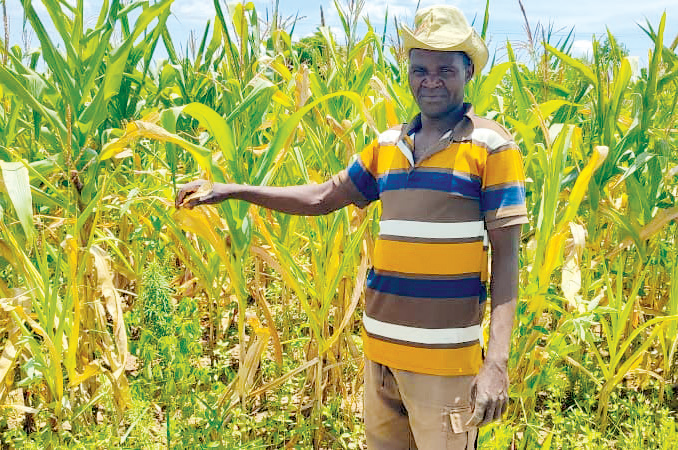
He said the prolonged dry spell threatens not only his family’s food supply but also his ability to repay farm loans.
This season, Kamanga planted maize on 1.5 acres. In the 2023/2024 agricultural season, the same land produced about 80 bags of 50 kilogrammes each before producing about 20 bags of maize last agricultural season. Now, he fears the yield may not even reach five bags.
He said: “I applied four 50kg bags of fertiliser which I got as a loan from One Acre Fund. We were getting two bags of fertiliser plus a 10kg bag of maize seed at K291 000.
“But now my worry is where the money will come from to repay the loan, because as things are now, I doubt if I can harvest even five bags.”
Like many smallholder farmers, Kamanga depends on good rains to repay agricultural loans and sustain his household.
With maize failing, Kamanga is appealing for help, not in cash, but in alternatives that can withstand dry conditions.
His plight mirrors the situation in some parts of the country.
Posting on his Facebook post on Sunday, Chibondo Chibondo of Binali Village, T/A Nankumba in Mangochi asked God to bringing rains in the district, fearing that if the situation continues it means more disasters.
In an interview on Monday, Mangochi District chief agriculture officer Oscar Kambombe said about 13 864 hectares (ha) of crops have been affected by the dry spells, representing about 8 percent of the total 173 011ha of the district’s agricultural area.
He said out of the total affected hectares, crops in 6 351ha have completely dried up.
Said Kambombe: “Most of the areas whose crops have completely dried up, last experienced rainfall on January 1 2026. The affected crops include maize and rice among others. So, as a district, we will start irrigation early on the 3 337 hectares irrigation developed area.
“Further to that, we are also appealing to more well-wishers to support our affected farmers with cassava cuttings to utilise the residual moisture.”
In separate interview on Tuesday, Ntcheu district director of agricultural services Patterson Kandoje said approximately 2 600ha of crops have been affected by dry spell in the district.
He said Sharpevale and Bilira extension planning areas (EPAs) are the most affected in the district.
“The situation is deteriorating here because last week, we were at 1200 hectares and in just few days we are now at about 2 600 hectares,” said Kandonje.
On the other hand, Balaka, Chiradzulu, Chikwawa and Mwanza district agricultural offices indicated that they are currently conducting assessments to find the extent of the damage.
Balaka and Chiradzulu directors of agricultural services David Ali and Mphatso Mbulukwa respectively, said dry spells have affect all EPAs in their respective districts.
However, both could not quantify the total hectarage that have been affected saying they are also conducting assessments.
Last week, Dedza District Council indicated that 1 000ha in Mtakataka EPA has been affected by the dry spell.
The Department of Climate Change and Meteorological Services (MET) on Saturday indicated that dry spells will persist in most parts of the Southern Region and other districts in the central region such as Ntcheu, Dedza and Salima.
In an interview on Monday, MET principal meteorologist James Pagona said despite forecast that some parts of Northern and Central regions will continue heavy rains; the situation in the Southern Region will remain the same up to Saturday.
The warning comes at a critical stage of the rain-fed cropping season, when most staple crops, particularly maize, are at tasselling and cob-formation stages that require adequate moisture.