Malawi’s reform agenda has entered a decisive phase with the government pledging fiscal consolidation and export revival amid private sector warning that policy distortions, foreign exchange shortages and administrative bottlenecks continue to suppress growth.
The 22nd edition of the Malawi Economic Monitor (MEM) produced by the World Bank shows the local economy is strained with double-digit fiscal deficits averaging 10.9 percent of gross domestic product (GDP) over the past three years, public debt approaching 90 percent of GDP, inflation at 24.9 percent and exports at levels last seen two decades ago.

In an interview, Minister of Finance, Economic Planning and Decentralisation Joseph Mwanamvekha acknowledged the strain and described fiscal consolidation as “not merely desirable, but an essential step toward restoring macroeconomic stability and safeguarding sustainable growth.”
Interest payments now consume more than 40 percent of domestic revenues, crowding out social spending and private sector credit. Domestic borrowing at rates between 16 percent and 35 percent has tightened liquidity, while inflation, though easing, remains elevated.
During a panel discussion held on the sidelines of the launch in Lilongwe on Tuesday, Reserve Bank of Malawi Deputy Governor for operations Kisu Simwaka confirmed that inflation has moderated, with food inflation falling largely due to emergency maize imports.
However, he cautioned that such measures are temporary.
“Importing food is a response and an emergency and it is a step in the right direction, but we need to sustain that process by ensuring that we address the fundamental issues related to food security,” said Simwaka.
But while the macro framework is tightening, exporters say structural distortions remain binding.
Illovo Sugar (Malawi) plc managing director Ronald Ngwira highlighted a severe contraction in export volumes.
He said in 2021, the company exported roughly 120 000 metric tonnes (MT) of sugar and last year the figure dropped to 12 000MT.
The company requires around $50 million (about K87 billion) annually for imported inputs, but has struggled to access foreign exchange.
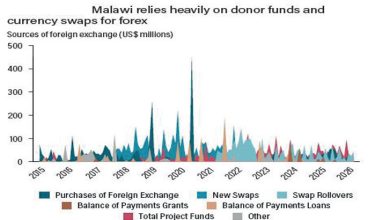
The MEM identifies exchange-rate distortions and trade barriers as central constraints.
World Bank Senior Economist Jakob Engel warned that structural weaknesses, macro instability and restrictive trade policies form a “self-reinforcing” cycle that discourages formal exports.
The report calls for simplified licensing, removal of non-tariff barriers and a move toward a unified, market-determined exchange rate supported by disciplined fiscal and monetary policy.
Deputy Minister of Industrialisation, Business, Trade and Tourism Edgar Tembo framed exports as foundational.
“Exports are the lifeblood of foreign exchange generation,” he said. “When export growth slows or declines, the entire economic ecosystem experiences strain.”
On their part, business leaders argue that implementation consistency will determine whether reforms translate into investment.
Malawi Confederation of Chambers of Commerce and Industry president Wisely Phiri said economic stability and a predictable tax regime are prerequisites for unlocking growth.
He cited operational friction, including multiple roadblocks and bureaucratic layers that undermine formal trade, even where reforms such as one-stop border posts exist on paper.
Thanthwe Farms CEO Ngabaghila Chatata highlighted financing constraints, arguing that “patient capital is what would build Malawi,” especially for long-term agricultural investments with export potential.
World Bank Country Manager Firas Raad stressed that the reforms have to be implemented urgently.