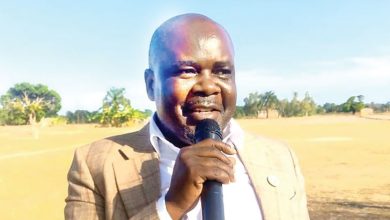
Minister of Finance, Economic Planning and Decentralisation Joseph Mwanamvekha yesterday unveiled a nearly K11 trillion budget anchored on deficit cuts, revenue expansion and a sharp surge in development spending to spur an economy weighed down by high inflation, mounting public debt and structural imbalances.
Mwanamvekha took more than two hours to deliver the 2026/2027 fiscal policy statement to a packed Chamber, maintaining a calm and composed tone throughout.

Budget. | Jacob Nankhonya
At moments, he appeared to enjoy the presentation, occasionally smiling as he outlined reform measures—perhaps relishing the opportunity to turn the economy around under the Arthur Peter Mutharika administration.
Even the usual partisan jeering and cheering from members of Parliament (MPs) appeared to wane midway through the marathon address, underscoring both the length and the technical density of the fiscal blueprint.
The K10.978 trillion package represents 34.8 percent of gross domestic product (GDP) and marks a 27.8 percent increase from the K8.589 trillion revised figure for 2025/26.
Macroeconomic assumptions anchor fiscal reset
The budget is built on a fiscalised GDP growth projection of 4.1 percent, an end-period inflation target of 15 percent, nominal GDP of K31.5 trillion and a policy rate of 18 percent.

These assumptions come against a backdrop of inflation that stood at 28.5 percent in 2025 and broad money growth of 44.9 percent—conditions that highlight the delicate balancing act between fiscal expansion and macroeconomic restraint.
Public debt remains elevated at K23.9 trillion, equivalent to 90.9 percent of GDP, with 65 percent of that stock held domestically—a deficit financing scenario that has created a vicious cycle of high-cost debt, crowded the private sector out of borrowing for investment and eaten into funds for critical social services such as health, education, water and sanitation.
As the debt stock expanded, so did repayments. Debt servicing is now approaching K2.5 trillion annually—rivaling or exceeding major sector allocations in several budget cycles.
Interest payments have followed a steep upward trajectory, rising from about 15 percent of total government expenditure (TGE) five years ago to 27 percent in the current financial year, reflecting higher domestic borrowing and refinancing pressures.
By contrast, allocations to the health sector have remained relatively flat as a share of expenditure, averaging below 10 percent of TGE across the period.
Education has fared better, hovering between 15 and 17 percent of TGE, but its growth has been outpaced by debt servicing. The widening gap suggests that rising interest obligations are increasingly competing with core social spending for limited fiscal space while suppressing development spending that is crucial to stimulating broad-based economic growth. Mwanamvekha’s budget yesterday sought to recast this spending imbalance between capital and recurrent outlays.
Development expenditure expands sharply
Development expenditure in the new budget now accounts for 30.9 percent of total spending, up from 20.9 percent in the current financial year—a structural shift signalling stronger emphasis on capital investment.
Of the total K10.978 trillion expenditure, K7.581 trillion will go towards recurrent spending while K3.397 trillion is allocated to development projects.
Within recurrent spending, statutory obligations remain dominant. Wages and salaries are projected at K1.923 trillion, while public debt interest will consume K2.793 trillion—an increase of 22.9 percent from the previous year.
Interest payments alone represent nearly 8.9 percent of GDP, underscoring the fiscal space constraints confronting Treasury.
Revenue projections rise sharply
Government projects total revenue and grants at K8.126 trillion, equivalent to 25.8 percent of GDP—a 48.8 percent increase from the previous year.
Domestic revenue is forecast at K6.454 trillion (20.5 percent of GDP), with tax revenue projected at K6.203 trillion, or 19.7 percent of GDP.
Non-tax revenue is estimated at K250.5 billion, reflecting a 67.6 percent increase, largely attributed to revised user fees, automation and higher anticipated dividends.
Foreign grants are projected at K1.672 trillion, significantly above the current year’s levels.
Deficit narrows, but borrowing pressures remain
The fiscal deficit for 2026/27 is projected at K2.852 trillion, equivalent to 9.0 percent of GDP, down from 11.9 percent in the current year.
Treasury intends to finance the deficit through improved domestic revenue mobilisation, debt restructuring and issuance of development bonds amounting to K78 billion to support selected infrastructure projects.
Despite the consolidation effort, the elevated debt stock and rising interest payments remain a structural constraint.
Production-focused measures dominate
A total of K1.334 trillion—representing 12.2 percent of the total budget—has been allocated to Agriculture, Tourism, Mining and Manufacturing, which are the sectors picked to drive the country’s growth agenda.
Agriculture alone received K931.1 billion, including allocations for fertiliser subsidies, irrigation expansion, maize purchases and mega farm initiatives aimed at boosting productivity and export capacity.
Energy and mining will receive K352 billion, while transport and ICT infrastructure are allocated K664.4 billion.
On the revenue side, Government introduced VAT on foreign digital services, imposed excise duties on selected luxury goods and hybrid vehicles, and replaced capital gains tax on listed shares with a 2 percent final withholding tax. The VAT registration threshold has been raised from K25 million to K50 million to ease compliance for smaller enterprises.
Fiscal discipline remains central
The minister reaffirmed continuation of austerity measures, including restrictions on vehicle procurement, recruitment controls and tighter oversight of public expenditure.
Throughout the address, Mwanamvekha positioned the budget as both a stabilisation instrument and a growth catalyst.
As Parliament begins debate on the K10.978 trillion package, the central question is whether the projected revenue surge and development push will offset the drag from high debt and interest obligations.
The minister’s calm confidence signalled belief in the strategy
Whether markets and households share that confidence will depend on implementation—and on whether the underlying macroeconomic assumptions hold.
Reacting to the budget, Leader of Opposition Simplex Chithyola-Banda described the 2026/27 Budget as one that “offers no hope”, arguing that it fails to provide tangible interventions to address mounting economic pressures.
He criticised the absence of meaningful tax reforms, particularly on Pay As You Earn (Paye), which he said has reduced take-home pay for workers despite widespread public outcry.
According to Chithyola-Banda, the revenue strategy appears to increase the burden on citizens through additional taxes and levies, warning that government risks “milking a thin cow”.
On agriculture, he said the budget does not adequately address production costs for maize farmers, arguing that reducing maize prices without tackling input costs could discourage production and lead to future shortages.