Heavy rains over the past five days have worsened the condition of infrastructure nationwide in sectors of transport, especially roads, energy and water.
The rains have crippled the Lakeshore Road or M5 at Kaombe in Nkhotakota, M1 between Chiweta and Karonga in the North, M3 between Liwonde in Machinga and Zomba, M1 section at Bereu in Chikwawa and a section of the Chiringa–Muloza Road in Phalombe District.
In an interview yesterday, Roads Authority chief executive officer Ammiel Champiti said they have received reports of road damage from across the country.
He cited the M3 between Liwonde and Zomba where overtopping water has eroded the lower side of the road, limiting the carriageway space.
Champiti said high water levels have also paralysed the M1 at Bereu in Chikwawa and the M5 at Kaombe in Nkhotakota.
He said the authority has deployed emergency contractors to the damaged sections while additional engagements are underway to strengthen response.
Meanwhile, Transporters Association of Malawi (TAM) and Truck Drivers Union of Malawi (TDUM) have expressed concern over the poor state of the roads.
TAM director Frank Banda highlighted the M1 between Chiweta and Karonga where he said there have been cases of fuel tankers travelling from Tanzania getting stuck.
“We are being forced to hire graders to pull out the trucks from muddy sections and we are also spending heavily on repairs of our vehicles,” he said.
On his part, TDUM vice-president Francis Mkandawire urged authorities to urgently repair the damaged sections to restore smooth movement of goods and people.
In the energy sector, the incessant rains have damaged electricity supply infrastructure and left Electricity Supply Corporation of Malawi (Escom) overwhelmed with electricity faults.
Escom chief public relations and communications officer Pilirani Phiri said yesterday that the adverse weather conditions have severely affected power distribution network, triggering a sharp rise in system faults and causing extensive damage to critical infrastructure.
He said a total of 588 electricity poles have collapsed while 111 transformers have been damaged nationwide.
About 402 poles collapsed in the Central Region with Mchinji alone recording 270 fallen electricity poles. The region has so far recorded 28 damaged transformers.
Phiri also said the Southern Region has recorded 72 collapsed poles with 80 damaged transformers. He said the corporation has also experienced a significant surge in low-voltage faults in the South, with daily averages of about 909 cases.
On the other hand, in the Northern Region, he said Escom recorded 1 810 system faults between March 13 and yesterday, with a daily average of 130 faults. He said total of 114 poles and three transformers have been damaged.
In an earlier statement issued on Wednesday night, Escom said the ongoing heavy rains, have also disrupted its primary hydropower supply following the partial shutdown of some generation units to facilitate debris removal and reducing power output at the same time.
The statement said the works to remove trash at Nkula Hydro Power Station reduced power supply by 25 megawatts (MW).
In a separate statement, Electricity Generation Company (Egenco) also indicated that debris and waste washed into water intakes along the Shire River have disrupted power generation at Nkula and Tedzani power stations.
Egenco spokesperson Moses Gwaza said the company anticipates periodic disruptions in power generation for a few hours at a time as its staff work to remove the accumulated trash.
Egenco operates the 129.6 megawatt (MW) Kapichira Hydro Power Station in Chikwawa as well as Tedzani Power Station with 121MW installed capacity and Nkula A and B power stations with combined 135MW, all in Blantyre, along the Shire River, the country’s biggest river and sole outlet of Lake Malawi.
In its load shedding schedule for March 16 to 24 2026, Escom divided customers into six groups, with three experiencing blackouts of at least 4.5 hours per day.
Meanwhile, the National Water Resources Authority (NWRA) on Wednesday moved to save Kamuzu Barrage in Liwonde, Machinga after continued rise in Lake Malawi water levels threatened to overflow and put the structure at risk.
The authority’s spokesperson Masozi Kasambala said in a written response yesterday that while Thursday’s readings were yet to be shared by the team on site, the difference in the mean lake level was more than 46 centimetres (cm) higher than that of the corresponding day last year.
He said the development prompted the authority to immediately operate the gates to safeguard the structural integrity of the barrage that was at risk of being washed away.
Said Kasambala: “The operation was done last night [Wednesday] and the release of water at the gates was raised to 1 450 000 litres per second from 1 000 000 litres per second.
“As at at 8am today [Thursday], the water level has receded by 10cm, and the authority is now releasing 1 440 000 litres per second. NWRA engineers at Kamuzu Barrage are keenly monitoring the developments with respect to forecasts by Department of Climate Change and Meteorological Services.”
Kamuzu Barrage releases 350 000 litres of water per second as the required amount downstream for power production by Electricity Generation Company (Egenco).
On his part, Egenco’s Gwaza said the increased discharge at the barrage coupled with heavy rainfall in the Shire River catchment area downstream led to elevated water levels, but said they have been operating at that level for several weeks.
He said they anticipate periodic disruptions in power generation for a few hours at a time as they work to remove the accumulated trash.
On the other hand, Southern Region Water Board said in its update on Wednesday that the situation at the barrage had affected water treatment, warning customers in Liwonde and surrounding areas of interrupted water supply.
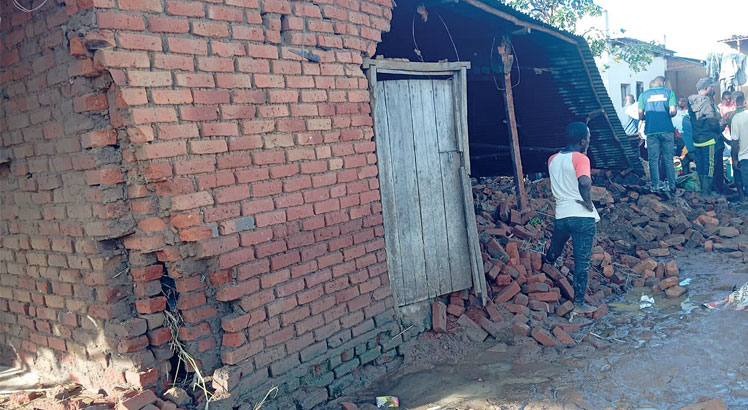
In its update yesterday, Department of Disaster Management Affairs (Dodma) said heavy rains and flooding experienced across the country between March 15 and 18 2026 have affected 9 598 households, including 128 households displaced.
The department said it has recorded 13 deaths and 35 injuries and to date, 12 evacuation camps have been established across six councils.
In its update yesterday, Department of Climate Change and Meteorological Services said rainfall intensity is today expected to significantly reduce nationwide.