Malawi Stock Exchange-listed National Bank of Malawi (NBM) plc has highlighted focus on innovation, efficiency and regional expansion as key targets to sustain its record profitability amid changing economic environment.
NBM plc chief executive officer Harold Jiya, speaking on Tuesday in Blantyre during a stakeholders’ engagement, said the bank’s performance was mainly driven by three key areas.
He said that in the year ended December 2025, NBM plc registered a 95 percent increase in profit after-tax from K101 billion in 2024 to K197 billion at the end of 2025 supported by improvements in deposits, customer numbers and increased digital banking transactions.
“The results demonstrate that the bank’s earnings are not solely dependent on favourable interest rate conditions, but on a diversified business model that continues to evolve,” said Jiya.
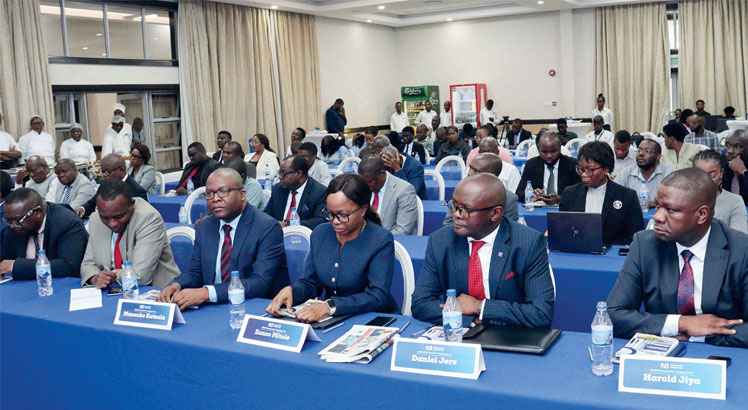
He said NBM plc recorded a four percent improvement in deposits alongside growth in its customer base and strengthened leadership in digital banking services, which continue to play a growing role in revenue generation.
Jiya told the meeting that included business captains, investors and shareholder that these areas will remain central to the bank’s earnings strategy as the operating environment changes.
He said NBM is exploring additional regional markets for expansion beyond Malawi’s borders, noting that the bank has presence in Tanzania through Akiba Commerical Bank and owns 51 percent stake.
Jiya said regional expansion forms part of the bank’s strategy to diversify geographically, reduce reliance on a single market and tap into new customer bases and business opportunities.
But the stakeholders raised concerns over the sustainability of the bank’s strong earnings trajectory amid expected shifts in interest rates and government borrowing patterns.
Minority Shareholders Association of Listed Companies member William Matewele said the concerns reflect a broader shift in the banking industry, warning that reliance on Treasury Bills-driven earnings may not be sustainable in the long-term.
“The era of relying heavily on Treasury Bills and high interest rates may be coming to an end. Banks need to become more innovative if they are to sustain the level of profitability that shareholders have become accustomed to,” he said.
Matewele urged NBM to expand lending to productive sectors such as agriculture, manufacturing, mining and tourism, while deepening digital financial services and strengthening regional operations.
He also called for diversification into trade finance, agency banking, cross-border transactions, wealth management services and fintech partnerships, saying innovation will define future competitiveness.
“The future belongs to banks that can innovate. Those that are able to leverage technology, expand financial inclusion and diversify their income sources will continue to grow even when interest rates come down,” he said.
Another investor Purity Chitalo questioned how the bank intends to sustain profitability in the changing macroeconomic environment.
He said: “With government reducing borrowing and interest rates, how are we going to make similar profits going forward?”
Chitalo also sought clarity on how broader economic growth projections could affect the banking sector’s performance.
“We have different gross domestic product growth projections. Some are projecting growth of around three percent while others are forecasting less than that. How do these economic realities affect the bank’s ability to sustain the kind of profits we are seeing today?” he queried.
NBM is one of the five commercial bank listed on the 16-counter MSE. The others Standard Bank plc, NBS Bank plc, FDH Bank plc and FMB Capital Holdings plc, the parent company of First Capital Bank.