What started as a promising search for economic opportunities has ended in regret for some Malawians returning from South Africa following renewed waves of xenophobic attacks.
In separate interviews with The Nation on arrival at Kamuzu Stadium in Blantyre yesterday, about 20 female returnees said they were reduced to begging while others turned to commercial sex work to survive.
Adija Milanzi from Nkhotakota said she never secured meaningful employment since getting to South Africa in 2024.
She said she survived through piecework such as washing clothes for people in residential areas in Durban, but opportunities were not consistent.
Said Milanzi: “Honestly, I regret going to South Africa because the money I used to obtain a passport plus transport would have been used to start a business and I don’t think I would be where I am today.
“For the last two years my life in South Africa has been that of a beggar. To have food, pay rent and dress was a challenge and I am returning home with nothing new, but the same old clothes, bags and wrappers.”
Another returnee, Amina Mologeni from Machinga, said she only managed to secure one job as a shop assistant after arriving in Durban in 2022, but was dismissed two weeks later.
She said her job involved offloading goods such as bags of maize flour, wheat, sugar and salt from trucks.
A 22-year-old woman from Salima, who refused to be named, said she turned to commercial sex work after spending about six months without finding employment.
Meanwhile, a 28-year-old woman, Halima Thom from Nsanje, says giving birth to a baby girl while travelling back from South Africa is one of the lowest moments of her life.
She said she started experiencing labour pains around Musina town in South Africa about 15 hours after leaving Sherwood Hall camp in Durban, where about 15 000 Malawians are seeking assistance to return home.
Thom said the bus stopped and she was rushed to a health facility in Musina where she delivered the baby.
“While delivering I was beaten by medical personnel saying I was not supposed to give birth at their hospital because I am a foreigner. They asked me if I had a passport and continued to beat me up because I told them I have no passport. But I thank God, my daughter and I survived,” she said.
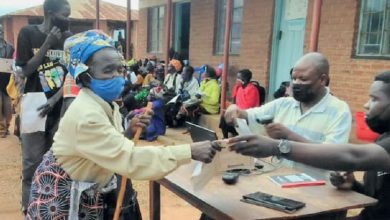
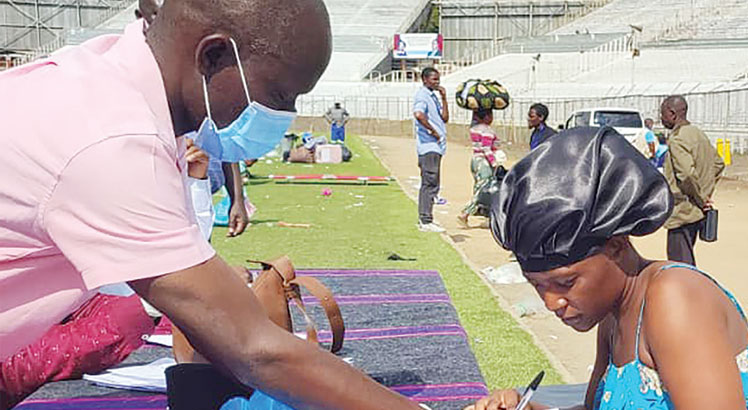
Yesterday, nine buses carrying about 720 returnees, mostly women and children arrived at Kamuzu Stadium where they underwent medical screening.
| Jonathan Pasungwi
After the screening, the returnees received transport assistance from the Department of Disaster Management Affairs (Dodma) to travel to their final destinations.
Those travelling within the Southern Region received K70 000 each, those going to the Central Region received K100 000, while those heading to the Northern Region received K150 000.
In an interview, Dodma director of response and preparedness Charles Matabwa said the number of Malawians camping outside Sherwood Hall in Durban continues to increase.
He said government is intensifying efforts to repatriate all Malawians stranded in South Africa.
In a statement issued yesterday, the Ministry of Foreign Affairs and International Cooperation said eight buses carrying 560 Malawians under the Voluntary Repatriation Exercise departed South Africa on Wednesday, while 10 additional buses carrying 700 Malawians were scheduled to leave yesterday.
Dodma commissioner Wilson Moleni earlier indicated that government requires K24.6 billion to repatriate about 15 000 Malawians stranded in South Africa following xenophobic attacks.