Malawi’s trade deficit with the 16-member Southern African Development Community (Sadc) countries has tripled in five years, hitting K1.4 trillion in 2024 as imports surged and exports declined, the National Statistical Office (NSO) report shows.
The NSO Foreign Trade Statistics Report indicates that during the period, imports jumpws from about K665 billion in 2020 to K1.82 trillion in 2024 while exports rose more modestly from K121 billion to K380 billion during the review period, widening the gap.
The acceleration was sharpest between 2023 and 2024 when imports jumped from K701 billion in 2022 to K1.15 trillion in 2023 and now K1.82 trillion.
The report further indicates that trade balances with neighbours Zambia, Mozambique and Tanzania deteriorated as Malawi’s imports of finished goods increased.
With Tanzania, exports grew from K24.7 billion in 2020 to K98.2 billion in 2025, but imports soared from K28.1 billion to K581.9 billion during the review period, increasing the balance toK483.7 billion deficit in 2025 after brief surpluses in 2021 and 2022.
“Malawi recorded surpluses with Tanzania in 2021 and 2022, but the balance shifted back to a deficit of K483.7 billion in 2025,” reads the report in part.
Trade expert and economist Paul Kwengwere said in an interview on Tuesday that the trend underscores Malawi’s role as a “regional consumer”, with industrial output failing to keep pace.
He cited structural imbalances under the Sadc Free Trade Agreement, saying: “South Africa is a highly industrialised giant while Zimbabwe and Zambia have more established manufacturing sectors. This structural imbalance guarantees a growing deficit as the domestic population grows.”
Kwengwere, who is a former Malawi Investment and Trade Centre chief executive officer and once served as Economics Association of Malawi president, said the country’s imports are dominated by finished, value-added products while semi-processed agro products dominate exports.
He added that the 44 percent devaluation of the kwacha in November 2023 inflated import costs, especially from South Africa, urging Malawi to shift from exporting raw commodities to negotiating long-term contracts with regional conglomerates in South Africa, Botswana and Zimbabwe for processed goods such as soya, groundnuts and macadamia.
Grain Traders Association of Malawi president Grace Mijiga Mhango, in an interview, noted that while exports to Tanzania have grown, Malawi loses value by shipping raw soya beans that Tanzania reprocesses for export.
She said: “As a country, we have been benefiting a lot from Tanzania, especially through exports of groundnuts and soya beans although the kind of market is not formal such that if you look at the proceeds in foreign exchange, we have not been able to attract impressive returns.”
Ministry of Industrialisation, Business, Trade and Tourism spokesperson Patrick Botha acknowledged Malawi’s deteriorating trade balance in the region, but said effort to strengthen intra-African trade are being strengthened.
He said there is policy shifting toward value addition, citing a presidential directive restricting raw mineral exports.
“Industrialisation is the focus. We must move away from raw produce that attracts low value. This means promoting value addition and maximise export proceeds which will eventually reduce trade deficit,” said Botha.
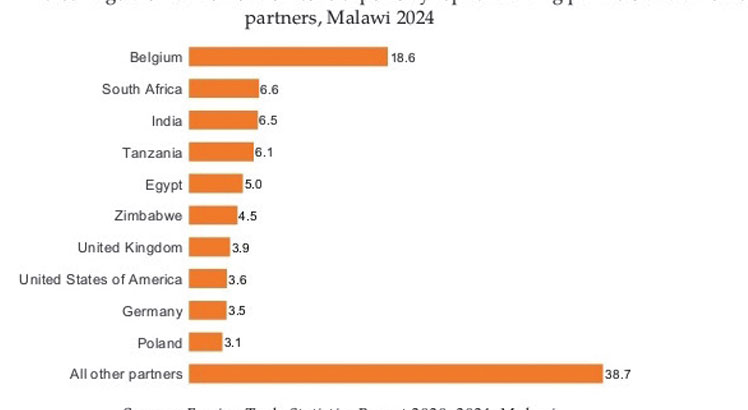
During the review according to NSO, Belgium was the leading destination for Malawi’s exports at K300.7 billion, accounting for 18.6 percent followed by South Africa at K106.1 billion or 6.6 percent and India at K104.4 billion or 6.5 percent.
On the import side, China led with K905.7 billion, accounting for 16.3 percent trailed by South Africa at K826.8 billion or 14.9 percent and Tanzania at K581.9 billion or 10.5 percent.
Malawi has a negative trade balance with all its trading partners, including the United Kingdom, China, United States, European Union, India as well as the Common Market for Eastern and Southern Africa.