It is July 6 2026. A strangely sunny Monday in southern Malawi. The 62nd anniversary of Malawi’s breakaway from Britain marked a bittersweet Independence Day for Blessings Steckshon, a father of three and a breadwinner for one of the homesteads denied electricity in Mangani Village, Senior Chief Chimombo in Nsanje District at the country’s southern tip.
“The nation has been independent for over six decades, but we are still living in the dark,” he says. “I own an electric sewing machine, but my family is stuck in poverty because we cannot put it to good use due to lack of electricity.”

Steckshon’s lamentation echoes widespread frustration in rural communities, home to 84 percent of the country’s population estimated at 22.5 million.
Electricity Supply Corporation of Malawi (Escom) has connected four percent of the rural majority since 1980 when it rolled out the Malawi Rural Electrification Programme (Marep), now under the Ministry of Energy’s grip.
“What is independence when most Malawians cannot do business or enjoy quality life due to lack of basics such as electricity which can help us lift ourselves from poverty?” he asks.
Electricity for votes?
The sluggish grid expansion spikes at a promising pace close to high-stakes elections when journalists photograph smiling Presidents and ministers switching on power in rural trading centres and chiefs’ residences.
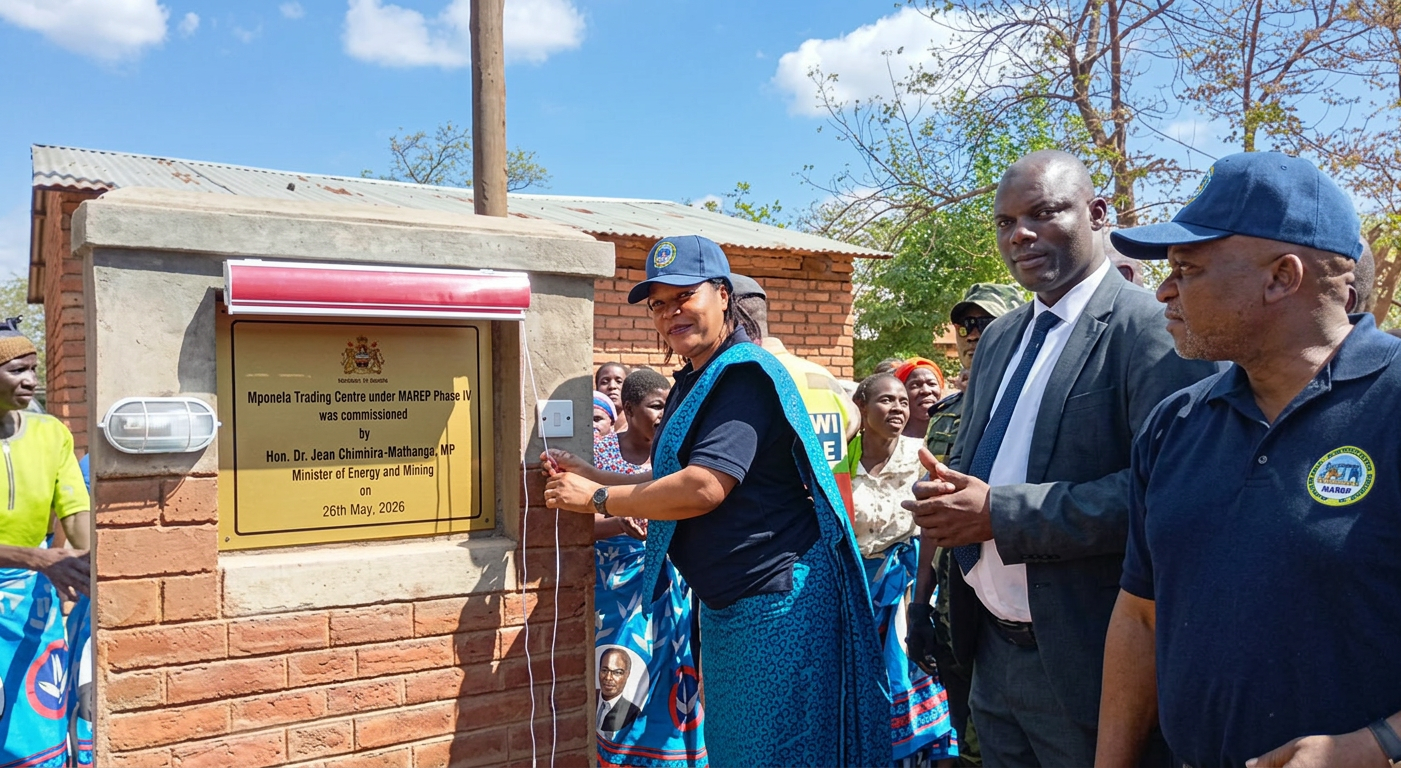
“Electricity is a need, not a luxury for an urban few. So, those in power should not use suspenseful Marep as a campaign tool,” the tailor-turned-bricklayer implores.
The tolerated use of State resources for campaign financing postpones the national initiative to an event that flickers every five years.
The electricity-for-votes campaign spread to southern tip in April 2025, five month before the September 16 General Election won by President Peter Mutharika.
Locals recall seeing Marep agents going village to village, rallying interested residents to pay connection fees because Escom was coming to power their homes and businesses.
A State-sponsored contractor hurriedly connected few houses in Chimombo area, leaving behind dozens of families that spent her meagre income on home wiring and connection fees.
“Escom staff and the contractor silently disappeared after connecting a lucky 14 on December 6, some 13 on the following day and 12 on December 9. They returned this year to replace 15 faulty meters that left connected homesteads and businesses without power for nearly five months.”
The stuttering rural electrification left several electricity poles without wires and several households unconnected.
“The tale of exclusion and suspense makes us feel like second-class citizens,” laments Billy Mafunga. “We wasted our meagre income wiring our homes instead of buying food for our families, but the wait for electricity continues.”
Section 20 of the Constitution prescribes equal treatment for all regardless of where one lives. However, Section 13 exalts the quality of rural life as the only yardstick of government policies
The rural Malawians in the southernmost district lament lost decades as Marep electrifies one percent of its target population per decade.
This persists with four years to the 2030 deadline for global Sustainable Development Goals that include universal access to affordable, reliable energy.
Ministry of Energy spokesperson Joan Thaundi says rural electrification remains at four percent since the 2018 census, but community energy campaigner Edgar Bayani says it could be falling.
Paradoxically, the ministry reports that urban access has more than doubled from 12 to 25 percent in the past eight years—thanks to greater investment, especially the $100 million Malawi Electricity Access Project, which cleared longstanding application for electricity.
The project, funded by the World Bank, illustrates the urgent need for increased financing and strong partnership to end energy poverty across the country.
However, the additional lights in towns and cities have widened the rural-urban power divide.
The stuttering rural electrification drive needs similar jump-starting sooner than later to power the country’s desired transformation into a self-reliant inclusive, industrialised, upper-middle-income economy by the centenary of self-rule in 2063.
“Energy goes beyond lights. It sparks growth, powers factories, drives businesses, aids production and lifts human development,” says the Fight Inequality Alliance communications officer Daudi Kayisi, warning against a dangerous divide.
Stuttering policy
The National Energy Policy promises electricity for all by the Malawi 2063 deadline, starting with 70 percent by the 2030 finish line of the global race for universal access to sustainable energy.
At the current pace, the country needs almost 10 centuries—960 years—to achieve universal access in rural communities.
The 2030 policy target may take 676 years unless Marep, currently dimmed by corruption and financial mismanagement scandals, stops doing business as usual.
“We are celebrating decades of self-rule without energy independence,” says Bayani, from Community Energy Malawi. “Lack of patriotism and urgency has paralysed our nation. Now it’s me, myself and I, as we see corruption taking a big toll, including in the energy sector, which keeps rural Malawians in poverty.”
The ninth phase of Marep has connected over 10 000 customers across 393 sites since 2024, according to Thaundi.
“Some sites are still under construction as Marep Phase 9 aims at electrifying over 500 sites,” she tells The Nation.
Malawians fund Marep through levies stacked on fuel pump price, urban electricity bills plus annual budgets.
Thaundi says the Energy Ministry is auditing Marep footprint to connect households left behind, including in Chimombo.
She narrates: “We have visited all areas electrified under Marep 9 to check how many customers have been connected, how many have completed wiring and how many have actually paid but have not been connected.
The ministry has reportedly discovered that some households have not completed wiring while others were unlawfully wired by unlicensed technicians.
The sneaky rural electrification inroads have stirred a social media storm, with frustrated Malawians flooding Ministry of Energy pages with corruption allegations in the selection of contractors as well as target sites and households.
Thaundi says Marep engages contractors to expand the grid to communal transformers and applicants homes, but Escom connects customers from the nearest poles.
“A contractor’s role ends after the power line has been energised, but we are now adopting a new modality that on the day the power line is energised, all paid customers should be connected,” she stated.
However, the ministerial spokesperson kept mum on why Marep’s activity in selected communities oddly surges in the countdown to winner-takes-all elections.
Escom spokesperson Pilirani Phiri says the utility company regrets that some households in T/A Chimombo’s area remain unconnected despite payment.
“The situation described appears to have resulted from material shortages and logistical issues during project implementation. The remaining households are scheduled for connection once materials become available and Escom is working to expedite this,” he said.
Phiri blamed technical faults or batch defects for the decried meter faults.
“We regret the inconvenience caused and are working to ensure that all defective units are replaced with reliable equipment,” he indicated.
Last year, tailor Jonas Joseph, 32, sold his sewing machine to raise money for wiring his home.
“With electricity, I can work till late in the night and do so much more. The longer I work, the higher the daily earnings,” he bemoans.
The father of four now rents a tailoring machine at K50 000 per month.
“Electricity means progress for our families and communities, but we are left behind. I don’t want my children to enjoy better fortunes that I could only admire due to lack of electricity,” he says.
Delays make the poor poorer
The sparse rural lights in Chimombo is a tale of false starts and thickening uncertainties that make the poor poorer.
Some poor households sold land and livestock to pay fees and wire their homes and shops to be connect to the national grid.
Twenty-year-old Patrick Noah fixes phones, televisions, computers, bluetooth speakers and other home appliances. He sold three goats at K150 000 each to wire his two-bedroom house in time for Marep deadlines.
“My business cannot grow without power. It’s like I mortgaged my meagre income for something that may not come in my lifetime,” says
The unmet demand for electricity worries community social accountability committees established by the Malawi Human Rights Resource Centre (MHRRC) in collaboration with Nsanje Civil Society Organisations Network to enhance citizen participation in development.
Promising lights
In May this year, the community-led initiative, funded by the Norwegian Church Aid and DanChurchAid, invited local government authorities and journalists to air their frustration.
“We are happy with progress, but we are asking for more because many houses are still waiting for electricity. Marep should speed up the remaining processes,” says MHRRC district coordinator Jayne Lipenga
The lobby reportedly jolted Escom to replace faulty metres that left 15 connected homes and shops without power for four months.
The locals also reported seeing a Marep team going door-to-door, tracking property wired, connected or skipped.
“The recent strides restored hope, but the connected population remains much lower than those sidestepped. If I met Minister of Energy Jean Mathanga, I would tell her Marep is giving the rural majority a raw deal,” says Chimombo Community Social Accountability Committee chairperson Aida Neva.
Tallies by committee secretary Thanks Sabao shows that Marep promised 139 connections in Chimombo, but only connected 39 of the 136 who paid connection fees.
“The rural electrification journey that started in April 2025 promised more than it has delivered on the ground. We thank Marep for replacing the faulty metres, but the unmet demand for electricity remains too high,” he says.
On his part, Nsanje District Social Accountability Committee chairperson Henry Zongoloti says Marep cannot continue to postpone their dreams.
“The pace is too slow for a country where many people are still living in poverty. The rural poor need electricity to transform their fortunes. Marep can do better,” he says.
Still, Steckshon, 32, lives without electricity even though his household is among 63 with complete wiring.
He argues: “Electricity powers community development and it can change all spheres of life, from access to education to quality healthcare and the way we do business.
“Why is Marep cheating the people it was conceived to serve?”