The Malawi Government borrowed about K144.6 billion in July through Treasury bills (T-bills), representing an 85.7 percent reduction from K880.4 billion borrowed in June in a development economists say indicates Treasury is reducing its appetite for borrowing.
T-bills results show that Treasury accepted about 60 percent of the bids, which were valued at K238.2 billion to moderate the July borrowing to K144.6 billion.
Economics Association of Malawi president Bertha Bangara-Chikadza, in an interview on Tuesday, said the decrease in the acceptance rate between June and July 2026 shows that the government wants to ensure that the market does not absorb its full financing need.
She, however, said the collapse in bid volumes could indicate that commercial banks are pulling back as bids become less attractive or that the market is testing the government’s stance on the low yields.
Said Bangara Chikadza “Sustained low participation is risky as the government remains heavily dependent on short-term instruments that mature and must be constantly refinanced.
“For the government, it is important to continue rejecting overpriced bids, but not too aggressively to the point that auctions collapse and disrupt refinancing of maturing bills.”
Mzuzu University economics lecturer Christopher Mbukwa said on Tuesday that the decline in domestic borrowing in July could imply that expenditure controls are working although the period is short to make that conclusion.
He said: “We have to wait until at least mid-way the financial year to make that conclusion.
“In the short run, we need to resolutely implement the expenditure controls and reduce the fiscal deficit by mid-year to reduce private sector crowding out of credit for investment also contain interest costs.”
Market analyst Bond Mtembezeka said that if government maintains its policy of reducing domestic borrowing, it would strengthen confidence of stakeholders who prefer clarity of policies and their sustained implementation.
“On the outset, the government was clear that they want rein in public debt, especially domestic debt,” he said.
Mtembezeka, who is Business Partners International country manager, said this shows government’s commitment to control domestic borriwng.
“Government has been busy discussing public debt restructuring with domestic and foreign creditors,” he said.
Minister of Finance, Economic Planning and Decentralisation Joseph Mwanamvekha said that the rejection of T-bills is a deliberate move to induce a decline in interest rates and reduce domestic borrowing and interest rate payment.
He said: “We are rejecting T-bills bids and we will continue rejecting them.
“This is meant to cut interest rates, to reduce domestic borrowing and enable banks to increase their lending to the private sector.”
Reserve Bank of Malawi spokesperson Boston Maliketi Banda said government seeks to reduce its appetite for high borrowing costs amid elevated domestic debt levels at about K14 trillion, which is 65 percent of the total public debt at K24 trillion.
He said: “The Government of Malawi has recently signalled a shift in its borrowing strategy, prioritising fiscal consolidation and debt sustainability.
“With domestic debt already at elevated levels, further borrowing at high yields would exacerbate debt servicing costs and strain the national budget.”
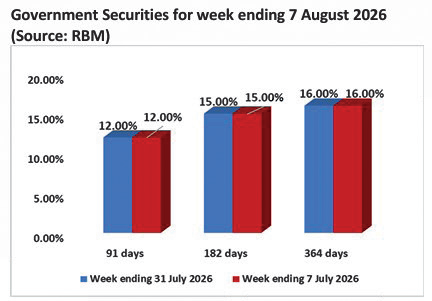
T-bills yields have been dropping from as high as 24 percent in 2025, especially for the 365 days tenor to around 16 percent due to government’s reduced borrowing appetite.
In the 2026/27 National Budget that runs up to March 31 2027, government expenditure is estimated at K10.9 trillion with K2.79 trillion going towards public debt interest payment while budget deficit is projected at K2.85 trillion or nine percent of the country’s gross domestic product.