The Malawi Government closed the first quarter of this financial year on June 30 with a cumulative fiscal deficit of K10.8 billion after revenue increase in June almost wiped out deficits accumulated during the first two months.
Calculations based on the Reserve Bank of Malawi’s (RBM) June 2026 Monthly Economic Review show that the central government recorded deficits of K254.2 billion in April and K106.5 billion in May, before posting a K349.9 billion surplus in June.
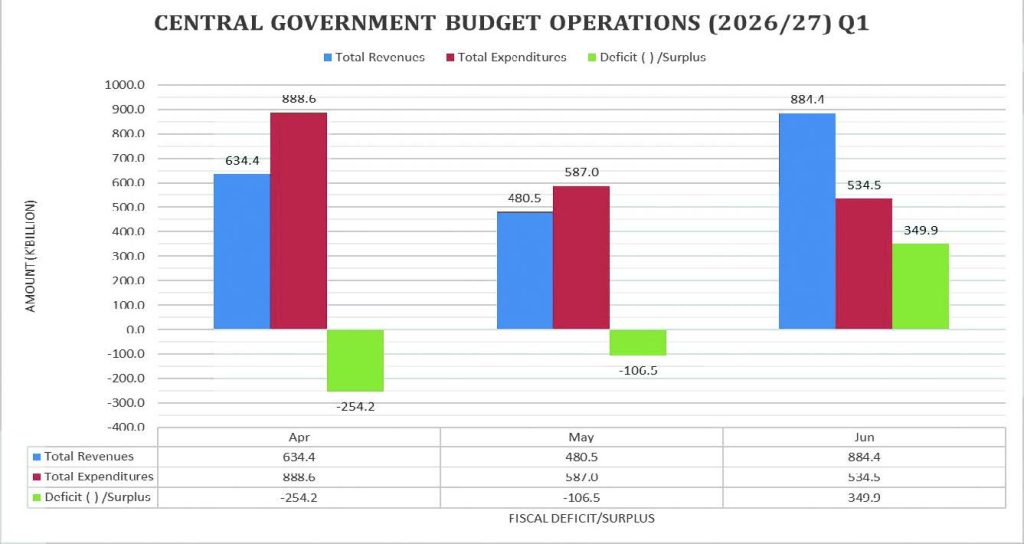
The RBM report further indicated that government revenue jumped by 84 percent from K480.5 billion in May to K884.4 billion in June while expenditure declined by about 8.9 percent from K587 billion to K534.5 billion.
The revenue increase was driven by tax collections, which rose from K122.9 billion to K503 billion and a particularly large K292.5 billion increase in non-tax revenue to K313.7 billion.
Commenting on the Q1 outturn, Economics Association of Malawi president Bertha Bangara-Chikadza said in the current fiscal year that ends on March 31 2027, the government announced its plans to reduce the fiscal deficit from 11.9 percent to nine percent of gross domestic product.
“The fiscal surplus in June 2026, therefore, highlights some success in measures being taken by the government towards fiscal consolidation driven by non-tax revenue,” she said.
But Bangara-Chikadza, who teaches economics at University of Malawi (Unima), cautioned that there is need to monitor the trend before attributing the surplus to fiscal consolidation.
Another Unima economics lecturer Edward Leman said the fiscal improvement was encouraging and credited the government’s efforts to contain expenditure, wastage and deficits.
“The main gain, so far, appears to have come from reduced expenditure,” he said, adding that sustaining lower deficits could reduce government borrowing, ease pressure on interest rates and reduce crowding out of private-sector borrowers.
However, the June figures also show that development expenditure fell K12.5 billion to K76.5 billion while recurrent expenditure declined K40 billion to K458.1 billion.
Scotland-based Malawian economist Velli Nyirongo similarly cautioned against interpreting one strong month as evidence that Malawi’s persistent fiscal imbalance has been resolved.
“The key test will be whether revenue performance can be sustained,” he said.