When floods sweep through Malawi’s communities, leaving behind destroyed homes, washed-away crops and families mourning loved ones, Faith Phiri sees more than a climate disaster.
She sees a warning about the future.
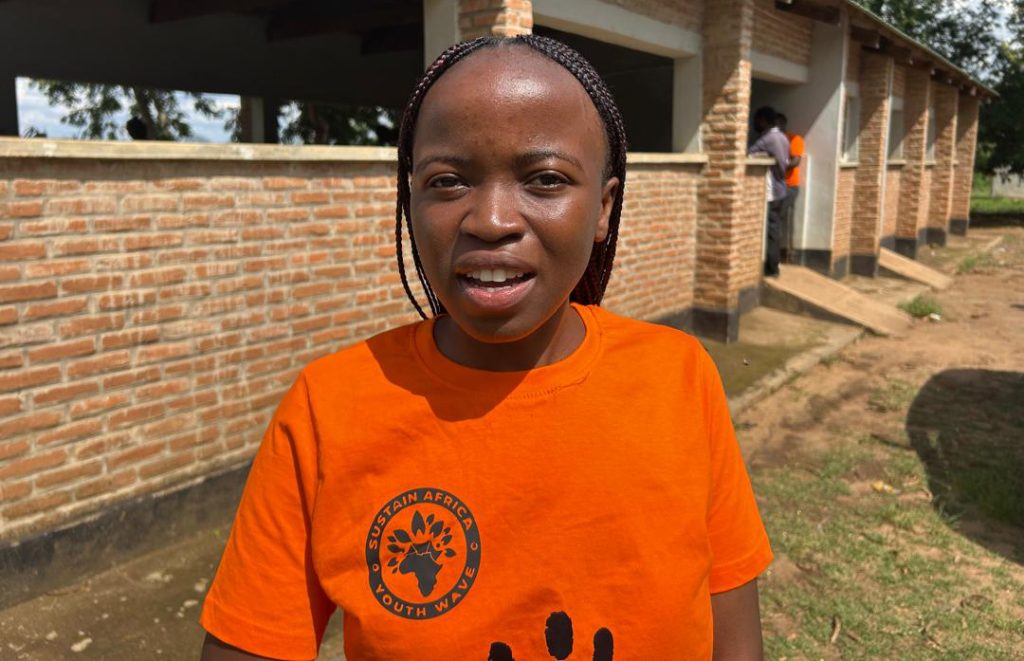
For the 21-year-old, the question is not only how Malawi can respond when disasters strike, but how communities can become better prepared before they happen.
That concern has shaped the work of the final-year Physiotherapy student at Kamuzu University of Health Sciences (KUHeS), who is using her knowledge, research experience and passion for community development to encourage young people and communities to take action on environmental challenges.
Through Sustain Africa Youth Wave (SAYW), an initiative she founded, Faith works with children, young people, women and farmers on issues linking climate change, environmental protection, health and sustainable livelihoods.
Her interest in the environment comes from a wider understanding of health.
For Faith, a community’s wellbeing is not determined only by what happens inside hospitals.
The environment people live in, the food they produce, their livelihoods, education opportunities and ability to cope with challenges all influence their health.
It is this connection between people and their surroundings that drives her work.
Her organisation mobilises resources by members contributing for the proposed activity.
“Sometimes I use my own money to fund some of the activities.
“But this has been a challenge because the resources we get are usually not enough. Otherwise we want to reach to more areas with such initiatives,” she says.
Faith’s journey into community action began with a belief that young people should not wait for opportunities to come before contributing to development.
“This is why despite challenges, I sarted this initiative which depend on the few resources I get from the friends and people who have passion for climate change,” she says.
That belief led her to establish Sustain Africa Youth Wave, an initiative focused on building healthier, more sustainable and climate-resilient communities.
The initiative brings together areas that Faith believes are connected—health, education, climate action, youth and women empowerment, innovation, sustainable livelihoods and community development.
For Faith, development is not about addressing one problem at a time.
A community cannot be healthy without a safe environment.
Young people cannot reach their potential without education and economic opportunities.
And communities cannot become resilient when some people are excluded because of disability, gender or poverty.
“Young people already have ideas, creativity and the ability to contribute to solving challenges in their communities,” she says.
But she believes many need support to turn those ideas into action.
“What is often needed is an opportunity, a platform, mentorship, knowledge and the confidence to begin,” she says.
One of Faith’s major areas of focus is environmental awareness among children and young people.
Through SAYW, she has been encouraging young people to participate in protecting the environment through activities such as tree planting.
The initiative’s Plant and Own a Tree campaign encourages children not only to plant trees, but to take responsibility for them.
The programme has planted 1 200 trees.
However, for Faith, the value of the initiative goes beyond the number.
She wants young people to understand that environmental protection is not only the responsibility of government institutions or organisations. Communities themselves must take part.
At a time when Malawi is experiencing the effects of climate change through floods, dry spells and environmental degradation, Faith believes changing attitudes among young people is an important part of building resilience.
Faith’s work has also moved into agriculture.
Through SAYW, she has engaged farmers and agricultural stakeholders on climate-smart agriculture, climate adaptation, food security and sustainable livelihoods.
The initiative has explored how farmers can respond to changing climate conditions while improving their economic opportunities.
For many Malawian communities, farming remains central to survival.
But unpredictable rainfall patterns, floods and dry spells have made farming increasingly challenging.
She believes communities need knowledge and innovation to adapt.
Although environmental work has become a major part of her life, Faith remains a healthcare student.
Her studies in physiotherapy have influenced how she sees community challenges.
She believes healthcare professionals must understand the factors that affect people before they reach a health facility.
This understanding has also shaped her interest in research.
Faith has been involved in research activities covering disability, tuberculosis care and health systems.
She has also gained exposure through the Malawi-Liverpool-Wellcome Research Programme.
Her interest is not only in generating evidence but ensuring that research contributes to solutions that improve people’s lives.
For Faith, knowledge must lead to action.
Faith’s leadership journey has developed alongside her academic journey.
At KUHeS, she has participated in student leadership and community activities, including serving within the Physiotherapy Students Association of Malawi.
She has also been involved in Science for All activities and other engagements connecting students, researchers and communities.
These experiences have shaped her understanding of leadership.
“Leadership does not always begin with a formal position or a large platform. Sometimes it begins with being willing to speak up, volunteer, learn, organise and take responsibility for an idea,” she says.
For her, leadership is about service.
“Leadership means being willing to listen, identify a problem, bring people together and help create a path towards a solution,” she says.
Despite the challenges facing Malawi, Faith believes the country can build a future where communities are better prepared for climate challenges.
Her dream is of a Malawi where environmental protection becomes part of everyday life, where young people have opportunities to contribute and where communities have the knowledge and resources to adapt.
In an interview, environmental activist Mathews Malata said there is a need for more young people to take an active role in addressing environmental challenges facing Malawi.
He said young people have the energy, creativity and ability to influence positive change in their communities if they are given the necessary support and platforms.
“If there were 1 000 young people such as Faith who are passionate about protecting the environment and working with communities, Malawi would be a different country,” Malata said.
He said initiatives such as Sustain Africa Youth Wave demonstrate that young people do not need to wait for government or other organisations to solve every challenge, but can contribute by mobilising communities and creating awareness.
Malata, however, said young environmental champions need support through resources, mentorship and opportunities to scale up their work and reach more communities.