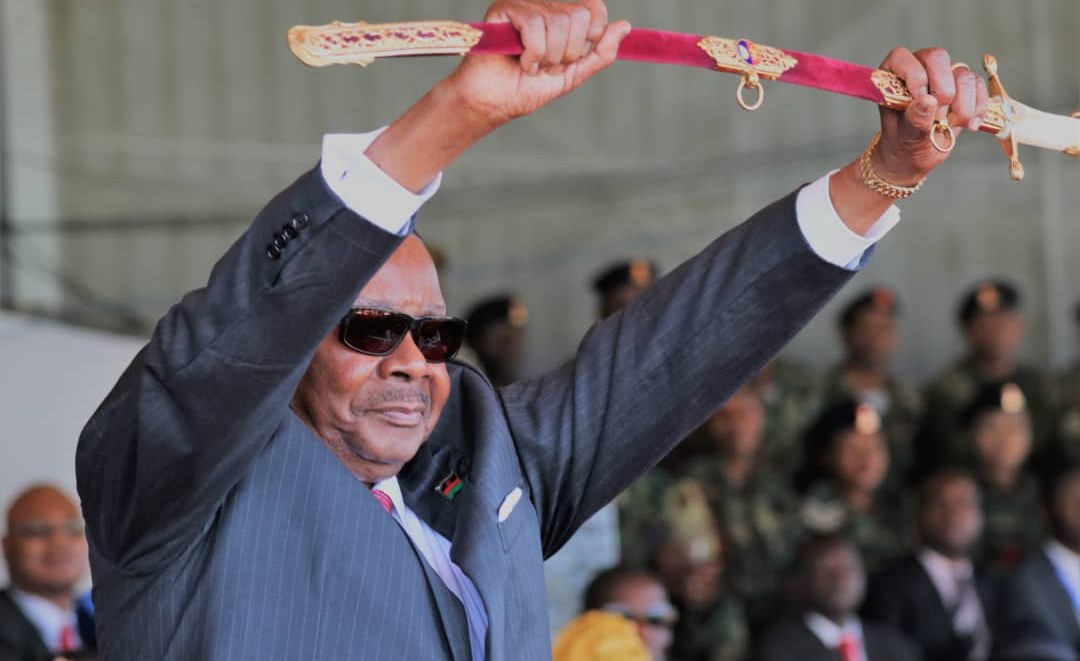
Nation Publications Limited’s (NPL) independent audit of President Arthur Peter Mutharika’s first year in office has yielded a composite score of 62.2 percent— placing his administration in the “Satisfactory” category.
Marking one year today since his swearing-in on October 4, after his September 16, 2025 victory on a ‘Return to Proven Leadership’ platform, the President’s performance was subjected to a rigorous, data-backed inquiry.
The panel—independently assembled by NPL based on proven expertise and a sustained track record of analysis and commentary on national affairs—found the economy partially stabilized, but still fragile.
While headline inflation has eased and fuel supply improved, foreign exchange shortages, heavy public debt and persistent blackouts continued to weigh on businesses and households.
Agriculture delivered more maize, but largely on the back of good weather and government imports rather than structural commercialisation and reform. Underlying weaknesses in inputs, irrigation and markets remain unresolved.
Social sectors led the scorecard. Health recorded the strongest gains, with improved supply chains and sustained HIV indicators, despite lingering stock-outs in public health facilities.
Governance and rule of law showed encouraging signs of constitutional restraint and judicial independence, according to the inquiry’s findings. However, this was tempered by weak anti-corruption enforcement and uneven support for oversight institutions.
Together, these judgments anchor the 62.2 percent—a pass for stopping the bleeding, not yet a cure.
Behind the scorecard
To cut through partisan spin, NPL judged the President on his own promises. The three categories—Economy, Governance and Social Delivery—were taken directly from the Democratic Progressive Party (DPP) 2025-2030 manifesto.
The audit, therefore, measures delivery against the administration’s explicit commitments and their impact on Malawians.
Economy and Governance were each weighted at 37.5 percent because reform and rule of law were the administration’s stated urgent priorities. Social Delivery was weighted at 25 percent for grassroots impact.
The panel was built to match those weights. We assembled 10 independent experts—economists, lawyers and policy researchers—with proven track records in law, governance, macroeconomics, public health and agriculture.
To safeguard credibility, we used expert segmentation and a double-blind assessment. Each expert scored only within their domain, using documented data from the National Statistics Office, World Bank, IMF, public registries and official publications. This isolates the results from partisan bias.
In the interest of transparency, eight panellists submitted numerical scores out of 100. Two economists gave qualitative briefs only. Their insights informed the analysis, but only the eight active scores fed the mathematical model.
To keep the final score valid, the baseline was set at 37.5 percent, 37.5 percent and 25 percent to make 100 percent.
Sector averages were 54.3 percent for Economy, 63.3 percent for Governance and 72.5 percent for Social Services. Applying the adjusted weights produced the final composite of 62.2 percent, or 6.2 out of 10.
What experts found
On the economy, the three scoring economists were unanimous: the pain is slowing, but recovery is still work in progress.
Macroeconomist Marvin Banda (55 percent) noted government spent K642.3 billion on interest in the second quarter of 2026 alone while real gross domestic product (GDP) grew 1.9 percent in 2025 against population growth of 2.6 percent.
For 2026, the Reserve Bank of Malawi (RBM) initially projected a 3.8 percent GDP expansion, but it has now lowered that expectation to 2.8 percent.
Economic policy, governance and entrepreneurship expert Milward Tobias (60 percent) flagged that K2.97 trillion in debt repayments is due in 2026/27.
He also noted that the deficit, though improved to around nine percent of GDP from 12.5 percent, remains unsustainable at K2.85 trillion, and that foreign exchange reserves, despite improving, still cover less than three months of imports.
Scotland-based economist Velli Nyirongo (48 percent) warned: “Until transmission from macroeconomic stability to household welfare occurs, recovery should be regarded as promising, but incomplete.”
Social sector’s agricultural component scored 60 percent from agriculture extension expert Leonard Chimwaza, who said production did well on favourable weather irrespective of last year’s late Farm Input Subsidy Programme (Fisp) deliveries and high input prices.
He cited ongoing initiatives such as Programme for Rural Irrigation Development (Pride), Agricultural Commercialisation Programme (Agcom 2), Shire Valley Transformation Programme and others targeting 43 370 hectares as critical to augmenting recovery in the sector.
Community health professional and rights advocate Maziko Matemba (85 percent) provided the highest score. He cited K17 billion added to health budget, 25 percent bump for drug budget, stabilisation of malaria, TB and ARV stocks, a secured $744 million five-year US grant and the early 2026 Mutharika Executive Order banning dual practice for public sector doctors and other professionals aimed to optimise public ward hours.
But Matemba cautioned kwacha depreciation has eroded hospital purchasing power and rural posts suffer acute vacancies.
On governance, experts noted the right signals, but without systems.
Legal expert Ben Kondowe, who scored the President at 65 percent, cited constitutional restraint as demonstrated by Mutharika’s refusal early in his term to assent to the Constituency Development Fund constitutional amendment following a Constitutional Court decision.
He also pointed to the reconstitution of the Judicial Service Commission and the courts’ continued handling of sensitive political matters as further indicators.
Governance expert Undule Mwakasungula (70 percent) saw no direct political interference and commended action on Amaryllis Hotel matter where an adviser was arrested, but called Cabinet “a mixed bag… some seemingly still on a honeymoon”.
Political scientist Gift Sambo (55 percent) said: “Yet to demonstrate commitment towards good governance… corruption and maladministration is still rampant,” though he commended DPP for no longer being associated with youth violence.
All three flagged ACB leadership vacuum—Director General post without substantive holder for two-and-a-half years—and procurement reforms yet to yield measurable enforcement.
Data analysis: A presidency running at different speeds
The final data reveals why 62.2 percent is not a uniform story.
The administration performed strongest in Social Sector Delivery at 72.5 percent. This was heavily driven by the health sector audit at 85 percent, which noted progress in stabilising clinical supply chains, alongside a steady 60 percent in agricultural management linked to early logistical corrections in Fisp coupon distribution.
Governance and Rule of Law followed at 63.3 percent. Panelists noted a distinct reduction in arbitrary executive interference and healthier respect for judicial autonomy compared to previous turbulent eras.
However, these achievements were anchored down by deep structural challenges.
The Macroeconomic Management pillar recorded a sluggish 54.3 percent. Even with one economist scoring 60 percent, consensus remained low due to stagnant cost of living despite headline inflation falling; persistent anxieties around fuel pump and foreign currency availability; power blackouts; stubbornly high public debt and interest levels despite modest improvements.
This economic drag was strongly mirrored in the written responses of the two qualitative contributors.
Both—Economics Association of Malawi president Bertha Bangara-Chikadza, a senior macroeconomics lecturer at the University of Malawi, and Centre for Social Concern economic governance officer Agnes Nyirongo—noted that while the administration averted an outright fiscal collapse, progress has been limited.
Inflation eased from 28.7 percent in September 2025 to 20 percent in August 2026 and fuel supply became more consistent although lines have popped up over the past two weeks as the forex lean period approaches.
However, both experts observed that reforms needed to unlock donor budget support have been slow, leaving firms operating below 50 percent capacity and poverty projected at 76.6 percent in 2026.
OPC responds
On its part, government—in a comprehensive report for NPL from the Office of the President and Cabinet (OPC)—says evidence indicates that the administration has made significant progress in laying the foundations for economic recovery and restoring confidence, while translating key campaign commitments into tangible programmes and interventions.
OPC says upon assuming office—President Mutharika, who won with 56 percent of the valid votes cast—identified five immediate national priorities—food, fertiliser, fuel, forex and pharmaceuticals (4Fs + P).
He also committed to free primary and secondary education, except for boarding fees, and to advancing a more people-centred and inclusive approach to development, including the allocation of MK5 billion to each constituency.
“The first year, therefore, represents a period of stabilisation, reform and renewed momentum, with continued implementation and measurable results remaining central to the government’s agenda,” says OPC.
The Verdict: Baseline achieved, headwinds remain
A final composite score of 62.2 percent indicates President Mutharika has successfully stabilised the basic administrative machinery of Statehood, but has yet to decisively transform policy frameworks into tangible, widespread economic relief for the ordinary citizen most of whose per capita incomes remain low—albeit on full stomachs.
As Banda summarised: “The government should stop measuring success primarily by whether inflation has fallen…. Are factories producing more? Are formal jobs being created?”
For now, the administration receives a passing grade—but with a clear warning that the honeymoon is officially over.
To climb out of “Satisfactory” into an elite tier, the DPP must aggressively confront fiscal vulnerabilities keeping its economic scores on the ground.
For President Mutharika, who campaigned on proven leadership, the first year has proven he can slow the slide. The next four years must prove he can reverse it.