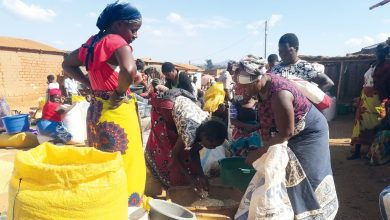
National Smallholder Farmers Association of Malawi (Nasfam) has unveiled plans to scale up rice production and expand exports to regional markets after securing funding under a World Bank-supported grant programme.
Nasfam is among 119 businesses and farmer organisations that on Monday received a share of $4.5 million (about K7.9 billion) in grants aimed at supporting private sector growth and agricultural commercialisation.

Speaking during the grant presentation in Lilongwe on Monday, Nasfam chief executive officer Betty Chinyamunyamu said the money will help the organisation to increase rice production to meet growing demand in Zambia, Zimbabwe and Botswana.
She said: “The demand that we have is quite big. I would say we are barely scratching the surface because at the moment, we are exporting to Scotland, but we only do about 200 metric tonnes [MT] a year.
“We are also exporting to Zimbabwe, but it’s just about 100 MT. However, we have received a lot of enquiries from Zimbabwe, Zambia and Botswana. In fact, the enquiry from Botswana was really at high level.”
Chinyamunyamu said the Botswana market is promising because Malawi rice was recommended by that country’s President Duma Boko.
Deputy Minister of Industrialisation, Business, Trade and Tourism Edgar Tembo said the grant initiative, which is part of the five-year World Bank-funded Southern Africa Trade and Connectivity project is in line with the Malawi government’s efforts to promote industrialisation.
He said the government expects the grants to strengthen the private sector’s readiness to increase production and participate in regional and international markets.
Said Tembo: “The idea from the perspective of the ministry and government is to have an industry that is ready for export.
“Government realises that the impediment to growth in many businesses, particularly the micro and small enterprises is access to finance. It is that impediment that makes all these businesses fail to achieve what they would ordinarily be able to achieve.”
Nasfam’s plans to invest in boosting rice production and exports come months after a study by Mwapata Institute, a local agriculture think-tank, said Malawi only exports two percent of its rice despite some varieties such as kilombero and super faya having significant demand in the region.
The study highlighted that Malawi’s aromatic varieties continue to be popular across Southern Africa, but only a small proportion is traded internationally.
National Planning Commission communications specialist Thom Khanje said in an interview that such programmes provide funding for realisation of the country’s development aspirations.
“This is important as it provides support, including funding towards the realisation of the Malawi 2063 pillar of agricultural productivity and commercialisation, which also feeds into the pillar of industrialisation through supply of raw materials,” he said.
The matching grants are coming at a time Malawi is implementing the National Export Strategy (NES II), which seeks to boost the share of exports in the gross domestic product to 20 percent by the end of this year.
NES II also envisages increasing exports of ‘Made in Malawi’ goods and services to the regional and global market, improve export readiness and international competitiveness of the country’s industries, enterprises and products.
The grants, which amount to a cumulative $4.5 million (K7.9 billion) were distributed to eight companies and 111 small and medium enterprises.