The Malawi Confederation of Chambers of Commerce and Industry (MCCCI) has warned that rising global energy prices, exchange rate pressures and higher transportation costs could reverse recent gains in containing inflation and further increase the cost of doing business.
In its October 2026 Inflation Bulletin, the chamber said although annual inflation eased to 18.6 percent in October from 19.4 percent in September, persistent domestic price pressures and external economic risks threaten the outlook.
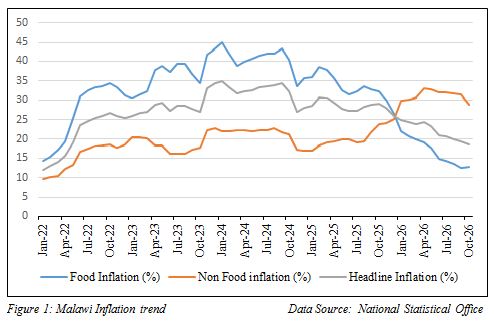
Monthly inflation remained elevated at 1.6 percent, while food inflation increased to 12.8 percent from 12.5 percent, indicating that the cost-of-living pressures facing households and businesses remain significant.
MCCCI identified rising international oil prices, kwacha depreciation and geopolitical tensions in the Middle East as major risks, particularly because of their potential impact on the cost of imported fuel, fertiliser, machinery and other production inputs.
The bulletin states: “For businesses, sustained high inflation continues to undermine purchasing power, increase working capital requirements, raise input costs and create uncertainty around production and investment decisions.
“Equally important is ensuring that monetary and fiscal policies remain sufficiently aligned to contain inflation without unnecessarily constraining private sector investment and economic activity.”
The chamber also noted that Malawi continues to experience significantly higher inflation than some of its regional trading partners. In October, inflation stood at 6.3 percent in Zambia, 5.2 percent in South Africa, 4.3 percent in Zimbabwe and 4.2 percent in Tanzania.
The disparity raises concerns about Malawi’s competitiveness, as persistently high domestic prices increase production costs and erode household purchasing power.
Meanwhile, in its October 28 Monetary Policy Committee (MPC) statement, the Reserve Bank of Malawi (RBM) reported that inflation declined to 20.1 percent in the third quarter from 22.9 percent in the preceding quarter, largely reflecting improved food availability.
However, non-food inflation remained elevated at 31.9 percent, pointing to continued pressure from other components of the economy.
The central bank maintained its 2026 annual inflation projection at 22 percent, compared with 28.4 percent in 2025.
However, it revised its 2027 inflation forecast upwards to 20 percent from an earlier projection of 18.5 percent, citing geopolitical tensions and an increased likelihood of El Niño conditions.
Earlier, the Economics Association of Malawi (Ecama) observed that the economy faced a daunting task of reducing inflation to 15 percent by March 2027, as food prices, electricity tariffs, fuel costs and exchange rate pressures continue to weigh on economic activity.
Ecama warned that the disinflation process remains fragile because of high fertiliser prices, transportation costs, imported production inputs and persistent kwacha depreciation.
Scotland-based Malawian economist Velli Nyirongo also cautioned that uncertainty surrounding inflation, exchange rates and borrowing costs could undermine business confidence and investment decisions.
“Monetary policy should remain cautious, with interest rate reductions guided by sustained improvements in underlying inflation rather than temporary declines in food prices,” he said.