Joan Ngwale of Area 47 in Lilongwe has a problem that has little to do with finding fuel. After spending hours in a queue stretching about a kilometre along the M1 near Area 6, the 37-year-old faces another challenge: finding somewhere to relieve herself without losing her place.
“Many daring ones simply dash to the nearest bush. As for me, I have on two separate occasions gotten on the nearest kabaza to get to the filling station where I can use their toilet in a dignified manner,” she says.
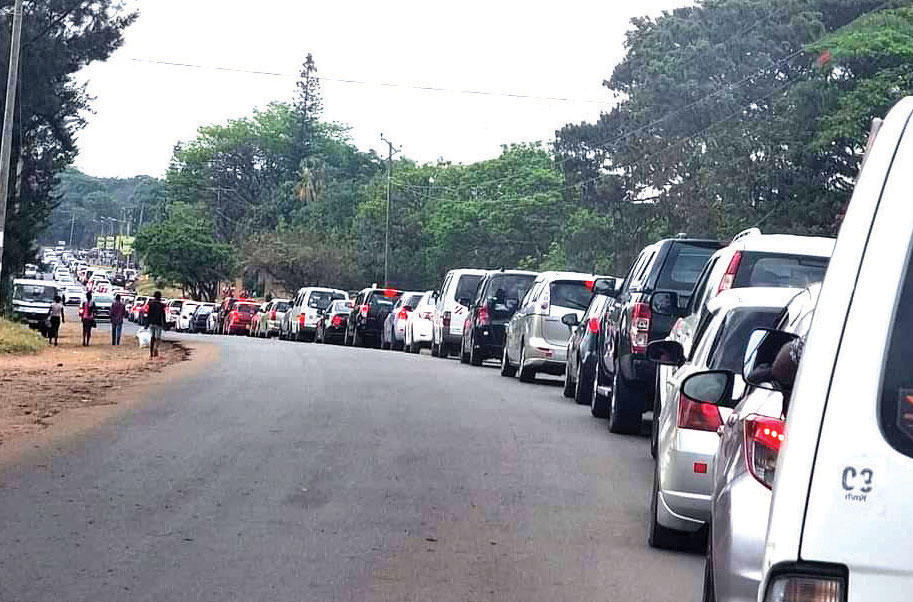
Her experience exposes a largely overlooked effect of Malawi’s fuel crisis: the sanitation needs of thousands of people spending prolonged periods along public roads.
Ngwale says the problem goes beyond individual inconvenience.
“Some people relieve themselves in plastic bags which they then throw away. It sounds unbelievable, but that’s the reality people are being forced to live with,” she says.
For men, the situation is hardly better. Truck driver Fred Sithole, who spent much of last week waiting for fuel at Ntcheu Boma, says finding a clean and convenient place to relieve himself has become an additional burden.
“You can spend an entire day waiting, sometimes without knowing when your turn will come. If you need a toilet, you have to look for one in nearby buildings or bushes. It is not a dignified situation,” he says.
Ngwale says women have additional privacy and hygiene needs, particularly during menstruation and pregnancy, while children cannot be expected to endure hours without toilets. Older people and persons with disabilities also struggle to walk long distances in search of facilities.
“Ultimately, it compromises people’s dignity, health and basic human rights,” she says.
Beyond personal discomfort, the situation raises serious questions about environmental health and the preparedness of local authorities to manage sanitation during a prolonged public emergency.
Where toilets are inaccessible, people resort to open defecation or use secluded spaces along roadsides. Improper disposal of human waste and rubbish could gradually turn areas occupied by fuel queues into sanitation hazards.
Blantyre City Council spokesperson Deborah Luka says the council recognises the challenge.
“All filling stations are mandated to provide sanitary facilities, but we acknowledge that such facilities are inadequate for the huge numbers that converge at pump stations. Also, public conveniences within the city are few and far between,” she says.
Luka says motorists should also take responsibility for keeping their surroundings clean.
“Litter can be kept in vehicles and disposed of when motorists reach appropriate waste disposal facilities. Those who need to relieve themselves should, where possible, politely seek permission to use facilities in nearby private or business premises rather than resorting to bushes or other open spaces,” she says.
On the proposal for councils to provide mobile toilets along affected routes, Luka says the idea is worth exploring despite capacity limitations.
“That is a valid proposal worth exploring. While the council currently has no capacity for such a venture, we will consider engaging corporate partners to support the initiative, not only for the current situation but also in preparation for other unforeseen challenges in future,” she says.
The responses expose a wider institutional question: has sanitation featured at all in the national response to the fuel crisis?
Ministry of Health spokesperson Benedicto Mbewe acknowledges that prolonged queues present additional sanitation and hygiene challenges, warning that facilities at filling stations may become inadequate when large numbers spend extended periods at the premises or along adjoining roads.
He identifies open defecation, indiscriminate waste disposal and possible environmental contamination as potential consequences, saying filling station operators should consider supplementary toilets, water, handwashing facilities and proper waste collection.
He also calls for coordination among public health authorities, local councils and fuel retailers, noting that assessments along affected routes would help establish the extent of the risk.
However, Mbewe did not say whether the Ministry has established the scale of the problem, or initiated specific interventions with councils. Its response acknowledges the risks and recommends action, but not what the Ministry itself has done.
Parliamentary Committee on Health chairperson Anthony Masamba describes the sanitation challenges as a grave public health and human dignity concern, calling for practical interventions.
Masamba says Malawi should examine whether existing public health and sanitation laws adequately address emergencies that force large numbers of people to congregate for extended periods without toilets.
“The question is not simply whether laws or by-laws exist. It is whether the existing provisions adequately anticipate and respond to an unusual situation such as this,” he says.
He urges fuel retailers, local councils and relevant government agencies to share responsibility for temporary facilities according to their mandates and capacities.
“Where queues extend way beyond filling station premises and occupy public roads, it would be unreasonable to place the entire responsibility on individual fuel retailers,” he says.
Meanwhile, Malawi Energy Regulatory Authority (Mera) spokesperson Fitina Khonje draws a distinction between their mandate and the sanitation: “Mera’s mandate is at the filling station,” she stresses.