Malawi Government faces the moment of truth on the sustainability of its fiscal management gains during fresh policy negotiations with a visiting International Monetary Fund (IMF) targeting to secure a new economic programme.
An IMF team led by mission chief Justin Tyson arrived in the country yesterday for negotiations scheduled to run until October 3, with the latest fiscal and external-sector data providing a new basis for assessing Malawi’s progress towards a possible Extended Credit Facility (ECF).
During what Ministry of Finance, Economic Planning and Decentralisation spokesperson Williams Banda described as “policy negotiations”, the significant new development is the scale of the improvement recorded in the first quarter of the 2026/27 financial year.
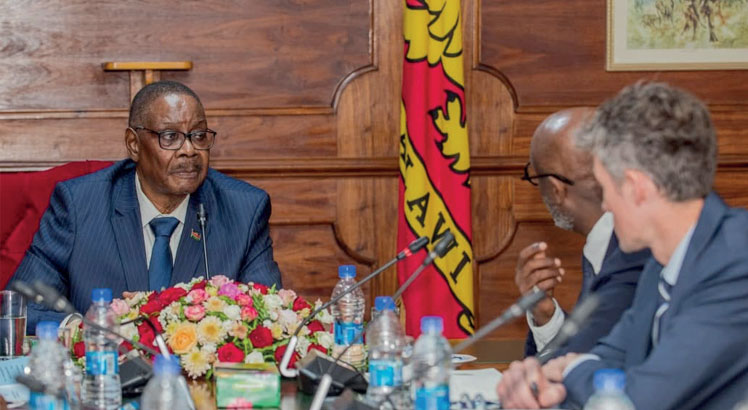
November. | State House
Fiscal data analysed by The Nation show that between April and June 2026, the government revenues and grants increased by 53.7 percent year-on-year to K1.8 trillion while expenditure fell by 18 percent to K1.96 trillion.
The result was an 86.6 percent reduction in the revenue-expenditure gap, from about K1.22 trillion in the corresponding period last year to K163 billion.
During the review period, domestic revenue performed even more strongly, rising 72.7 percent to K1.69 trillion, well above the 20.8 percent year-on-year inflation rate recorded in July.
The figures offer the clearest indication yet that government’s efforts to strengthen revenue collection and contain expenditure are beginning to show in the fiscal accounts.
However, the IMF talks come with important unresolved pressures, including interest payments that increased from K436 billion in April-June 2025 to K642 billion during the corresponding period this year, underlining the pressure that debt servicing continues to place on public finances.
Foreign exchange reserves have also improved, rising from $536 million, equivalent to 2.1 months of import cover in March 2025 to $600.6 million or 2.4 months of import cover.
However, the reserves remain below the conventional three-month import-cover benchmark while foreign exchange shortages continue to constrain economic activity.
In an interview yesterday, University of Malawi economics lecturer Edward Leman said rebuilding Malawi’s external position will require more than exchange-rate adjustment.
“Exchange-rate adjustment can, therefore, correct a price distortion, but it cannot by itself resolve a structural foreign-exchange shortage,” he said.
Leman said stronger exports, import substitution and higher productivity were necessary to sustainably improve the country’s capacity to generate foreign exchange.
On his part, Mzuzu University economics lecturer Christopher Mbukwa said fiscal discipline, debt management and foreign exchange management would likely remain central to the negotiations.
“An agreement is likely [to] offer donor confidence rather than a source of IMF dollars,” he said, arguing that an ECF could help unlock grants, concessional financing and creditor cooperation.
But Mbukwa cautioned that a new programme would not, on its own, resolve Malawi’s structural economic weaknesses.
Scotland-based Malawian economist Veli Nyirongo said the negotiations would have to balance the need for credible economic adjustment with the impact of reforms on households.
“The most difficult part of the negotiations will be reconciling the IMF’s need for credible macroeconomic adjustment with government’s need to manage the immediate social and political consequences of that adjustment,” he said.
The talks follow the IMF’s June 8 to 18 mission during which the IMF noted that the government had taken measures to reflect global market prices, stabilise public finances and address food security challenges.
The IMF said at the time that discussions would continue on a package of policies and reforms that could be supported under an ECF while government reaffirmed its commitment to implementing “sound and credible policies” to restore and preserve macroeconomic stability and support inclusive and resilient growth.
In July, the IMF said technical and policy discussions were continuing towards agreement on reforms that could be supported under an ECF, with protection of priority social spending expected to form part of any programme.
Malawi’s four-year $175 million ECF with the IMF terminated automatically after going 18 months without a review. Malawi Government stated that the suspension or “lapse” of the ECF was a result of a mutual agreement between the Bretton Woods institutions and Lilongwe while the IMF said the programme expired and that the fund was now engaged in Article IV consultations with the Malawi Government.