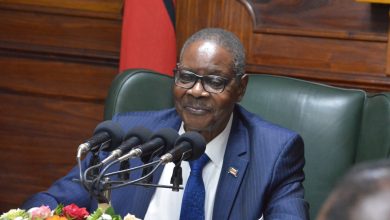
Former president Lazarus Chakwera has declared he will contest the presidency in the 2030 General Election on a Malawi Congress Party (MCP) ticket, setting up a bruising succession battle inside the party.
Speaking in Blantyre yesterday when he met MCP representatives from the Eastern and Southern regions, Chakwera said his vision remains alive and accused the current administration of betraying Malawians after promising change.
“Palibe angandipangire malire. Osataya ndalama, chuma pofuna kulimbana ndi ine [No one can set limits for me. Do not waste money and resources fighting me],” he said, vowing to defend MCP against attempts to sell it.
The meeting was attended by secretary general Richard Chimwendo Banda, campaign director Moses Kunkuyu, publicity secretary Jessie Kabwila and other national executive committee (NEC) members, including Kondi Msungama and Deus Gumba. Both Chimwendo Banda and Kunkuyu endorsed him for 2030.

welcomes Chakwera on arrival
at the venue. | MCP Media Team
Chakwera, who lost the September 16 2025 election to President Peter Mutharika of the Democratic Progressive Party (DPP) on the back of an economic and governance collapse, blamed some of his former Cabinet ministers for putting personal interests ahead of teamwork.
Kabwila said the bid was in response to calls from party structures: “The emphasis is that Chakwera is standing again in 2030. That has not come from him; it is the structures that have endorsed him.”
The early declaration comes as MCP prepares for crucial grassroots elections. On September 19, Chimwendo Banda announced polls for all regional, district, constituency, ward and area committees by May 8 2027, following a High Court order of May 8 2026.
Inside sources say those elections have become a proxy war. Chakwera’s allies are campaigning for loyalists to control delegate lists, while rival hopefuls—including former State House chief of staff Prince Kapondamgaga—are also fronting themselves for the top MCP job.
At the heart of the fight is Article 31 of the MCP Constitution. It provides that NEC members are elected every five years “except the president who shall hold such office for two terms only if elected for a second term.”
An exception allows a sitting State President in his second term to contest again. Having lost in 2025, Chakwera no longer qualifies, critics argue.
A legal opinion presented to Chakwera four months ago concluded his return is blocked unless the constitution is amended, a senior NEC member said. “Any attempt to bypass Article 31 without lawful amendment would be instantly vulnerable to a fatal legal challenge.”
That proposal was aired openly in Kasungu on September 5, where district chairperson Chisomo Mbembeza confirmed: “Malawi laws allow Chakwera to contest, but not the MCP constitution. So, can’t we amend the constitution?”
Critics call it personalisation of the party.
“Ideally, his term ended in 2023, but was extended because he was State President. Changing the Constitution to suit individual interest is quite undemocratic,” said one NEC member in an interview with Weekend Nation.
If he stays until 2034, Chakwera would have led MCP for 21 years—the longest since founding president Hastings Kamuzu Banda. He took over the party’s leadership at the Natural Resources College Convention in August 2013.
Analysts say Chakwera’s push for a return defies electoral logic.
Political scientist Clemence Alfazema argued last month that MCP has a structural ceiling of about 33 percent of voters, with core support around 20 percent based on Afrobarometer and historical data.
Chakwera’s 59 percent win through the Tonse Alliance in the court-ordered 2020 Fresh Presidential Election was down to the electoral marriages and the late Vice-President Saulos Chilima’s pull—not MCP alone, said Alfazema.
“Chakwera is now a tested leader whose performance is well-documented and, in the eyes of many, disappointing. He lost when he had the incumbency advantage that would have allowed MCP to tap into swing votes,” Alfazema said.
A NEC member sympathetic to Chakwera countered that stability matters: “With Chakwera the party will have stability. This is the same reason DPP retained APM [Arthur Peter Mutharika].”
Chakwera’s trajectory underlines the gamble. He finished second to Mutharika in 2014 and in the nullified 2019 poll, won in 2020, then lost again to Mutharika in 2025.
His early declaration is, therefore, both a show of strength and a defensive move— an attempt to lock down structures before May 2027 and quell rivals before the battle for delegates begins in earnest.