Nurses and midwives have renewed calls for higher locum rates, improved incentives and faster recruitment, saying better pay and working conditions are essential to retaining staff and addressing chronic shortages in the public health sector.
The Association of Malawian Midwives (Amami) and the National Organisation of Nurses and Midwives of Malawi (Nonm) made the demands in a joint statement signed by Amami president Keith Lipato and Nonm president Shouts Simeza.
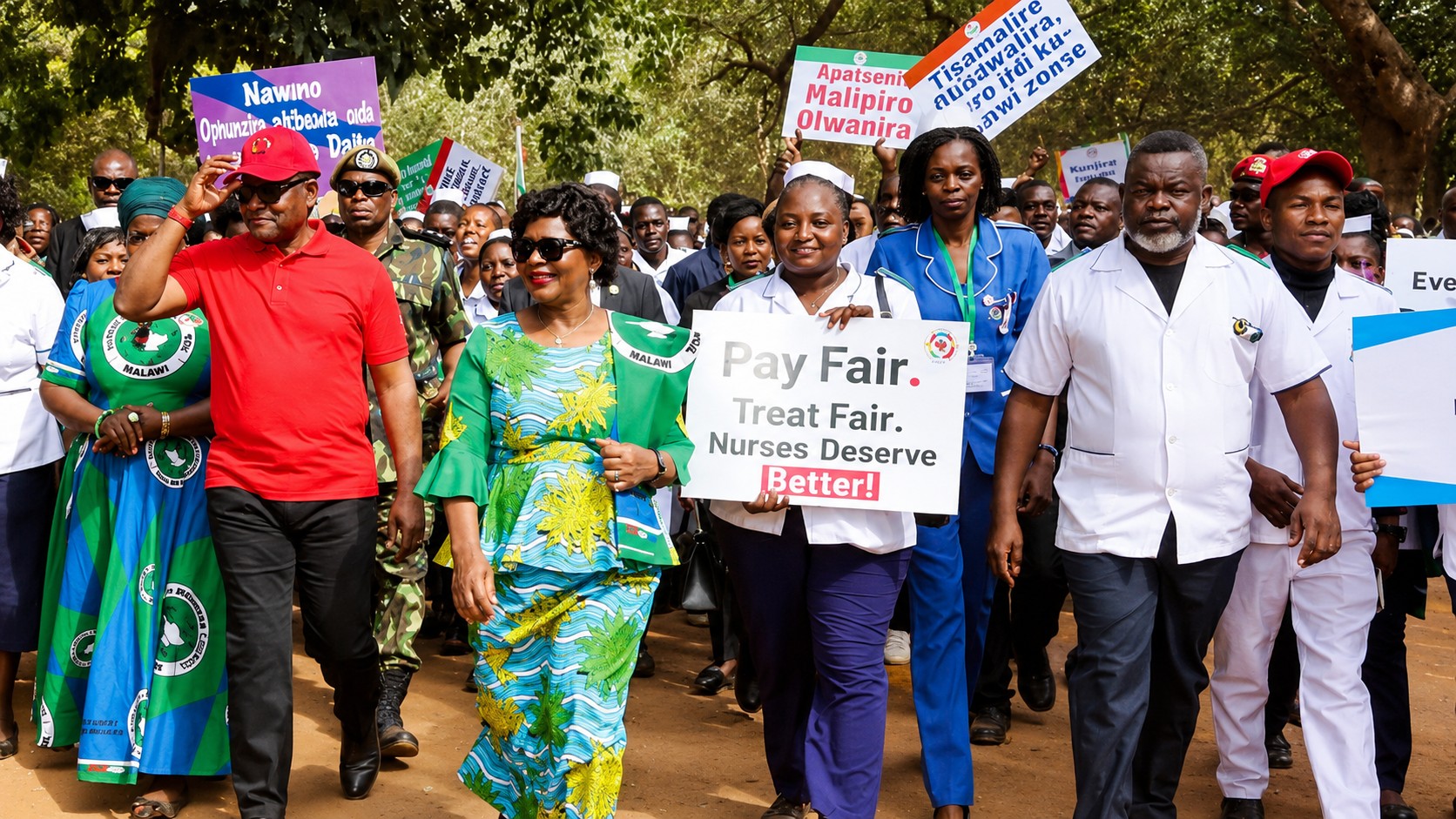
The two organisations also commended Minister of Health and Sanitation Madalitso Baloyi for making an unannounced visit to Mangochi District Hospital, describing the gesture as a positive step towards boosting morale among frontline health workers.
However, they said improving working conditions requires more than symbolic visits, urging government to review remuneration and incentive packages “in recognition of nurses’ and midwives’ commitment and workload.”
The organisations also called for accelerated recruitment and retention of nurses and midwives, while ensuring uninterrupted supplies of essential medicines and medical commodities, citing the recent shortage of gloves in several district hospitals.
Although acknowledging progress in recent recruitment exercises, they said the efforts remain insufficient to close the country’s estimated shortage of nearly 8 000 midwives.
The statement further called for merit-based promotions and greater representation of nurses and midwives in senior leadership positions within the Ministry of Health and Sanitation.
“We have a huge pool of well-qualified and experienced nurses and midwives who have stagnated at the same grade for years. They need to be considered for key leadership positions in the ministry,” the statement reads.
Ministry of Health and Sanitation spokesperson Benedicto Mbewe yesterday asked for more time before commenting on the demands.
The renewed calls come amid concerns over Malawi’s critical shortage of nursing personnel.
According to a recent World Health Organisation (WHO) report, Malawi has only 5.4 nurses per 10 000 population against the recommended benchmark of 56.73, while the country has just 0.3 midwifery personnel per 10 000 population, far below the recommended 9.23.
In April this year, government increased locum rates for healthcare workers by 250 percent in an effort to improve service delivery and compensate staff covering shortages.
A Ministry of Health memo dated March 18 2026, signed by Secretary for Health Dan Namarika, revised locum rates for central hospitals from K4 800 to K12 000 for day shifts and from K6 200 to K15 500 for night shifts.
At district hospitals, day-shift rates increased from K3 750 to K9 375, while night shifts rose from K5 250 to K13 125.
For anaesthetic and orthopaedic clinicians, radiographers, dental, audiology and other scarce specialised cadres, the rates increased from K35 000 to K87 500 for the first category, K26 250 to K65 625 for the second and K21 000 to K52 500 for the third.
The ministry said the revised rates were intended to provide fair compensation for healthcare workers providing locum services due to staffing gaps and to improve efficiency across public health facilities.
The memo also directed heads of health institutions to ensure strict compliance with locum guidelines and approved budgets, warning that controlling officers would be held accountable for any abuse of the system.
Despite the increase, some stakeholders have argued that government should prioritise recruiting permanent staff rather than relying heavily on locum arrangements, which they say are more expensive than employing health workers on permanent terms while doing little to address long-term staffing shortages.