Rose Fulayitoni, 34, knows the bittersweet slap of frequent flooding in the Shire Valley.
“Floods leave behind enough moisture and fertile soils for bumper harvests if we replant,” she says. “We can reduce hunger and poverty if we put them to good use.”
Rose and her neighbours boast green maize as the dry season is baking Malawi brown.
Their crops adorn a riverside spot where Cyclone Idai displaced over 200 Namatchuwa villagers in 2019. They fled upland, giving way to winter cropping aided by a familiar foe—flooding.
“When floods strike, not all is lost. They bring good harvests. Less rain spells doom,” she narrates.
Rose cautiously watches storm clouds to figure out the right time to plant.
No canal. No pipework. No sprinklers. The leafy fields dotted with soil-enriching nsangu trees have become a symbol of community resilience.
The fertile farmlands near Bereu Market, Traditional Authority Maseya, now boasts promising maize, potatoes and beans.
There are similar sights near Kamuzu Bridge on the Shire River and Sekeni next to Nchalo sugarcane plantation in Chikwawa District.
Every morning, local farmers march to their fields, carrying hoes, sprayers, seed and food packs.
“We are not lazybones waiting for handouts when disasters strike,” the farmer asserts. “With irrigation pipes, solar-powered water pumps and good seed, we can feed ourselves.”
The green fields defying the Shire Valley’s scorching weather offer a lifeline to households surviving hand-to-mouth, as a bucketful of maize fetches K5 000.
Those who cannot afford enough grain to fill a five-litre bucket—a common measure in the Shire Valley—survive on a K2 000 cupful at a time. They call the scoop ‘bluetooth’ after portable smart speakers.
The calls for greater investment in irrigation echo beyond the Shire Valley amid looming drought.
The Department of Climate Change and Meteorological Services forecasts Malawi to face an 80 percent risk of Super El Nino that could worsen water stress and food shortage.
Stinking hunger
Marita Fulayitoni, 35, survived a biting El Nino three years ago.
The mother of six, not related to Rose, gives flashbacks of the 2023/24 cropping season when farmers in the Shire Valley spent 10 weeks gazing at barren clouds.
“The rainy season delayed and crops dried up soon after emerging from the ground. We planted thrice—in November, December and January,” she recounted.
About 5.7 million Malawians required urgent food aid, with some surviving on grass tops, bitter tubers and itchy buffalo beans.
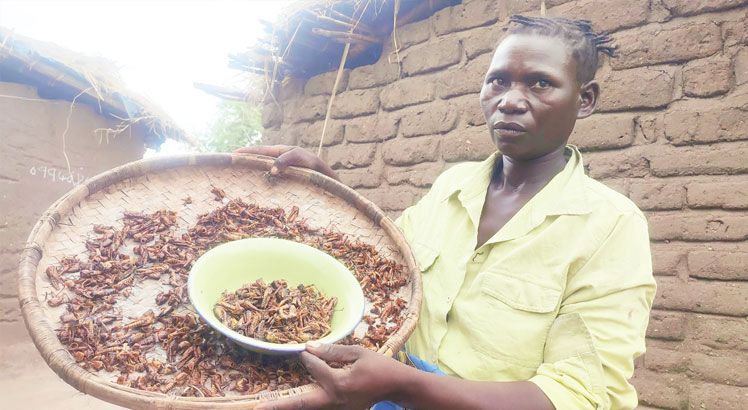
Marita and her children woke up by 4am to catch elegant grasshoppers known as bobi in her Sena-speaking community. The Chewas call them anunkhadala due to a repulsive smell.
“A hungry nose knows no smell,” she said, munching a crunchy striped grasshopper. “I catch a bucketful, but fill two to three buckets when children join me.”
Pest scientists say the pest is toxic, but Marita says removing its internal organs reduces the bitterness and cooks it for over an hour to kill the smell.
“There are no shortcuts,” she said, drying her catch on a kitchen roof.
She sells some at Ngabu Trading Centre and spares a little for relish.
Professor David Munthali, a seasoned pest scientist, told The Nation that the elegant grasshopper (Zonocerus elegans) “is not an edible insect”.
“It produces a yellow fluid—their blood—when threatened. There is evidence that a child in South Africa died after eating one,” he stated.
The pest thrives on tender leaves of bean-like crops, sweet potatoes, cassava, cotton and finger millet during wet conditions, said the entomologist.
During his early research on the East Bank of the Shire, farmers ranked the elegant grasshopper as the most disruptive pest alongside termites.
Munthali recounts: “Then, they were not utilising them as food. This is clearly a recent development, a result of climate change.
“The processing will remove some of the poison in the fluid, but scientists need to conduct research to determine how effective the boiling and drying is in rendering them fit for human consumption.”
Local lead farmer Silesi Ndanga tells The Nation: “Desperation can do the unthinkable to survive. We can end hunger and restore the dignity of our people by investing in simple irrigation, which helps them get two or three harvests a year.”