For six years, the scent of petrol and burning flesh has lingered over Area 24, a grim reminder of the 2020 arson attack on a building housing UTM offices that killed three members of the Tambala family.
Today, the survivors are still waiting for closure, trapped by a court case that has stalled for over two years awaiting a ruling on whether the accused have a case to answer, long after the prosecution closed its submissions.
The Judiciary says the ruling is expected in November, but gives no date.
“The ruling on case to answer will be delivered this coming November,” said Judiciary spokesperson Ruth Mputeni.
However, follow-up inquiries sent on October 12 2026, seeking the exact date and an official explanation for the crushing delay went unanswered by the time of publication.
The tragedy dates back to May 4 2020, when a petrol bomb struck the Area 24 building during a volatile pre-election political climate.
The inferno trapped six family members, leaving them with severe burns. Three later succumbed to their injuries at Kamuzu Central Hospital: Ayiles Tambala, her 11-year-old son Shukuran, and the family patriarch, Seleman Tambala. Ayiles and Shukuran died hours apart and were buried side by side; Seleman, incapacitated by his own severe burns, was too ill to attend their final farewell before passing away shortly after
In the immediate aftermath, the police arrested 12 suspects, including former Democratic Progressive Party (DPP) Director of Youth Dyton Mussa and former United Democratic Front (UDF) spokesperson Ken Ndanga. Yet, by 2022, the High Court discharged Mussa and three co-accused, and the prosecution trail has since grown ice-cold.
Remarkably, the Office of the Director of Public Prosecutions (DPP) could not even establish when the matter was last heard in court, laying bare a staggering lapse in state oversight.
“I can’t really recall the last time it was in court, but maybe over two years ago. The court record can assist on this one,” conceded Ministry of Justice spokesperson Frank Namangale.
However, court records Nation On Sunday examined reveal that as far back as September 26 2024, the State filed a formal notice of delivery of judgment, desperately trying to jump-start the dormant bench. According to well-placed sources, proceedings stalled in part because the presiding judge, Justice Annabel Mtalimanja, was subsequently appointed chairperson of the Malawi Electoral Commission.
Hearings, including site visits and the parading of witnesses, took place between 2021 and 2022.
Mputeni disclosed that the file was transferred to Justice Bruno Kalemba, whereas Namangale insisted it sits before Justice Chifundo Kachale, exposing a glaring breakdown in coordination between the Judiciary and the Ministry of Justice..
We sought clarification from both Mputeni and Namangale on October 12 but had received no responses by the time of publication.
For 31-year-old Ishmael Tambala, who was away from home on the night of the attack, the endless bureaucratic delays mean more than an unfinished trial. They mean he remains unable to answer the haunting questions of his surviving siblings.
“I do not just owe my siblings a home, but also an explanation on what happened and why it happened. This is for the court to help us,” he said.
According to court files, particularly witness accounts, the Tambala family had lived in the building for years after seeking permission from a village head around 2004 to occupy the idle property, which had previously been used as a community orphanage.
Before UTM moved in, the United Democratic Front (UDF) rented the same building as an office, with the proceeds going to the community, according to a witness statement dated July 28 2022, which forms part of the case file.
The attack became one of the most disturbing episodes of political violence ahead of the June 23, 2020 fresh presidential election, drawing widespread condemnation and calls for accountability.
Hundreds of people attended the funerals, including then UTM Party president Saulos Chilima and Malawi Congress Party (MCP) president Lazarus Chakwera. Both condemned the attack and called on police to investigate and ensure that those responsible were brought to justice.
Chilima alleged at the time that his party’s intelligence indicated that the violence had been sponsored.
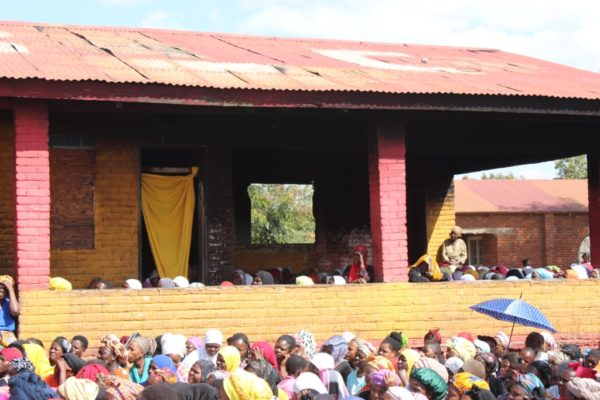
The human cost of the attack came into sharp focus during a court hearing in April 2022, held at the UTM Party offices in Area 24. Ahamadu Tambala, then 13, recounted how the fire killed his parents and brother.
His account was a painful reminder that behind the prolonged proceedings are children who lost their parents and have been left to grow up with memories of the attack.
Ishmael now works as a welder in Lilongwe. Despite earning a living, he says he cannot adequately support his three surviving siblings, who live at an orphanage in Blantyre.
He is grateful to well-wishers who have helped the family, including one who bought them land. He hopes to build a house there and eventually provide his siblings with a home.
“They are now at an orphanage in Blantyre. They are happy, and I am happy too that the burden has lessened. I hope, with support, I should be able to build my own house,” said Ishmael.
But the support has not answered the questions surrounding the attack. Ishmael wonders why anyone would target his family, which he says was not politically active.
In a written response, Centre for Human Rights and Rehabilitation (CHRR) executive director Michael Kaiyatsa said the delay undermines the right to a fair and timely trial, as guaranteed under Section 42 of the Constitution.
“The families of the three people who lost their lives have already suffered an irreparable loss. When the justice process is prolonged without a clear explanation, these families are left waiting for answers and this can prolong their emotional distress and deepen their sense of uncertainty,” said Kaiyatsa.
He called on the authorities to address delays, strengthen court administration and ensure that judicial officers are held to appropriate professional standards.
In a written response, retired Supreme Court of Appeal justice Dunstain Mwaungulu said delays in delivering rulings could partly arise when a new judge takes over a case and must assess evidence recorded by a predecessor, particularly where witness credibility is in question.
However, Mwaungulu argued that a ruling on whether an accused has a case to answer should ordinarily be delivered promptly, especially in the High Court after the prosecution has presented its evidence.
In an interview, chairperson of Parliament’s Legal Affairs Committee Gilbert Khonyongwa said during its recent quarterly oversight meeting, the committee had engaged senior Judiciary officials, with delays in delivering judgments and rulings featuring prominently in the discussions.
“The engagement was fruitful, and we were assured that the Judiciary is taking positive steps to address the challenge. We welcome this engagement and look forward to continued progress,” said Khonyongwa.
Khonyongwa, a lawyer, added that heavy caseloads, resource constraints and the complexity of cases may contribute to delays. He pointed out that the Courts (Amendment) Act of 2022 provides a 90-day timeframe for the delivery of judgments and rulings.