Claims of disappearance of men’s private parts have cost seven lives through mob violence in Chikwawa and Nsanje but authorities have said the claims are unfounded and driven by malice.
By yesterday, the Malawi Police Service confirmed five deaths in Chikwawa and two in Nsanje while two others narrowly escaped death after officers intervened.
In one incident yesterday in Chikwawa, officers went to Tomali Village in Traditional Authority Lundu where they rescued a man who was being beaten by an angry mob.
Throughout the day, a police vehicle moved through villages using loudhailers to urge communities to stop taking the law into their own hands.
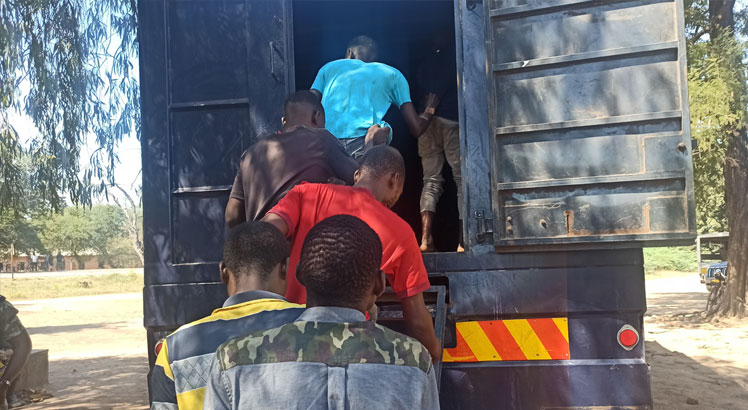
Police Station. | Macmillan Mhone
Among the seven killed are 42-year-old Yobe Ching’oma and his wife Migresi Mussa, 37, from Chikwawa. Another victim, 42-year-old Madalitso Joe William, originally from Chikwawa, was killed in Nsanje while 34-year-old Baza Sande also died in the attacks.
Police have since arrested 45 suspects, many of whom are expected to face murder and related charges.
Deputy Inspector General of Police responsible for operations Noel Kayira, who led a team to the two districts yesterday, said more than 300 officers have been deployed to Chikwawa and Nsanje to restore calm and track down those responsible.
He said medical examinations conducted at Chikwawa District Hospital found that complainants who alleged that their genitals had disappeared still had their organs intact.
“The rumours are possibly emanating from malice because some of the victims were businesspersons,” he said.
Kayira added that police would continue operations in the two districts to prevent further violence.
Senior Chief Ngabu of Chikwawa said the rumours are not rooted in any known cultural beliefs and could be driven by grudges targeting the victims.
He condemned the attacks and urged communities to always report their complaints to police rather than resorting to violence.
Chikwawa district commissioner Frank Mkandawire blamed the violence on deliberate misinformation and hatred, saying the council has intensified civic awareness campaigns in affected communities.
The Malawi Human Rights Commission (MHRC) has also condemned the attacks, describing them as senseless killings fuelled by falsehoods.
MHRC chairperson Chikondi Chijozi-Jere, who was part of the fact-finding mission to Chikwawa, said officials interviewed some of the complainants and found no evidence supporting their claims.
“It is deeply worrying that lives have been lost and we are following the issue to ensure justice prevails for the affected families,” she said.
Meanwhile, Medical Doctors Union of Malawi president Henry Makowa told The Nation in an interview that the claims have no scientific basis.
He said it is impossible for male genital organs to suddenly disappear through touch.
“In some cases, cold weather, fear, stress, or anxiety may temporarily cause the genital organs to retract slightly due to normal muscle reflexes in the body, but this is a normal physiological response and not evidence of witchcraft,” said Makowa.
Psychologist Dr Eric Umar of Kamuzu University of Health Sciences said rumours of this nature spread quickly because they provide emotionally satisfying explanations during periods of fear and uncertainty.
He added that leaders should be quick in intervening to debunk such myths through public sensitisation.
Mob justice linked to witchcraft allegations remains a recurring issue in Malawi.
Malawi Network of Older Persons’ Organisations data indicates that nearly 300 elderly people were killed between January 2016 and April 2026 after being accused of practising witchcraft.
In 2017, rumours about so-called “blood suckers” triggered mob attacks that left at least nine people dead in Mulanje, Thyolo, Nsanje, Phalombe, Chiradzulu and Blantyre.