In Nkhata Bay District and beyond, Orton Chirwa needs no introduction.
The iconic founding leader of the Malawi Congress Party (MCP) contributed immensely to the country’s independence from British colonial rule.
The fallen lawyer, briefly detained at Khami Prison in Zimbabwe, kept the struggle for self-rule alive when founding president Hastings Kamuzu Banda and his contemporaries were jailed at Gweru following the declaration of a State of Emergency on March 3 1959.
His grave in Manolo Village, Nkhata Bay, is set to be immortalised with the construction of a K1.4 billion mausoleum by government.
Orton Chirwa died a political prisoner on October 20 1992, nine months before the historic referendum of June 21 1993 when Malawians rejected Kamuzu’s one-party rule and elected restoration of democracy.
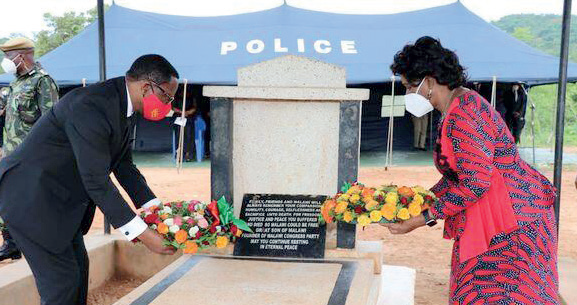
He was detained in 1981 for his non-violent opposition to tyrannical rule and died in jail after spending nearly eleven years on death row.
In 2022, President Lazarus Chakwera, the sitting MCP leader, announced the construction of a mausoleum at Chirwa’s gravesite in in Manolo Village, Nkhata Bay.
“If you are a citizen of Malawi, you owe Chirwa your thanks for he was a key figure in the transformation of Nyasaland, a nation of subjects, into Malawi, a nation of citizens,” said the President on his way from commemorating the 2022 Martyr’s Day in the district.
Late he took to Facebook to pay tribute to the “national hero” whom he eulogised as “a fine barrister and vociferous activist who was driven by urge for equality among all people”.
“He believed that for a people to develop, they must be emancipated socially, economically and politically in equal measure,” Chakwera wrote.
The Ministry of Local Government, Unity and Culture is implementing the mausoleum project expected to be completed in May 2025.
Initially, the mausoleum was supposed to be completed in September last year.
Apart from a stately building housing the tomb, the memorial project encompasses four houses for Chirwa’s surviving family members, two staff houses, a library and an office.
Secretary for Local Government, Unity and Culture Richard Hara says the monument aims to preserve Malawi’s history and celebrate its national heroes.
“These heroes deserve a dignified final resting place,” he says.
Nkhata Bay District Council director of public works George Gopani says the memorial site will not only preserve the history of the unsung hero, but also attract visitors to interact with Chirwa’s family and gain deeper insights into his life and contribution to the liberation struggle.
The mausoleum will be connected to the national power grid, boosting access to electricity, quality of life and business activity in the surrounding villages.
For Orton’s niece, Daliwa Bulukutu Chirwa, the project taking shape represents a long-awaited recognition of their patriarch’s contributions.
She says: “The construction of the mausoleum for our late father was first commissioned by [former president] Dr Bakili Muluzi in the 1990s, but this new initiative marks a significant step in honouring his legacy. It will ensure Chirwa’s legacy is preserved for generations to come.”
The mausoleum is also expected to boost tourism in the northern district endowed with go-to mountains and postcard beaches of Lake Malawi.
Foster Grancer, a businessperson from Mpamba Trading Centre, says: “Orton Chirwa’s legacy needs to be preserved for future generations. The mausoleum and its infrastructure will help people appreciate his contributions better.
“As visitors go to the mausoleum, small businesses by local entrepreneurs like me will also benefit.”
On Christmas Eve in 1981, armed men kidnapped Orton together with his wife Vera and son Dumisani on their way to a meeting with other exiled Malawians in Zambia.
The family was taken across the border into Malawi where they were detained and eventually sentenced to death on May 6 1983 by one of the traditional courts, which were notorious for jailing critics of the one-party regime.
Due to pressure from Amnesty International and a global backlash, the Chirwas escaped execution, but languished in prison for over a decade.
Vera was released on January 24 1993, but Orton died at Zomba Prison months before pro-democracy pressure groups triumphed over the one-party rule in the 1993 Referendum.
Their heroics and agony adorn Vera’s post-detention autobiography, Fearless Fighter.