Malawi’s deepening foreign exchange crisis is driving remittances away from formal channels, as widening forex premiums have made the official rates increasingly unattractive for the diaspora community based in South Africa.
A report titled ‘South Africa to the rest of Sadc remittances market assessment’ indicated that formal remittances to Malawi fell by 49 percent to R2 billion (about K220 billion) between 2021 and 2024 from their 2021 peak.
This decline comes as other major destinations in the Southern African Development Community (Sadc) region maintain stable or growing inflows, including in Lesotho and Zimbabwe.
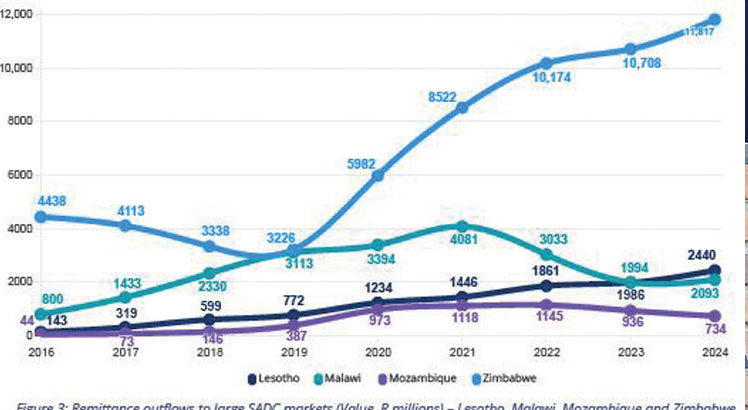
The four largest destination markets of Zimbabwe, Lesotho, Malawi and Mozambique account for nearly 90 percent of all formal Sadc remittances, according to the assessment.
Reads the report in part: “Malawi’s decline in formal remittances is mostly driven by the country’s currency crisis, creating discrepancies between official and black market exchange rates that steer remitters towards informal channels offering better rates.
“The size of the formal remittance market from South Africa to Malawi has almost halved since 2021, suggesting that constraints in the formal foreign exchange market have negatively affected remittance flows.”
While the official exchange rate for the dollar remains at K1 751, on the parallel market the local unit is trading at as high as K3 800.
According to the data, Malawi remains a notable outlier, with weighted averages of negative 33.75 percent for $55 (about K96 000) and 34.24 percent for $200 (about K350 000) transactions, an indication that people are losing value when they use formal channels to send money to Malawi.
For instance, a negative 33.75 percent margin on a $55 transfer means the sender or receiver effectively loses about a third of the value compared to what they would get using the parallel rate, according to the assessment.
Similarly, negative 34.24 percent on $200 means the loss is equivalent to about one-third, even for larger transfers.
On the other hand, Mozambique’s weighted average stood at 6.76 percent while Zimbabwe’s weighted average stood at 8.76 percent in 2024, an indication that senders are not losing value when they use formal channels.
Speaking in an interview, Binwell Munyenyembe, a Malawian living in South Africa, said formal channels no longer give value for money.
He said: “I send money through people because the black market gives my family more kwacha than banks or money transfer services.
“As long as the gap between official and parallel rates remains, many of us will continue using informal means despite the risks.”
Scotland-based Malawian economist Velli Nyirongo said inefficiencies in formal remittance system, including high transaction costs and strict regulations discourage people from using official channels, thereby fuelling the expansion of the black market.
He said the situation is largely driven by economic and policy challenges, particularly the growing gap between the official exchange rate and the parallel market rate.
“These policies limit access to foreign exchange through formal channels, forcing individuals and businesses to turn to the informal market,” he said.
Exchange Control Regulations of 2022 govern the repatriation of export proceeds and the operation of foreign currency-denominated accounts. They aim to ensure the timely repatriation of export earnings and the proper management of foreign currency accounts, thereby stabilising foreign exchange inflow.
The Reserve Bank of Malawi has acknowledged that a significant share of foreign currency may be held in this market, indicating that official channels are not meeting the demand for foreign currency.