The World Bank says despite employing some emergency measures, a long-term solution to address structural foreign exchange market challenges is yet to be implemented.
The Bretton Woods acknowledged in July 2025 Malawi Economic Monitor that the country is still facing challenges in bolster foreign exchange reserves and narrow the spread between the official and parallel market rates.
Reads the update in part: “Reserve Bank of Malawi [RBM] has announced a reduction in the mandatory conversion rate for export revenues from 30 percent to 25 percent, with further reductions for qualifying companies anticipated.
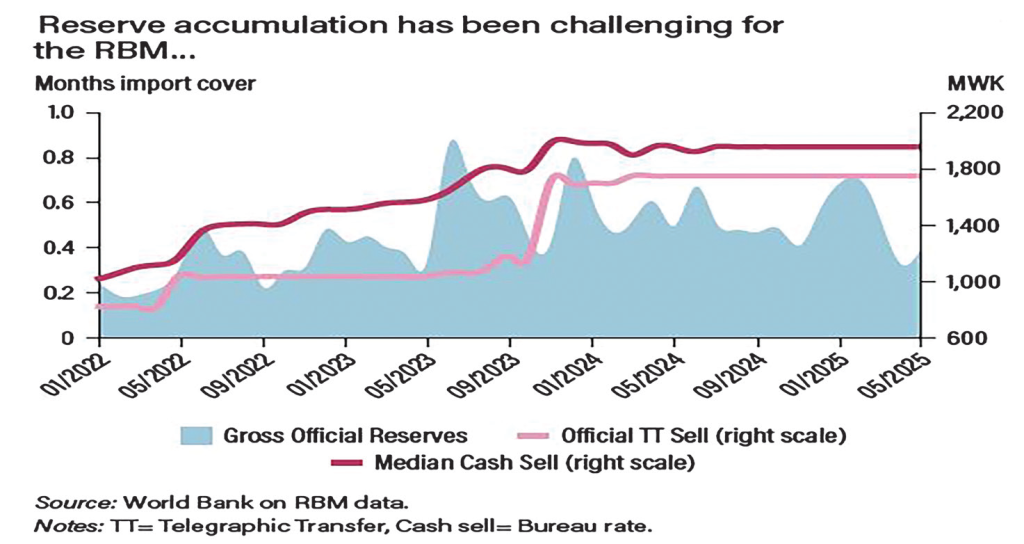
“However, the disappointing tobacco and macadamia harvests have neither significantly bolstered foreign exchange reserves, nor reduced the exchange rate differential between the official and the parallel market.”
In March 2025, the RBM amended foreign exchange controls to promote import substitution and incentivise the export sector while curbing use of informal sources of funds for importation.
Among others, the central bank reduced the mandatory conversion ratio on export proceeds for exporters with exemption from the mandatory conversion of export proceeds for manufacturers meeting criteria issued by the central bank.
RBM also reduced the mandatory conversion ratio from 70 percent to 50 percent for non-governmental organisations and introduced a verification requirement for importers to demonstrate that their imports have been financed through the formal banking channel.
Former Finance minister Joseph Mwanamvekha said in an interview that while the policy change could help to improve foreign exchange reserves and curb the black market, without forex in the banks, it will not work.
World Bank data shows the spread between bureau rate and official rate is sitting at about 10 to 12 percent while the gap between the parallel market and official rates has widened, reportedly peaking at over 150 percent in early 2025.
RBM data, on the other hand, shows that economy’s total reserves position declined to $569.5 million or an equivalent of 2.3 months of imports cover in February 2025 compared to $570.6 million or 2.31 months of imports in the preceding month.
In its 2025 First Quarter Business Review, Malawi Confederation of Chambers of Commerce and Industry observed that the dip in reserves, especially due to a decline in private sector foreign exchange holdings, could signal tightening access to foreign exchange availability for businesses.
Reads the review: “Companies that import essential inputs may face longer delays in obtaining foreign currency, disrupting production timelines, especially in manufacturing, agro-processing and retail sectors.”
RBM Deputy Governor responsible for economics and regulation Kisu Simwaka conceded in his Facebook post recently that the country’s export receipts only pay for one-third of import bill, leaving the country to increasingly rely on foreign aid flows, external borrowing and financial derivatives such as foreign currency swaps to pay for the remaining two-thirds of the import bill.