Malawi Electoral Commission (MEC) data has shown independent candidates as a dominant bloc in the parliamentary race in the September 16 2025 General Election, accounting for 632 of the 1 474 aspirants.
The number represents about 42 percent of the candidates.
In contrast, there were 501 independents making up 31 percent of candidates in the 2019 Tripartite Elections while the 2014 election had 417 independents.
Worth noting is the fact that this year the number of constituencies has increased from 193 to 229.
The Southern Region has the highest number of independents with 317 while Lilongwe District Council recorded the highest at district level with 54.
Political analyst Ernest Thindwa said the data is not surprising because there has been an increase of people contesting and winning on independent tickets since 1994.
He attributed the rise in independents to loss of credibility in political party primary elections which forces some losing aspirants to go solo.
On the other hand, Thindwa said some party members are not loyal to their parties and that is why they compete as independents rather than support candidates who won primary elections.
He said: “Moreover, in areas which are strongholds of particular parties, it is hard to win on a ticket of another party so the nearest chance of winning is to stand as an independent.”
Since 1994, there has been an increase in independent members of Parliament (MPs) with four in 1999, 40 in 2004, 32 in 2009, 52 in 2014 and 55 in 2019.
The governing Malawi Congress Party, which already bagged one seat in Lilongwe Chilobwe Constituency after it emerged that its candidate was the sole contestant, has 219 candidates. The party has no representation in eight constituencies in the Southern Region and one in the North.
Former governing Democratic Progressive Party has placed candidates in 195 out of the 229 constituencies. The party has not placed a candidate in only one constituency in the Southern Region.
The list shows UTM Party as third with 169 candidates in 229 constituencies, having placed candidates in more than 80 constituencies in the Southern Region and in over 30 constituencies in the Northern Region.
United Democratic Front follows with 70 candidates, People’s Party with 55, Alliance for Democracy with 46, People’s Development Party with 34, Odya Zake Alibe Mlandu with 20 and Freedom Party which has 8.
The rest of the parties have fielded less than seven candidates and they include People’s Progressive Movement, Patriotic Citizens Party, Nationalist Patriotic Party, Liberation for Economic Freedom Party and National Development Party.
Commenting on the trend, Thindwa said ruling parties usually field more candidates because they have resources and have incumbency advantage, making them more attractive to aspirants.
In a separate interview, UTM publicity secretary Felix Njawala said they are happy with the numbers considering that the party has been in existence for less than 10 years.
“We are competing with parties that have been there for more than 20 years. This shows that our party is strong,” he said.
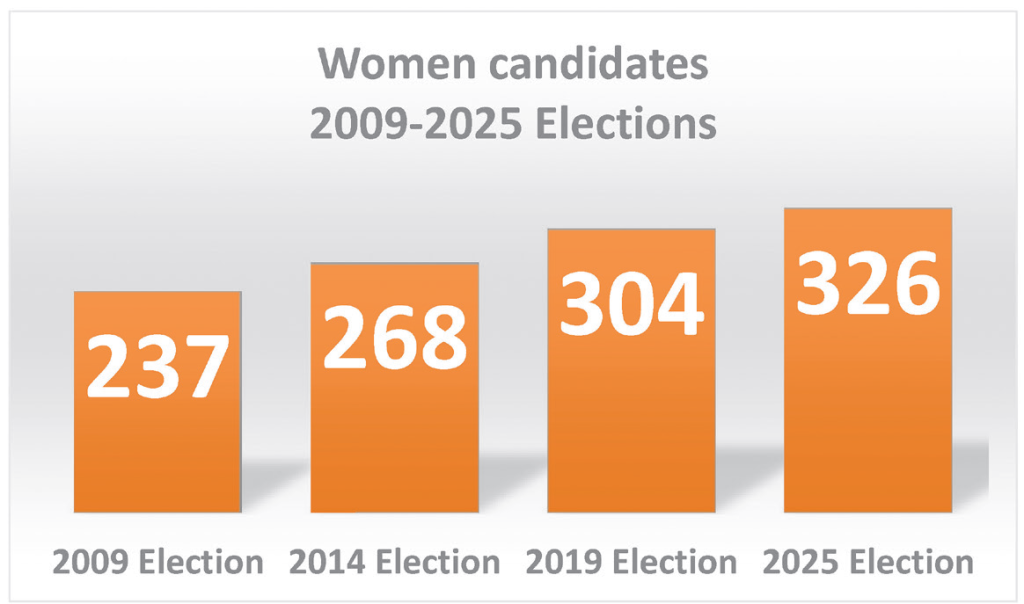
On women, there are 326 female candidates which is an increase from 295 that contested for 193 parliamentary seats in the 2019 elections.
In an earlier interview, Women Manifesto Movement coordinator Margaret Kathewera-Banda attributed the low representation of women to funding challenges, saying some women found the nomination fees to be high despite the fact that women were paying half the amount.
The NGO-Gender Coordination Network chairperson, called on well-wishers to support female candidates with campaign materials such as T-shirts, wrappers (zitenje), and posters to help increase their visibility.
The National Strategy on Political Empowerment of Women the government launched last year aims to have at least 35 percent of parliamentary and local government seats in 2025 elections won by women, with the hope of increasing the number to 50 percent of the seats in 2030.
In 2014, the representation dropped to 32 women or 16 percent, while in 2019, 45 women were elected as MPs, representing 23 percent of 193 parliamentary seats.