Paying caregivers remains a government responsibility and the Malawian child is getting a raw deal as most of them flee childcare centres in protest to slavish conditions. Our Staff Writer EUNEAS ZINYENGO explains. From Monday to Friday, five-year-old Cecilia Moyenda spends all morning sitting cross-legged on the floor at Senjele Community-Based Childcare Centre (CBCC) in Nkhotakota District.
She clutches a frayed picture book, reciting the alphabet from A for ant to G for giraffe, but cannot remember H for hyena until Aunty Thoko comes, kneeling beside her and prompting her to go on.
However, learning by playing has not been the same for the jovial girl since the previous week when the caregiver and two other aunties quit.
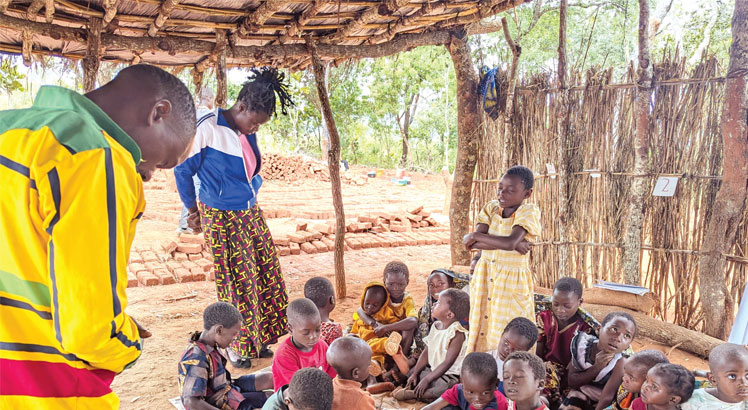
“They are gone because there is no pay,” says Dorothy Fred.
She is among the remaining caregivers at the community-led preschool facility in Traditional Authority (T/A) Mwansambo.
When Fred joined three years ago, she was among 10 women who cared for about 40 children without pay.
The caregivers, trained by Help A Child, teach the alphabet, sing songs, clean the children and feed them.
The CCAP Livingstonia Synod Aids Programme (Lisap) invested K269 million to train about 200 caregivers in 32 CBCCs across the lakeside district.
However, the training does not feed the caregivers’ families.
The volunteers who give children a solid start in life work in slavish condition as early childhood development remains underfinanced in Malawi even though policymakers say it is crucial for children’s long-term growth, learning and productivity.
According to official figures, only 2 000 of the 46 000 caregivers nationwide—about six percent—receive a K20 000 monthly stipend from government.
This demotivates the have-nots, threatening the country’s commitments to providing quality early childhood care and ensuring every child gets a solid start to lifelong learning in line with the global Sustainable Development Goals.
“Many caregivers have moved on to paid jobs. They couldn’t continue working without pay. They had to balance community service against personal survival,” says Fred.
Most days, she returns home exhausted only to find her children fast asleep.
“I love these children, but my family also needs me,” she says.
Research shows that working for low or no pay fuels exodus, disrupting early learning, especially in rural areas neglected by government.
For children like Cecilia, the exodus leaves them ill prepared for transition to primary school and productivity later in life.
Fred urges government to expand the stipend to more caregivers.
Lisap stepped in 2022 when no child in T/A Mwansambo was attending free pre-school, according to its acting head of programmes Gilbert Phiri.
He states: “Our needs assessment revealed an immediate need for ECD interventions in the area.
“Before these centres, children were going straight to Standard One with low literacy levels. Now we have the caregivers, but they keep leaving due to lack of monetary incentives.”
HAC programmes manager Tina Kutani-Banda says while they empower communities to be self-reliant, paying caregivers remains a government responsibility.
“We build CBCCs, train caregivers and provide necessary learning materials. These incentives are enough to motivate communities we support, but government has to live up to its mandate of paying caregivers,” she says.
Ministry of Gender, Community Development and Social Welfare chief child development officer Nina Njanji says government wants to pay more caregivers, but “is failing to recruit more caregivers because it cannot afford to pay them all”.
“Our machinery relies on development partners to support all aspects of early childhood development, including payment of stipends,” she says. “However, government plans to recruit more caregivers to work for a preparatory class set to be introduced next month.”
Government pledged to add 2 000 caregivers to its payroll annually since 2023.
However, the unfulfilled promise compelled the Association for ECD in Malawi (AECDM) to rollout soft loans in support of caregivers.
AECDM executive director Clement Silungwe says: “Each CBCC gets a loan of about K300 000 which caregivers utilise. So far, we’ve reached 705 CBCCs with funding from Roger Federer Foundation.”
Recently, National Children’s Commissioner Lucy Kachapila warned that cost of government’s inaction will be felt by children long before they see a pay slip.
Globally, studies show that quality ECD significantly boosts literacy, health and economic outcomes, especially in developing countries.
Malawi 2063 agenda makes universal and compulsory ECD pivotal to human capital development, inclusive wealth creation and self-reliance.
However, dispirited caregivers’ resignations threaten to undo fragile gains in early education.
Still, Cecilia keeps turning the pages—struggling to recite the alphabet beyond G for giraffe. As more caregivers depart, the remnants’ work surge with no pay in sight.