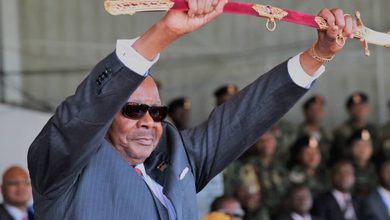
The ruling Democratic Progressive Party (DPP) has exerted its authority at all levels, beginning with the Executive, National Assembly and Local Government, which also included sweeping all mayoral positions in the country’s four cities.
While such a majority is a sweet melody to the party, political, governance and accountability experts are worried that the situation could not only reduce the likelihood of effective checks and balances, but also increase the risk of impunity.
How DPP has performed
In the September 16 polls, DPP candidate Peter Mutharika won the Presidency with 3 035 249 votes against 1 765 170 for immediate past

Osman. | Nation
leader Lazarus Chakwera to secure 56.8 percent of the vote.
At Parliamentary level, out of the 224 declared constituencies, DPP secured 77 seats, independents got 71 seats while the immediate-past governing Malawi Congress Party (MCP) got 53 seats. Already, some independent legislators have flocked to the DPP.
Out of the 502 wards where Malawi Electoral Commission (MEC) conducted elections, DPP won 249 followed by MCP with 143 and independent candidates secured 83, the rest having been shared among other parties.
To cement authority at local government level, the DPP has also won mayoral positions in all the cities of Mzuzu, Lilongwe, Blantyre and Zomba.
Experts wary of weak oversight
Yesterday, Associate Professor of Political and Administrative Studies at University of Malawi (Unima) Boniface Dulani felt the situation provides DPP with platforms to implement its agenda, and will not have anyone to blame for failure, but itself.
He is worried though, that such a super majority might increase the risk of impunity, with opposition and other critical voices drowned out.
Said Dulani: “It is less likely that executive appointees that require parliamentary scrutiny might be properly vetted. At the council level, the DPP control might drown out any other voices, even if they offer much needed alternative visions.
“But, again, we should be mindful that the DPP’s commanding control is a result of a democratically credible election, and it means Malawians wanted it this way.”
Governance pundit Undule Mwakasungula, cautioned that while the DPP could use this majority to help improve the economy, fix public services, and make government systems stronger, it should do so by being fair, open and inclusive.
He observed: “The danger is that checks and balances could become weak. A party with too much power
may become arrogant, ignore advice, avoid scrutiny, or make decisions that are not fully debated.
“This could lead to poor decisions, corruption, or a decline in our democratic values. This is a big show of power. It could help government work smoothly, but it also reduces the balance that comes when different parties share power.”
On his part, Human Right Defenders Coalition (HRDC) chairperson Michael Kaiyatsa observed that Malawi’s history shows that concentrated power can lead to governance challenges.
For example, he said under the late Bingu wa Mutharika’s second-term (2009-2012), a strong majority contributed to reduced tolerance for criticism, evidenced in civil society clampdowns and the 2011 governance crisis.
“Majority dominance increases the danger of rubber-stamp Parliamentary behaviour, as seen when controversial bills have passed with limited debate in past administrations.
“It creates space for corruption networks to flourish—as seen in both Cashgate under People’s Party and multiple procurement scandals reported under later governments, when oversight slackened,” he feared.
Any remedies for weak opposition, CSOs?
Policy and governance pundit George Chaima feels the onus is on the DPP to prove whether it wants continuity of its rule or short-term pleasure, arguing “any bit of mistake will easily be taken as misuse of majority”.
“Where their authority falls short, the opposition can partner with non-State actors and others to ensure that the government is under microscopic scrutiny.
Gift Sambo, a legislative, electoral politics and public policy expert from Unima, said as the government-in-waiting, the MCP should strive to provide constructive perspectives.
“The country has other non-State actors in the governance sector that can help to ensure that the government does not fall into the temptation of abusing its majority status. This is the beauty of political pluralism,” he said.
On his part, Mwakasungula said the situation calls for the strengthening and letting oversight and accountability institutions such as courts, the Anti-Corruption Bureau and parliamentary committees to work independently and transparently.
“With strong media and civil society oversight, it could help make sure the government remains answerable to the people. Even if they are small in number, the opposition must speak boldly, ask hard questions, challenge weak decisions and offer better ideas for the country,” he urged.
Private practice lawyer and chairperson of National Unity Platform (NAP) Benedicto
Kondowe urged the civil society to provide evidence-based advocacy, monitoring public spending, and mobilising citizens to hold leaders accountable.
Meanwhile, Bangwe-Ntopwa Ward Councillor Isaac Jomo Osman and Zomba Mapira Ward councillor Christopher Jana, both belonging to the Democratic Progressive Party (DPP) were yesterday elected mayors of Blantyre and Zomba cities, respectively. In the course of the week, Lilongwe and Mzuzu cities also elected their city fathers, both of whom belong to DPP.
Osman, who served as deputy mayor—a position now rebranded to vice-mayor—has Limbe- Chiwembe councillor Gerald Lipikwe as his second in command. Zomba City vice-mayor is Anthony Gonani of Masongola Ward, also of DPP.
In his acceptance speech, Osman, a former street kid-turned entrepreneur, said he will prioritise engagement with residents to come up with strategies for tackling street vending and solutions for street-connected children.
He said: “We cannot just chase the children away from the streets. We need to find activities for them so that they should not return to the streets.”
On his part, Blantyre City chief executive officer Dennis Chinseu assured the new leadership of the secretariat’s support in implementing their vision