Malawi is set for a major boost in rural electrification as government accelerates efforts to connect more households than ever before.
Treasury data shows that the momentum will be amplified by the World Bank–funded ship Accelerating Sustainable and Clean Energy Access Transformation (Ascent) Project, which aims to connect 235 000 households to the grid and distribute 811 000 solar home systems, promising reliable power closer to villages long underserved by national infrastructure.
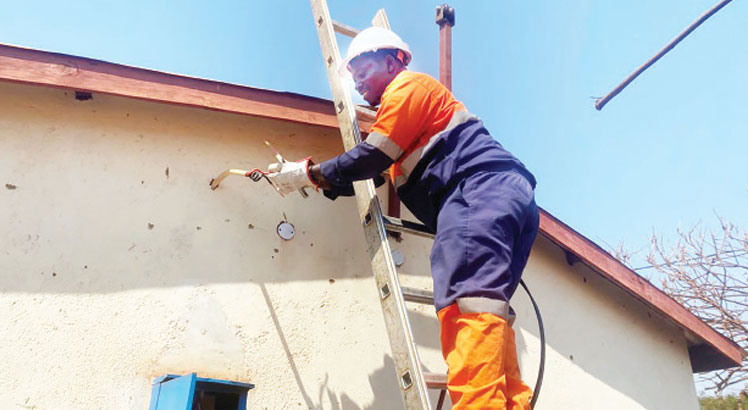
beneficiary’s house. l Nation
The Malawi Rural Electrification Programme (Marep) remains another cornerstone of the access agenda.
Already, Marep Phase nine has completed 334 of 460 sites, with Phase 10 expected to add another 500 rural communities when it begins in the 2026/27 financial year.
Said Treasury in its 2026 Fiscal and Economic Policy Statement: ‘Implementation of Phase 10 will commence 2026/27 financial year, connecting approximately 500 additional sites nationwide to ensure that no community is left behind. Building on the success of the Malawi Electricity Access Project, the government will implement the flagship Ascent Project. The project funded by the World Bank will connect 235 000 households to the grid, distribute 811 000 Solar Home Systems, electrify 1 000 schools and 280 health facilities, and support 150 000 households with clean cooking solutions.”
Through Ascent, Treasury projects national electricity access to reach 50 percent by 2030.
According to the National Energy Compact for Malawi, only 25.9 percent of the Malawi population have access to electricity with 11.3 percent connected through the national grid and 14.6 percent through off-grid solutions.
Around 56.5 percent of urban households have electricity through the national grid, compared to 3.8 percent of rural households. In contrast, 15.9 percent of the rural households rely on off-grid solutions compared to 6.5 percent of the urban households.
However, Malawi requires $5.5 billion (K9.55 trillion) to increase electricity access from the current 25.9 percent to 70 percent by 2030.
By 2030, Malawi aims to add 1.15 million on-grid connections and 1.55 million off-grid connections.
Former minister of Energy Grain Malunga described the targets as achievable if government prioritises production industries by ensuring resources are available to the energy sector.
He said: “I believe this is achievable only if priority is given to the production sector. That is to say give the energy sector the needed resources to generate electricity and support manufacturing, mining and agriculture sectors, which will generate foreign exchange.
Malawi currently has total installed capacity of 554MW with 401.8MW from hydro power, 101MW through solar power and 51.4MW from diesel-powered generators.