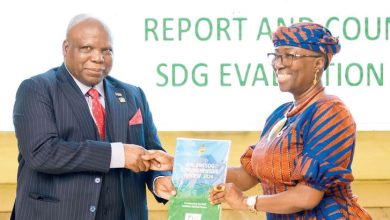
In the quiet poise of Dr. Eluphy Banda-Nyirenda, there is an understated power—not the thunderous sort that announces itself loudly, but the elegant, disciplined resolve that has defined her journey from a curious girl to one of Malawi’s most influential figures in agricultural transformation.
Now 42, the trade economist and AGRA Malawi country director has become a central voice in shaping how Malawi feeds itself, grows its agricultural markets and positions its farmers, especially women and youth, at the centre of economic change.

Yet her story begins not in boardrooms or policy roundtables, but in the warm, bustling home of Chrispin and Grace Siwande Banda from Kasungu District.
Her father, then a senior official in the Department of Immigration, embodied the discipline, excellence and service that would become her compass.
His fiercest motivation came from a painful comment he once received—that he was “kungobereka mahule,” because his first three children were girls.
“That pushed him to empower us even more, probably to demystify the gender narrative,” she says.
And empower them he did; all four siblings are now university graduates, independent and thriving.
Eluphy is a firm belief that educated, empowered women are an unstoppable force in economic development.
She is married to her university classmate, Orton Nyirenda and they have two daughters—Nomhla-Grace, Ndagha-Esther and an adopted son, Darwin Gondwe.
There was nothing accidental about her path into agricultural economics and trade, although it didn’t begin on a farm, but with a bus.
“When we lived in Area 3, the Bunda College bus used to pass by our house and I told myself one day, I will ride in that bus,” she recalls.
Eluphy’s first major break came at the Ministry of Trade, where she joined as an economist.
“I met people who inspired me along the trade and private sector profession,” she says. “That shaped the path I chose for my master’s and eventually my PhD in International Trade.”
A career-defining transition came when she rose to the position of chief economist in the Ministry of Trade and later in the Ministry of Agriculture.
But the role came with frustrations.
“My job was to produce evidence and data to inform government decisions on resource allocation,” she explains.
“The biggest challenge was that decisions were made without relying on that evidence. You could see mistakes happening in real time because expert advice wasn’t fully utilised on which programmes and activities to invest in more for growth. That was painful.”
Her move to Usaid was a deliberate choice to operate where evidence mattered and influence was possible.
There, Eluphy managed an integrated private sector polio which included agriculture and designed transformative programmes.
She also served as a local economic advisor to the United States Ambassador to Malawi, David Young, providing expert advice from a Malawian perspective.
Professionally, she blossomed. And when Agra called, she was ready.
As Agra country director, Eluphy manages the Malawi mission and serves as Agra’s representative under an accreditation with the Ministry of Foreign Affairs.
Her mandate is ambitious: transforming Malawi’s food systems.
“Our work is to support Malawi to increase production and productivity, strengthen seed systems, improve policy implementation, build institutional capacity, expand market access for farmers and ensure sustainable production,” she explains.
By 2028, her team aims to help Malawi increase soybean and groundnut production by at least 10 percent in partnership with the private sector and other development partners.
But just as importantly, Agra is working with government to create approximately 251 554 dignified and fulfilling work opportunities, especially for young people.
“You cannot talk about food systems transformation without young people,” she says firmly. “They must be economically active, building businesses, linking farmers to markets, driving change.”
Agra is also responding to complex pressures of climate change, inflation and global market volatility.
“Our strategic plan is aligned to Malawi 2063, ensuring that our programmes support food security and resilience. We advise farmers on climate-smart practices.
“And through our support to the Ministry of Trade, we are working to support trade facilitation and create a predictable policy environment, especially for smallholder farmers and SMEs because without stability, private sector investment suffers,” she says.
As a trade economist, Eluphy sees both opportunities and missed chances across the continent and at home.
“Africa is not taking full advantage of global markets. We must understand our comparative and competitive advantage,” she says.
For Malawi, she believes the value chains with the greatest potential—soybeans and groundnuts—are already well known.
What is missing is better coordination and predictable policies.
“We have smallholder farmers with produce, large processors with capacity and markets demanding these commodities. Yet they cannot connect. These actors are not speaking to each other. We must strengthen business-to business linkages, especially through youth-led enterprises that can move goods from farm to factory to market, she says.”
Working with the US Development Finance Corporation, she helped establish credit guarantee schemes with FDH, First Capital Bank and NBS Bank.
“Farmers are under-served because commercial banks consider them risky,” she says. “Credit guarantees cushion that risk and make lending possible.”
But she is frank: one structural barrier remains.
“As long as government continues borrowing heavily from commercial banks, they crowd out private sector lending,” she says. “Banks will always prefer lending to government because it is predictable, large-scale and low-risk.”
At AGRA, she insists on the same approach: consultation with government, private sector, civil society, farmer groups, development partners, and SMEs before designing any program.
Despite her portfolio, she remains anchored in her personal mission: empowering women and girls.
“I always encourage women to be hungry for education,” she says. “Education unlocks opportunities whether in business or professional careers. And when women thrive, communities thrive.”
Her voice softens as she recalls a quote she holds dear, by former UN Secretary-General Kofi Annan in 2003: “Africa’s future lies in its own hands. Let us therefore work together to bring about a uniquely African Green Revolution—a revolution long overdue.”