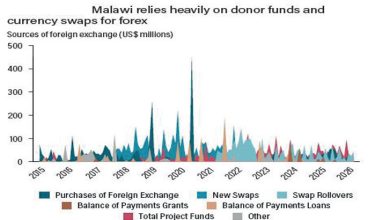
Economists have expressed concern that the Reserve Bank of Malawi’s (RBM) strict enforcement procedures will not ease the strain in the country’s foreign exchange market unless structural gaps are addressed.
The remarks follow instructions from RBM deputy governor for economics and regulation Henry Mathanga to individuals and companies to stop asking for direct foreign exchange allocations from the central bank and instead channel their requests through commercial banks.

While framed as a procedural clarification, University of Malawi economics lecturer Edward Leman argues the directive reflects deeper structural weaknesses in Malawi’s forex ecosystem, where enforcement is increasingly substituting for supply-side reform.
The instruction comes against a backdrop of worsening external imbalances.
National Statistical Office data show Malawi’s trade deficit widened by 15 percent in 2025 to $2.67 billion (about K4.6 trillion), driven by rising imports and declining exports. Meanwhile, the country’s import cover has dropped to 2.1 months far below the 3.9 months recommended for credit-constrained economies such as Malawi.
The widening gap underscores a fundamental imbalance: the country spends significantly more foreign currency than it earns.
In a separate interview, Christopher Mbukwa, who teaches economics at University of Malawi, said regulatory tightening without expanding forex supply risks pushing activity into informal channels.
“It is only through increased forex supply through export growth or investor inflows that we can have a natural rate of forex on the market,” he said. “Attempts to regulate without supply-side strategies will consolidate the black market and weaken export incentives.”
Malawi’s multi-rate exchange framework and mandatory surrender requirements have also come under scrutiny.
In its Public Finance Review, the World Bank has observed that forcing exporters to sell a portion of proceeds at an overvalued official rate functions as an implicit tax on exporters while subsidising importers with privileged access to official forex. Since the reintroduction of surrender requirements in 2022, official reserves have steadily declined.
Scotland-based Malawian economist Velli Nyirongo argues that heavy reliance on enforcement treats symptoms rather than causes.
“When foreign exchange management is driven primarily by regulatory enforcement, the immediate risk is that it discourages exporters and informalises forex transactions,” he said.
“Controls can slow outflows temporarily, but they do little to expand underlying supply.”
Concerns have also emerged around public confidence in foreign currency-denominated accounts (FCDAs).
Kondwani William Susuwele-Banda, a Malawian who spent the past year studying in South Africa, said accessing funds from his local bank became increasingly unpredictable amid the forex shortage.
“Debit cards would suddenly stop working for international transactions,” he said. “Forex allocations were granted with undisclosed expiry periods and later withdrawn without warning. Customers only discovered changes when transactions failed.”
He stressed that while the forex shortage itself is structural, poor communication by commercial banks worsened the experience.
“What falls within the banks’ responsibility is how they treat customers in moments of crisis,” he said, arguing that silence and delayed disclosure created unnecessary hardship for Malawians living abroad.
Analysts warn that reduced trust in domestic forex instruments may encourage offshore retention, further shrinking the formal forex pool.
Economists agree that restoring confidence is critical, adding that forex is as much a confidence-driven asset as it is a flow variable.
They also argue that Malawi’s forex challenge cannot be solved through rationing, devaluation or administrative directives alone.
Structural reforms, including export diversification, value addition, improved logistics and credible policy sequencing, are needed to expand the supply base.