The K10.9 trillion 2026/27 National Budget passed in Parliament on Tuesday offers a mixed outlook for the Ministry of Youth, Sports and Culture as well as the Malawi National Council of Sports which are adjusting to significant shifts in funding priorities.
The ministry has been allocated K12.2 billion, with K4.96 billion earmarked for recurrent expenditure and K7.28 billion directed towards development projects under Vote 180.
Ministry of Youth, Sports and Culture spokesperson McMillan Mwale in an interview yesterday said the budget reflects a deliberate focus on infrastructure, with major allocations going towards long-standing projects.
He said: “Infrastructure development is expensive. That’s why the figure looks huge unlike operations.
“With the current resources, we will make some tangible progress in the sector.”
The Griffin Saenda Indoor Sports Complex in Lilongwe has been allocated K1.5 billion while the Aquatic Centre at Kamuzu Institute for Sports also in the capital city will receive K1 billion.
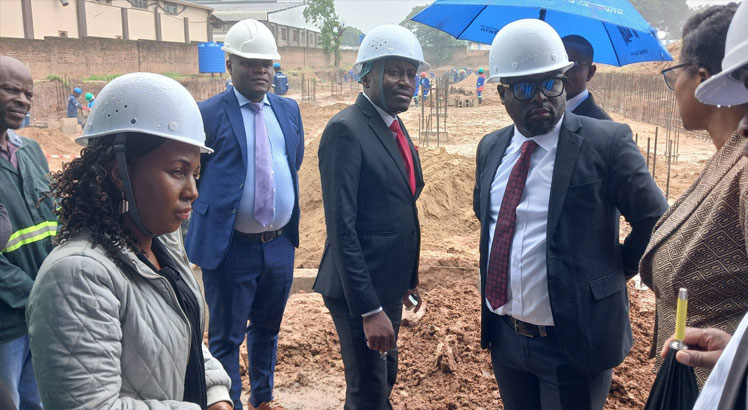
BAT Stadium project last month. | Nation
Blantyre’s stadiums projects for FCB Nyasa Bullets in Zingwangwa and Mighty Wanderers in Soche have been allocated K2.5 billion, up from K1.7 billion, although their combined cost is estimated at about K10 billion. Existing facilities will also receive maintenance support.
Bingu National Stadium in Lilongwe has been allocated K315.9 million, largely for utilities and upkeep while Kamuzu Stadium in Blantyre will receive K138.5 million, including K100 million specifically for maintenance.
On the other hand, the Mzuzu Youth Centre has been allocated K1 billion.
Despite the development-driven approach, concerns persist over implementation as several of the highlighted projects, including the Blantyre stadiums, the Aquatic Centre, the Mzuzu Youth Centre and the Griffin Saenda Indoor Sports Complex have faced prolonged delays, raising questions about delivery capacity.
However, Mwale said they are optimistic of completing all of them.
He said: “The ministry is optimistic that the planned activities will be implemented with very few challenges to ensure that we make considerable progress.
“We would appreciate if all the projects are completed and available for use to contribute towards sports development.”
In contrast, Sports Council has seen its budget rise significantly from K14.5 billion to K25 billion.
The previous financial year’s allocation was revised upwards from K13.5 billion to K14.5 billion to accommodate reconstruction works.
The new ceiling of K25.3 billion marks a substantial increase with K9.3 billion set aside for operations.
BAT Stadium project has been allocated K10 billion.
Football Association of Malawi will get K3 billion for the Flames while Netball Association of Malawi will receive K2 billion for the Queens’ assignments.
However, other associations will have to share K1 billion, a figure widely seen as insufficient given that the Malawi Olympic Committee alone requires K1.6 billion for international competitions such as the Commonwealth Games in August.
This imbalance has left Sports Council facing an estimated funding gap of K2.7 billion.
Sports Council board chairperson Jim Kalua in an interview acknowledged the constraints, pointing to the broader economic environment and government austerity measures.
He said: “That’s the position. It’s a tough one. But lt’s also appreciate that there are austerity measures which the government has put in place.
“So, obviously, some of them have already started being implemented. Administratively, we should also be having that.”
Kalua added that the council is exploring alternative revenue streams to bridge the gap.
He said: “We will also be coming up with some initiatives to make sure that we raise funds to cover the deficit.
“These will be announced in due course. Some of the revenue, with the board’s approval, will be channelled to associations.”
Kalua further described the situation as a turning point for sports associations, urging them to become more commercially driven.
He said: “We can’t continue relying on the government for everything. We also need to do our part as an association. This is now the time for commercialisation for associations.
“That’s why we are reviewing the policy for affiliation to ensure that registered associations are compliant.
“You may agree with me that most of these associations are just registered for the sake of being registered.
“Because if we had proper associations with proper structures, then the issue of commercialisation I think, would be easy.”