Malawian actor and theatre instructor Thokozani Kapiri is using his time at Bowling Green State University in Ohio, United States to further the African narrative through the theatre stage.
He led a Pan-African Theatre Ensemble in a devised spoken word theatre performance titled Poetry in Motion: Voices Rising, a production he co-produced with American playwright Pella Felton and South African Amanda Black.
The Poetry in Motion: Voices Rising is a narrative of three overlapping stories of xenophobia and immigration set-up in South Africa, law battles that the trans-communities are going through in today’s America and a mother’s love and loss packed in one box.
Speaking from his base in the US, Kapiri said the play is a collage of three texts; one from his Tales of a Migrant production, the second narrative is from Amanda Black’s Penny Full of Wholes and the last This is Pella Felton from Pella Felton.
He said: “Tales of A Migrant talks about a youthful Malawian who takes a bus to South Africa searching for a greener pasture. He faces a backlash of xenophobic violence. With the economy getting worse in Nyasaland, the choice becomes about choosing between a rock and a hard place.
“Penny Full of Wholes witnesses a woman grieving and not letting go of a box tied to her leg full of memorabilia about her recently deceased mother. She cannot come to terms with it, making her depressed, dysfunctional and in denial that her mother is gone until reality hits
hard that she can’t keep rotting in grief.
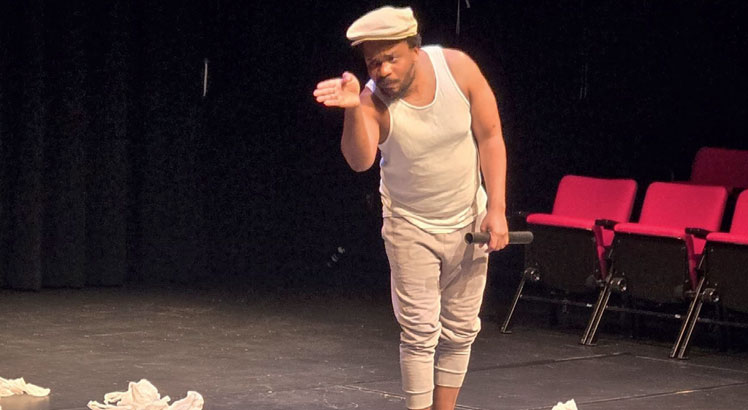
“The last text This is Pella Felton is about trans-justice, self-actualisation and empowerment using selected poems ‘Draw the Barrel/ Blood Work/ Barrel the Draw,’ ‘January 11, 2025 (The Last Night of Disco),’ and Presence.
“They all raise serious questions about the diminishing queer space in today’s America, specifically in this case, Ohio; the future looks grim for queer people in that text but they try to just have a good time, and sustain a glimmer of hope.”
Kapiri said the scenes were episodic such that the narratives and the characters were interwoven where one could not exactly tell where one narrative begins or end as each author spoke from a semi-autobiographical point of view.
“I tapped into my time at Wits University in South Africa around 2008-2010 where xenophobic attacks were rampant. Alongside compatriot Nyamalikiti Nthiwatiwa we were part of the research survey at Wits Department of Forced Migration that interviewed Malawians who were affected,” he said.
Kapiri said Pella, as a trans-citizen, has had to fight with the anti-trans laws that keep threating their lives to the point of losing their passports despite being an American citizen.
He said: “As we performed a new
anti-LGBTQ law was being deliberated in the Ohio legislature, creating more uncertainty in their community in terms of basic human rights.”
Kapiri said students and staff members had a rare chance to appreciate African aesthetic elements as he injected Chichewa, Zulu and Xhosa lines and songs in the predominantly English speaking audience.
“My approach is what I call myself now as an academic artist, so it is not just performing for showbiz but rather performance as research and activism. The next step is to step out of the university theatre and make Malawian theatre to make its mark at Broadway,” he said.
In her reaction to the production, Amanda Black said: “It was interesting in terms of the collaborator process, especially how the stories found common ground of intersection.”
On the other hand, Pella Felton said: “I found the box in Amanda’s resonating with my text and when Thokozani was playing out the xenophobic acts, I did react like a victim in that context. While both Amanda and Thoko had to perform as dancers in my clubbing scene.
“We were all in one, with audience, just having a good time, and that is enough.”
Amanda Black and Kapiri are PhD candidates and graduate teaching assistants in the theatre and film department of Bowling Green State University. Pelle Felton is an alumnus of the university.
The play was staged twice over Easter at Eva St. Marie Theatre, Wolf Arts Centre, department of theatre and film, University of Bowling Green