Elsewhere, the death of three Senior Chiefs—iNkosis—within a span of just eight months could easily have sparked succession disputes.
Here, succession is not left to chance. It is cast in stone.
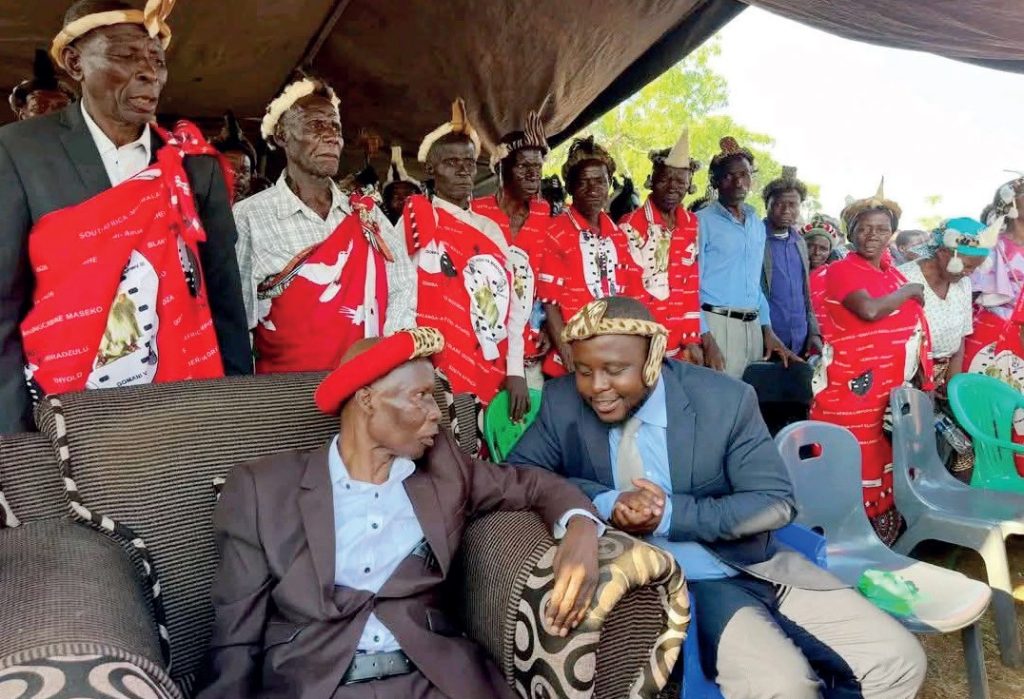
“No, we neither have nor can afford a power vacuum at any level of chieftaincy, at any point in time,” says Kandi Padambo, general secretary of the Maseko Ngoni Heritage Trust.
The same system has ensured stability in Madzanje and Kachindamoto chieftancies, which lost their chiefs last year. It now turns to the Champiti clan, the latest to mourn its iNkosi.
Yet, behind this assured continuity lies a deeply human story.
A whirlwind of emotions must have filled the mind of Moffat Champiti following the death of his father, Morton Champiti, who died last Friday at 84. He had cared for him closely, even moving both parents into his Chirimba home in Blantyre as illness took its toll.
Ordinarily, he would have led the mourning or at least been allowed to grieve. But tradition demanded otherwise. He could not even attend his father’s burial. The process of succession had already begun.
“In this kingdom, a chief is not elected. He is born,” Padambo explains.
Moffat, a former football referee, had long been in that frame. One of two sons to the fallen chief, he had carried responsibilities even before his father’s death. Morton had entrusted him with duties as his health declined.
Still, that alone does not make one heir.
The system must be followed without compromise.
Representing the Ngwenyama, iNkosi ya Makhosi Gomani V, at the funeral, Maseko Ngoni Heritage Trust chairperson iNkosi Makwangwala was emphatic:
“Our succession is patrilineal. A son of the chief, born within a recognised marriage, inherits. Not a brother. Not a sister. Not anyone else. Age does not matter. The crown belongs from birth.”
So, even as Morton Champiti’s body lay at a Blantyre funeral parlour, elders were already consulting. The next chief had to be identified before burial.
On Sunday, hundreds gathered at the Gwati Headquarters, Champiti Village in Ntcheu. Leaders, villagers, and dignitaries came to pay their respects. Eulogies—from government officials to traditional authorities—spoke of a life well lived. Minister of Local Government and Rural Development Ben Malunga Phiri was one of them.
Then came the burial.
In line with Ngoni custom, the chief was interred seated—just like his ancestors. The grave, the rites, and even the gun salute reflected the honour he commanded in life.
The CCAP Blantyre Synod allowed the cultural rites to proceed alongside church prayers.
And then, the moment arrived.
From the western side of the cemetery, at the sun was setting in the horizon, Ngoma dancers emerged in song:
“Pa lidiwa… bwera udzaponde pa lidiwa…”
The message was clear. The successor was ready.
Until then, his identity remained concealed. Tradition demands it. The crown prince is shielded—both to preserve ritual order and to guard against disruption.
“Anything can happen at such a time,” explains iNkosi Ganya Hlawati, who oversaw the traditional proceedings.
“In the past, thrones were contested at this very stage. We take no chances.”
Heavily guarded, the chosen heir was led to the grave. Warriors cleared space, ordering everyone to sit. Only a tight circle remained standing.
Then he appeared.
Dressed in full regalia, he stepped onto the fresh grave. A spear in one hand. A shield in the other. He raised them, turned to the four cardinal points, and struck them together before driving the spear into the mound.
It was more than ritual. It was a declaration.
A challenge.
“This is the moment,” Padambo explains.
“If anyone disputes the choice, they step forward and pull out the spear. In the past that meant combat. Today, no one challenges. The choice stands.”
No one stepped forward.
The man on the grave was Moffat Champiti.
As chants filled the air—“Za bambo ake mpatseni…”—the message spread through the crowd.
The son had taken his father’s place.
He is now iNkosi Champiti V.
Until his formal coronation, Moffat, a father of four, will continue leading the Gwati clan as he had already begun to do during his father’s illness. Whether he steps away from his role at St Andrews International High School in Blantyre remains to be seen.
The absence of the Ngwenyama did not go unnoticed. But it was understood. He is said to be in deep mourning, having lost two pillars of his kingdom in close succession—iNkosi Champiti in Ntcheu and a father to his half-brother, Ngwenyama Inkosi ya Makhosi Zintambira V, who was buried the same day in Tete, Mozambique.
If he were watching, Gomani would have been satisfied. The traditions held. The process endured.
From grief came order.
From burial, authority.
From the grave, a chief rose!
As darkness hovered, the crowds dispersed to their respective destinations. One Ngoma song, though, lingered in the air:
“Yaika nkhwangwa patebulo, mfumu yochenjera. Haikhona, haikhona… mfumu yochenjera.