If transport is truly the lifeline of Malawi’s economy, then it is steadily weakening on a beeping life support as the ripple effects of a biting fuel scarcity is being felt across every sector.
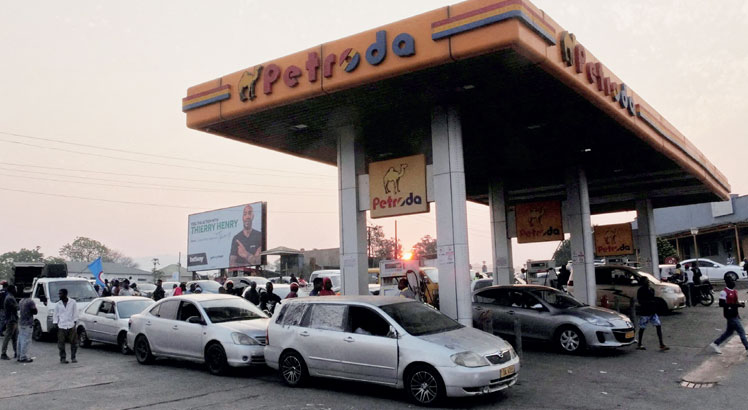
As darkness falls at Kameza Roundabout in Blantyre, a merciless economy pops to life—one defined not by productivity, but by waiting and cashing in on mass desperation.
Long queues of vehicles stretch deep into the night as motorists search for fuel just to remain operational. Headlights flicker over tired faces—minibus drivers, traders and small business owners—all losing valuable working hours and patience in queues that beget fierce scrambles for scarce fuel that has yet to arrive.
What begins at the fuelling station quickly spreads into the wider economy as time lost in fuel queues translates directly into lost income.
For transport operators, a day without fuel is a day without earnings while for businesses, delayed deliveries, disrupted supply chains and reduced customer flow are becoming the norm.
Even private vehicle owners say the cost of staying immobile is eroding their incomes.
“I expected the recent fuel price hike to at least guarantee availability, but the queues are back in town. The money we spend on fuel per month is like we are working just to afford transport,” says motorist Angela Namitembo, a white-collar employee who runs a small-scale business to supplement her income.
Pump prices of fuel in Malawi have risen sharply since the reintroduction of the automatic pricing mechanism.
From last month, the Malawi Energy Regulatory Authority (Mera) pegged petrol prices at K6 672 per litre and diesel at K6 687, but they now fetch K20 000 and K25 000 per litre on the black market.
For commuters, the impact is immediate and severe.
There are fewer minibuses on the road, longer waiting times and spiking fares. In many places, fares have more than doubled, forcing workers to choose between public transport and buying basic necessities.
“I now walk from Chilomoni to town,” says Shalon Masache, a shop worker at Ginnery Corner, approximately seven kilometres from home. “If I take a minibus, I might not even afford to return home. If I do, I will sleep on an empty stomach. Transport has become a luxury.”
Fare increases across key routes highlight the scale of disruption.
In February 2026, Minibus Owners Association of Malawi (Moam) more than doubled fares on many routes.
For longer distances, the strain is even greater. Between Blantyre and Lilongwe, it costs K75 000, up from K35000, while Limbe–Nsanje costs nearly K50 000, jumping from K22 0000.
Transport operators say they are simply trying to survive.
“We don’t have standard fares anymore,” says Peter Kambalame, a driver on the Limbe–Mangochi route. “If you can’t find fuel at service stations, you are forced to buy from the black market. Someone has to pay that cost.”
The burden ultimately falls on commuters, says Moam general secretary Coaxley Kamange.
He states: “The situation has made it nearly impossible to maintain fare controls as we no longer have a stable operating environment.
“Minibus operators spend hours, sometimes an entire day, fetching fuel. That reduces the number of minibuses on the road. This means longer waiting times and higher transport costs. The commuter absorbs the shock.”
Businesses under Strain
For businesses, the impact is equally damaging as retailers face rising transport costs for goods, which they relay to consumers.
Small-scale traders struggle to restock as transport becomes unreliable and expensive. Service providers lose customers as mobility declines.
In effect, the fuel crisis is increasing the cost of doing business while simultaneously reducing demand—a double blow to economic activity.
When transport becomes expensive, everything else follows—food prices, commodity costs, and overall inflation.
Beyond transport, the crisis is now undermining energy production—further slowing economic activity.
The Electricity Generation Company (Egenco) has confirmed that its diesel-powered backup plants in Kanengo and Luwinga are stuttering due to fuel shortages.
The generators help stabilise electricity supply when hydropower levels drop.
“We depend on generators to supplement hydropower during deficits, but they cannot operate without fuel,” says Egenco spokesperson Moses Gwaza.
Power users at the receiving end of the Electricity Supply Corporation of Malawi (Escom) transmission lines bear the brunt of blackouts that span up to eight hours in some areas.
To businesses, the worsening load shedding means reduced production hours, increased reliance on costly alternatives that eat into their profits.
Consumers Association of Malawi executive director John Kapito says the fuel shortages and power outages are exerting unprecedented pressure on households and businesses.
According to Mera, the country consumes approximately 845 000 litres of petrol and 834 000 litres of diesel, but supply is stuttering. Government spokesperson Shadric Namalomba blames it on forex scarcity and disruption in global supply chain via the Strait of Hormuz in the wake of the US-Israel-Iran war in the Middle East. At least a quarter of global petroleum shipments pass through the channel disrupted by US and Iran naval blockades.
However, Minister of Energy and Mining Jean Mathanga said the situation would improve by yesterday as over 100 tankers had entered the country.
However, for the worst affected poor Malawians, change needs no rhetoric. When enough fuel arrives, they will see it at the dry pumps now inundated with immobilised vehicles.