Yusuf Investment Limited, owners of Amaryllis Hotel, has argued that the Public Accounts Committee (PAC) of Parliament lacks mandate to probe it over the sale of the hotel to the Public Service Pension Trust Fund (PSPTF).
A letter signed by Yusuf Investment Limited lawyer Gabriel Kambale informed PAC of the firm’s decision, saying the committee lacks jurisdiction over private entities such as Yusuf Investment Limited.
“Second, that the scope of the inquiry, as framed in your letter of 10th April 2026, is ultra vires your statutory mandate,” reads the letter to PAC in part.
Kambale argued that PAC’s mandate is confined to public finance oversight, noting that sections 18 to 20 of the Public Audit Act, if read holistically, shows the committee’s mandate is confined to oversight of public expenditure, public money and public resources.
He said there is no provision— expressed or implied—that extends this mandate to the regulation or investigation of private commercial entities acting in their own capacity.
“Yusuf Investment Limited is such a private entity, it is not a public body and it is not an entity controlled by government. It is not subject to audit by the Auditor General and it is not entrusted with the administration of public funds. On that basis alone, jurisdiction of this committee does not arise,” said Kambale.
The lawyer also noted that Standing Order 173(4) of Parliament provides that deliberations of the committee shall be confined to its jurisdiction, adding that these Standing Orders are purely procedural and cannot enlarge substantive jurisdiction.
“They derive from and remain subordinate to the Constitution and the Public Audit Act; they regulate how powers are exercised, not whether they exist. Jurisdiction is conferred only by law and no internal rule can extend it to persons or matters beyond that mandate.
“Any attempt to rely on Standing Orders to compel disclosure from a private entity absent a clear statutory nexus to public funds is ultra vires and unlawful. To hold otherwise would collapse the distinction between rule-making and law-making and expose private actors to unbounded inquiry,” he said.
Kambale has since warned that the committee’s invitation of Yusuf Investments Limited’s bankers, National Bank of Malawi (NBM) plc, to the inquiry exposes the bank to significant legal liability.
When contacted last evening, PAC vice-chairperson Tulinje Muluzi said he could not respond to the matter on whether they have received the letter or not, “call me another time, I am in another meeting”.
Commenting on the matter, Human Rights Defenders Coalition chairperson Michael Kaiyatsa said a parliamentary committee must only do what the law allows it to do.
“But the real issue depends on one key question: Is Yusuf Investments being called because it is just a private company, or because it is linked to a scandal involving government decisions, public money, or abuse of office?
“If the company is connected to how public resources were used or misused, then it becomes a matter of public interest. In that case, the committee has a good reason to ask questions so that the truth comes out,” he said.
However, private practice lawyer Benedicto Kondowe said Kambale’s argument narrows the constitutional and procedural scope of parliamentary committees.
He said: “First, the Constitution expressly empowers Parliament to regulate its own procedure and, by implication, the functioning of its
committees, including the taking of evidence.
“Section 56 vests Parliament with the authority to regulate its procedure, while Section 60 recognises the privileges and immunities necessary for Parliament to effectively discharge its functions, which include compelling attendance and production of evidence. These powers are not ornamental; they are designed to ensure that oversight is effective and not illusory.”
Kondowe also said the Standing Orders operationalise this constitutional mandate.
In a statement released last night, Yusuf Investment Limited said it strives to act in good faith.
” Yusuf Investment Limited has, at all material times, acted in good faith and with full respect for the authority and oversight role of the PAC.
” In compl iance with the PAC’s request, Yusuf Investment Limited submitted a comprehensive written account on the sale of the Amaryllis Hotel on 24 April 2026, well in advance of its scheduled appearance.
“Yusuf Investment Limited further attended before the PAC in person on 29 April 2026 as required. Earlier yesterday when Yusuf Investment Limited chairperson Shiraz Yusuf appeared before PAC, he insisted on a closed-door hearing despite the committee earlier rejecting the request.”
The firm first protested against the arrangement in an April 25 2026 letter through Kambale, citing alleged security threats, harassing calls, hostile social media commentary, recent kidnapping incidents and fears of exposing confidential commercial information.
And when the committee met yesterday, Yusuf stood his ground, refusing to proceed unless the session was held in camera.
On two occasions yesterday, PAC asked Yusuf to go out of the meeting room to allow members to deliberate on his request, but the committee reaffirmed its demand for an open hearing. However, Yusuf refused to comply.
The hearing, set for 9.30am, stalled for hours before the committee sent Yusuf away for refusing to participate.
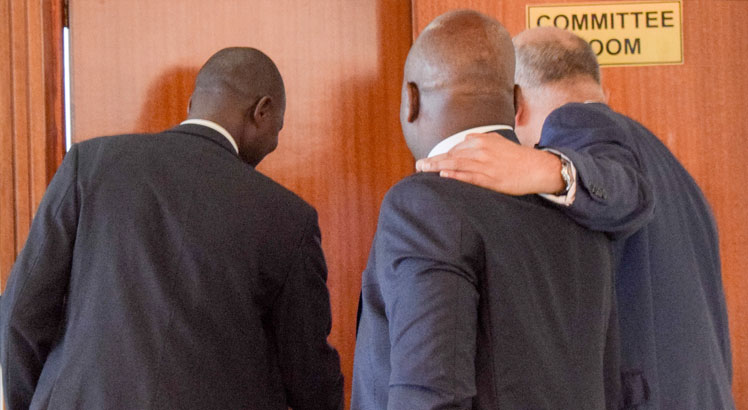
Yusuf also sought protection from the media to avoid being photographed and the committee granted the request as he exited the meeting room.
Addressing the press after the impasse, Muluzi said the company’s conduct amounted to contempt of Parliament and warned of unspecified action.
He said: “This inquiry is not about personalities. It is about accountability. It is about protecting public institutions.
“Above all, it is about safeguarding the pension savings of ordinary Malawians whose future security depends on the integrity of public decision-making.”
Muluzi dismissed claims of interference in private affairs, saying Parliament has a constitutional duty to oversee public resources.
“Section 60[3] empowers parliamentary committees to summon ‘any person’… and the seller’s appearance is directly linked to our inquiry into public pension funds,” he said.
Under the National Assembly Powers and Privileges Act, refusal to answer lawful questions before a committee can attract a fine and up to two years’ imprisonment.
Committee member Noel Lipipa said they were unconvinced by the security fears, noting police had assured Yusuf of protection.
“Of course, he wrote the police and the police have also written him back that they will provide security,” he said.
The committee also appears helpless to bring former Secretary to the President and Cabinet Colleen Zamba, who maintains that she cannot testify while the matter is before courts