Across Africa, millions of people continue to face persistent challenges linked to unsafe drinking water, weak healthcare systems, financial exclusion and limited access to affordable technologies.
From cholera outbreaks caused by contaminated water, to neonatal deaths in under-resourced hospitals, to the struggles women face managing informal village savings groups, these problems persist despite decades of development efforts and investment.
In the middle of these challenges is Tadala Mtimuni — a Malawian biomedical engineer whose work is quietly shaping practical solutions across health, finance and water systems.
She is the woman behind Bank Mkhonde, a digital platform designed to strengthen transparency and accountability in informal village banking systems.
Tadala is also the mind behind the Infant Life Engine, an affordable biomedical innovation aimed at reducing neonatal deaths in low-resource hospitals.
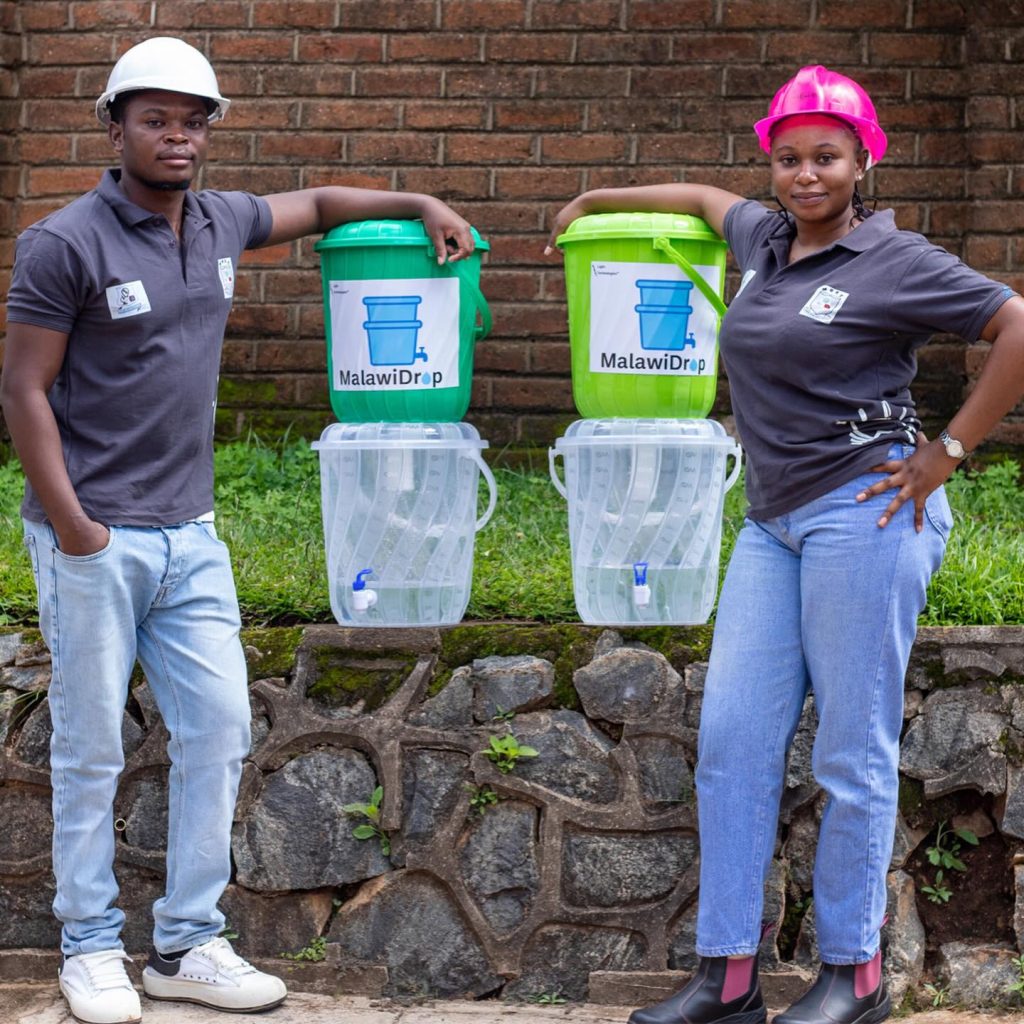
She has also expanded her work into water systems, developing a chlorinated resin-based treatment approach designed to improve the safety and consistency of drinking water in rural and peri-urban communities.
From fintech to healthcare to water systems, Tadala’s innovations share a common thread: solving everyday African problems using engineering designed for real-world conditions.
These challenges are not limited to a single sector, but cut across unsafe drinking water, waterborne diseases, weak sanitation systems and broader public health risks that continue to affect millions of communities across the continent.
For Tadala, this journey did not begin with recognition or international partnerships. It began with observation.
Innovation rooted in everyday life
One of her earliest breakthroughs, Bank Mkhonde, emerged from the fragility of informal village savings systems that many women depend on for survival and economic support.
The idea was inspired by conversations at home.
“Actually, the challenges my mum faced inspired Bank Mkhonde,” she says.
Tadala recalls stories of women losing money through poor record-keeping, loan defaults and cases where members disappeared with community savings.
Those experiences shaped Tadala’s understanding of how trust-based systems, while important, often lacked structure and accountability.
Bank Mkhonde was, therefore, designed as a digital tool to improve record-keeping, transparency and financial control without disrupting the cultural foundation of village savings groups.
The innovation got recognition in 2020 when it won the ICT Association of Malawi Innovation Award under the Best ICT Solution categorry, as well as the Sadc Innovation Awards in the Regional Financial Inclusion and Digital Innovation category.
It was later adopted beyond Malawi, including in Rwanda where is being used.
Her next major innovation moved into neonatal healthcare.
The Infant Life Engine evolved from early biomedical engineering work focused on addressing a critical gap in under-resourced hospitals: the lack of affordable infant monitoring systems.
Many health facilities in low-income settings struggle to access reliable equipment for monitoring newborns, contributing to preventable neonatal deaths.
Tadala’s innovation provided a low-cost monitoring solution to improve early detection of complications in newborn care, especially in facilities with limited equipment.
The project was first developed during the UBORA and ABEC Biomedical Engineering Design Competition in 2018, where it received prototype recognition, before later winning the Malawi Innovators Design Competition Award in 2020 under the Biomedical Engineering.
Today, it is being used in Kenyan hospitals.
The same philosophy guided her into water treatment systems, a challenge affecting millions across Africa.
After her undergraduate studies, she pursued a master’s degree in chemical engineering at Stellenbosch University.
Her research focused on a persistent, but often overlooked issue in water safety — chlorine dosing in disinfection systems.
Chlorine remains widely used due to its effectiveness in killing pathogens, but she says, its application is highly sensitive to dosage.
In many rural and peri-urban systems, under-dosing leaves water unsafe, while over-dosing affects taste, safety perception and long-term consumption behaviour.
Tadala identified this not simply as a technical issue, but as a systems challenge shaped by limited infrastructure, weak monitoring tools and lack of technical capacity.
From this, she developed a chlorinated resin-based water treatment system designed to stabilise chlorine release and reduce dependence on manual dosing.
The aim, she says, was not to replace chlorine, but to improve how it is used.
“Clean water is directly connected to health, education and development,” she adds.
In 2025, she secured an $88 000 research and innovation grant under the Water Innovation and Public Health category to advance this work in collaboration with the University of Rwanda, with support from WaterAid.
The project targets communities affected by cholera outbreaks, floods and weak water infrastructure.
Today, she is also involved in training future engineers at the Malawi University of Science and Technology (MUST), where she lectures in medical device maintenance and lifecycle engineering while supervising student research projects.
Her own journey began in Area 18 in Lilongwe where her fascination with mathematics and problem-solving first developed.
“Engineering was a natural path for me because of my interest in mathematics and desire to explore and validate ideas,” she says.
Tadala later attended Mary Mount Secondary School before being selected to study biomedical engineering at MUST in 2014, part of the university’s pioneering cohort.
At the time, engineering classrooms were male-dominated, with only a small fraction of female students.
“Sometimes you walk into spaces where people already underestimate your abilities before you even speak,” she says.
Engineering remains male-dominated in Malawi and across much of Africa, but Tadala believes visibility and representation are slowly changing perceptions.
“When girls see women succeeding in engineering, they begin to believe it is possible for them too,” she says.
Looking ahead, she hopes her work contributes to transforming Malawi from a largely consumer economy into a more innovation-driven and productive nation.
“I want local innovation and research to contribute to Malawi’s economic growth,” she says. “I want to see industries, factories and systems built around African solutions.”
Tadala has now begun shifting her focus toward industrial-scale impact, with plans that extend beyond individual innovations into national economic transformation.
She is embarking on a step toward contributing to Malawi’s industrial development, with intentions to establish a manufacturing facility that will support local production of her technologies while also creating employment opportunities.
The vision is not only to scale her innovations, but also to help address one of Malawi’s persistent economic challenges — limited industrialisation and a shortage of formal jobs for young people entering the workforce.
For her, engineering is no longer just about solving technical problems; it is about building systems that can strengthen local economies and reduce dependency on imported solutions.
Yet alongside these ambitions lies a persistent challenge that continues to define her journey — the gap between innovation and local adoption.
While her technologies have gained recognition and use beyond Malawi, including in Kenya and Rwanda, local uptake remains limited.
This reflects a broader structural issue in the country’s innovation ecosystem, where promising solutions often struggle to transition from prototype to widespread national adoption.
The challenge is not only about funding, but also about institutional trust, procurement systems and limited integration of local innovations into public infrastructure.
For many innovators, recognition often comes first from outside the country before it is fully embraced at home.
For Tadala, this reality underscores a deeper question: how Malawi can move from being a producer of ideas to a consistent adopter and scaler of its own innovations.