Malawi’s energy sector continues to be haunted by financial gaps, undermining efforts to expand electricity access and accelerate rural electrification nationwide.
The Japan International Cooperation Agency (Jica)’s Energy Sector Position Paper shows that in the 2025/26 financial year, the sector had a financing gap of about K447 billion as Treasury only allocated K21 billion against a requirement of K468 billion to make a huge impact.
On the other hand, Malawi Rural Electrification Project phase nine was also hit by financial challenges, slowing implementation and delaying in the phase and wider electricity penetration efforts, particularly in rural areas, where electricity penetration is at less than two percent.
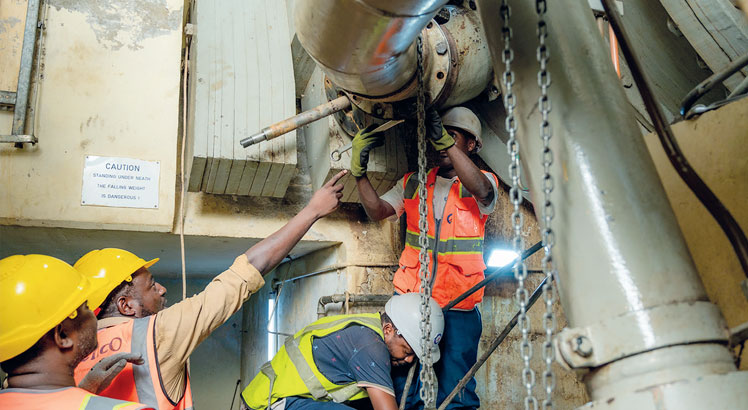
infrastructure repairs. | Nation
Ironically, only about 25.9 percent of the population has access to electricity, including grid and off-grid, with rural access much lower, against the Government of Malawi’s 70 percent target by 2030 in line with Malawi 2063, the country’s long-ter, strategy which seeks to transform Malawi into a lower middle-income economy by 2030 and upper middle-income status by 2063.
Reads the position paper in part: “Malawi continues to have unreliable electricity supply due to aging infrastructure and frequent blackouts. There is an over-dependence on hydropower, which is highly vulnerable to climate change.
“Financial and investment constraints prohibit large-scale and decentralised energy development.”
In an interview on Monday, industry commentator and former Electricity Supply Corporation of Malawi (Escom) chief executive officer Kandi Padambo said the financing gap threatens progress, observing that achieving the target will require annual electricity access growth of about 12 percent over the next four years.
He said: “Closing the energy financing gap is essential if Malawi is to expand electricity access to 70 percent by 2030 and achieve aspiration outlined in Malawi 2063 of becoming an inclusively wealthy and self-reliant nation.”
Malawi Union of Small and Medium Enterprises president James Chiutsi said in interview on Monday that the funding challenges have affected electricity access to the extent that businesses now spend over 30 percent of their monthly operating costs on diesel and petrol for generators due to power outages, which now last an average of six hours.
He said many small and medium enterprises (SMEs) now spend between K200 000 and K450 000 per month on fuel alone, up from less than K80 000 in 2024.
“SMEs cannot absorb these costs indefinitely. With customers already struggling with high living costs, businesses face the choice of closing or pricing themselves out of the market,” he said.
In February, Escom Limited announced “a structured eight-month rollout of embedded power and battery storage” to strengthen the grid, effectively exposing Malawians to a long wait for stable power supply.
Escom also acknowledged the significant impact the current power outages have on households, businesses and the national economy at large.
However, last week, Electricity Generation Company (Egenco) admitted the country is generating far less electricity than national demand.
Egenco officials led by director of planning Jeddie Luka and company secretary Videlia Mluwira, told the Parliamentary Committee on Government Assurances and Public Reforms on Friday that the power system is under pressure from equipment breakdowns, fuel shortages and rising demand.
Luka noted that while solar energy is an important alternative, it is still not sufficiently reliable for heavy industrial use.
Currently, Egenco generates 444 megawatts (MW) to the national grid, which includes 390MW from hydro, 53MW from diesel generators and 1.3MW from solar.