The African Development Bank (AfDB) says Malawi’s access to development financing is tightening, forcing the country to rely solely on grants amid deteriorating macroeconomic conditions and rising debt distress.
The AfDB assessment on operational performance in Malawi shows that over the past African Development Fund (ADF) cycles, Malawi has transitioned from a blend country eligible for both loans and grants to an ADF grant-only country due to deteriorating macroeconomic and debt sustainability indicators.
Reads the assessment in part: “The International Monetary Fund has assessed Malawi as being in debt distress, reflecting persistent fiscal and external imbalances, significant currency depreciation and unsustainable levels of public debt.
“These challenges have adversely impacted Malawi’s country policy and institutional assessment and debt sustainability assessment ratings, key criteria used to determine ADF allocations and eligibility for concessional lending.”
In an interview on Tuesday, public finance expert Dalitso Kubalasa observed that ADF cuts and disbursement failures mean that the infrastructure the country needs for climate resilience, watershed management, climate-smart agriculture and reinforced transport networks, remains on paper.
He said: “With an 80 percent donor dependency rate, we are in a strategic stranglehold. This is not just a funding cut, it is a loss of voice.
“Our cherished self-reliance is being traded away, one delayed procurement at a time for the short-term convenience of a system that resists accountability.”
Scotland-based Malawian economist Velli Nyirongo said in an interview on Wednesday that the reduction in the fund’s allocation has serious implications for economic growth, infrastructure development and poverty reduction efforts as it limits the government’s capacity to fund critical projects without increasing fiscal pressure.
“Projects such as transport corridors and regional trade facilitation initiatives are not merely construction programmes. They are strategic investments designed to lower the cost of doing business, improve regional connectivity and attract trade and industrial activity,” he said.
Nyirongo said more broadly, the development risks slowing progress towards Malawi’s long-term development aspirations, including economic transformation, export diversification and poverty reduction.
Economist and September 16 General Election presidential aspirant iMilward Tobias said donor support does not only enable government to deliver more goods and services, it is also a key source of foreign exchange.
“What is even more concerning are the reasons for the reduction which border on weak accountability on the part of project implementation staff,” he said.
Ministry of Finance, Economic Planning and Decentralisation spokesperson Williams Banda was yet to respond to our questionnaire, but he earlier admitted that there are inefficiencies in the management of donor funding.
Treasury data show that the current public debt stock levels stand at K23.9 trillion as of December 2025, which is 90.9 percent of gross domestic product. Of this amount, 65 percent is domestic debt, translating to K16 trillion.
In the current fiscal year that that rolled out on April 1 2026 and end on March 31 2027, public debt interest is projected at K2.7 trillion, representing 22.9 percent increase from the 2025/26 fiscal year revised figure of K2.2 trillion, largely due to past committed debt.
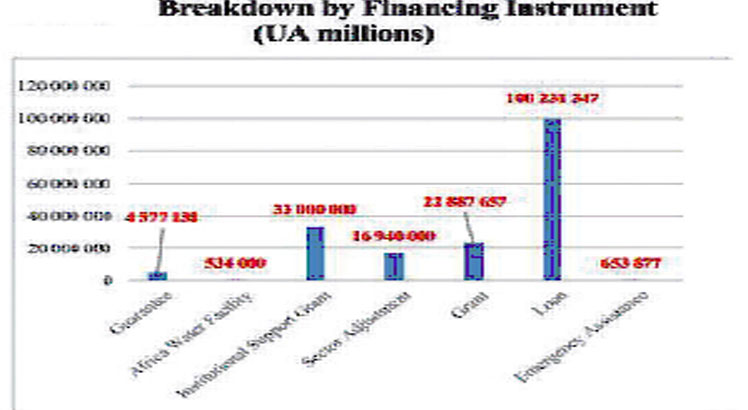
The AfDB Group has financed 149 operations in Malawi, with a cumulative net commitment of $1.89 billion (about K3.3 trillion).
As of March 14 2025, AfDB’s active portfolio in Malawi comprised 11 operations with a total commitment of $234 million (about K409 billion).