‘Mwanza Four’ families distance memorial services from politics

Families of four politicians murdered during the one‑party State say there are no political connotations to the annual memorial services they hold.
Family representatives said this during a memorial service at St. Michael’s Cathedral in Chikwawa yesterday.
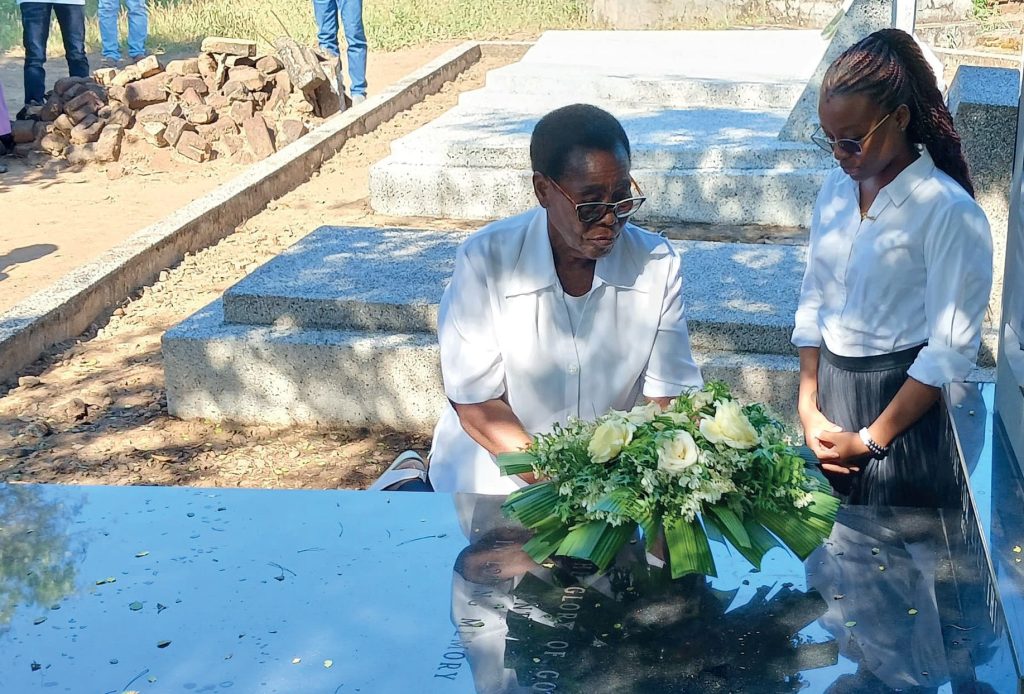
late husband’s tomb.
The four politicians David Chiwanga, Dick Matenje, Aaron Gadama and Twaibu Sangala were found dead on May 181983 in a vehicle that had been abandoned at Thambani in Mwanza.
At the time, the then‑Malawi Congress Party (MCP) government said the four had died in an accident while fleeing to Mozambique. A 1994 Commission of Inquiry, instituted by the country’s first democratically elected president, Bakili Muluzi, found that the four were murdered by State agents for opposing the leadership style of then president Hastings Kamuzu Banda.
Speaking on the sidelines of the memorial, Augustine Chiwanga, the second‑born son of the late David Chiwanga, said the families have moved on but regretted that some people still view the annual memorials as political.
“We have moved on and we hold these memorial services to pray for our fathers so that wherever they are, they should also be praying for us because we believe they are now in the hands of God,” he said.
“It’s not about politics; we do it in our private capacity. In short, there is nothing political about this; we do it for the good of the departed fathers.”
Joseph Gadama, the sixth son of the late Aaron Gadama, said it is sad that people attach political meaning to the services.
“The families sit down to agree and decide when to hold these memorial services. This time we agreed to come to Chikwawa, which is the home of the Chiwanga family, and next year we propose to go to Ntcheu, the home of the Matenje family, where we will also hold prayers. Nothing political and nothing sophisticated,” he said.
Gadama urged the government to renovate the memorial pillar at Thambani, where the four were found. The pillar was constructed by the Muluzi government and remains under government care, according to the families.
“With time and lack of maintenance, the memorial pillar has become dilapidated and could collapse at any time,” he said. “If the government cannot renovate it, the responsibility can be passed to the families.”
Richard Matenje, a representative of the Matenje family, also called for renovation of the memorial pillar.
“As the priest said, we cannot talk about the history of Malawi without talking about these people. They fought for the country’s democracy and this is why, as families, we will always keep praying for them,” he said.
“However, this should not be viewed through a political lens. We do not invite politicians to these memorial services and we keep them private.”
The memorial began with Mass at St. Michael’s Cathedral, followed by the laying of wreaths on the late David Chiwanga’s grave, which is a stone’s throw from the church.
At the time of their deaths, Chiwanga was the legislator for Chikwawa, while Matenje, Gadama and Sangala were Cabinet ministers in Kamuzu Banda’s government.
After the transition to multiparty politics, Kamuzu Banda was arrested in 1995 alongside his official hostess Cecilia Kadzamira, former MCP president John Tembo and police officers MacDonald Kalemba, Augustino Leston Likaomba and MacWilliams Lunguzi.
They were charged with conspiracy to murder and conspiracy to defeat justice by destroying evidence. After a six‑month trial, High Court Judge Mackson Mkandawire, assisted by a seven‑member jury, acquitted the accused of all charges for lack of substantial evidence. The State appealed, but the Malawi Supreme Court of Appeal dismissed it.