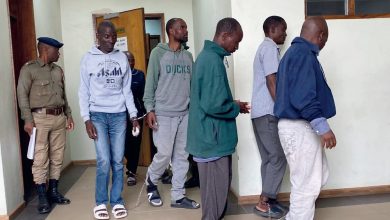
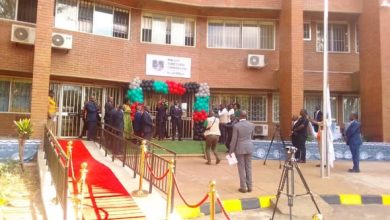
Attorney General (AG) Frank Mbeta has referred disputed Malawi Rural Electrification Programme (Marep) Phase 9 contracts to the Anti-Corruption Bureau (ACB) as government intensifies efforts to recover more than K1.4 billion in public funds.
Mbeta said this week that government had already secured court victories in some of the civil cases and was pursuing the recovery of public funds lost through the disputed contracts.

The Ministry of Energy sued three companies it accuses of receiving more than K1.4 billion in advance payments for Marep Phase 9 materials that were never supplied.
The firms—Africa Green Economy Limited, Kumakoka Trading Company and Loui Holdings Group (PVT) Limited— received the payments during the 2022/23 financial year.
“Marep matters have been referred to the ACB for further investigations. In some of the matters we sued, we have since obtained judgments for the refund of the money with interest,” Mbeta said.
Last month, Weekend Nation established through court documents and interviews that Africa Green Economy Limited received K698 050 991, Kumakoka Trading Company K523 538 243.57 and Loui Holdings Group (PTV) Limited K144 674 756.91 for cables that are yet to be supplied. The court documents did not indicate the total value of the contracts.
Through the Attorney General’s chambers, the Ministry of Energy commenced legal proceedings in August 2025 to recover the funds, together with interest, damages and other costs arising from the alleged contract breaches.
Court documents filed at the High Court’s Lilongwe District Registry show the cases were instituted in August 2025.
“We will recover all the money. Where necessary, we will also prosecute the perpetrators for abusing public funds,” Mbeta said.
ACB spokesperson Jacqueline Ngongonda said she would respond to our inquiry but had not done so by press time.
Meanwhile, Blantyre-based businessman Azhar Mahmood Chaudhry has applied for an injunction to stop individuals from seizing his property over the Kumakoka Trading Company Marep Phase 9 contract.
In Commercial Case No. 159 of 2026 before the High Court Commercial Division in Blantyre, Chaudhry says he entered into an oral agreement in 2022 with Hassan Hussein Jussab, Hassan Jussab and Karim Abdul for the pre-financing of the project.
According to court documents, the defendants agreed to lend him K800 million, with his residential property, Title No. Blantyre Central 242, offered as security.
However, Chaudhry claims the loan was never disbursed. He alleges that in June this year the defendants, accompanied by security officers, attempted to seize the property on claims that he had defaulted on repayment.
“I have genuine fears that unless restrained by a court order pending determination of my claims, the defendants will do everything to further interfere with the property subject of the claims,” reads Chaudhry’s sworn statement dated June 29 2026.
The Attorney General’s disclosure comes amid growing public scrutiny over procurement and contract management under Marep Phase 9.
In April this year, Minister of Energy Jean Mathanga told Parliament that an audit into the programme had uncovered accountability gaps involving contractors who failed to account for materials supplied for rural electrification works.
The audit placed 27 contracts under scrutiny and prompted further investigations.
In 2021, it also emerged that Marep had not been audited for 23 years despite receiving about K40 billion annually from fuel levies.
Marep is a government programme under the Ministry of Energy, jointly funded with the World Bank and implemented by the Electricity Supply Corporation of Malawi (Escom) to expand electricity access, particularly in rural areas where only about five percent of the population is connected to the national grid.
Introduced in 1980, the programme is implemented in phases and is currently in Phase 9.
Phase 9 targets about 500 sites covering nearly 21 000 households. However, implementation has been affected by escalating costs, with the budget rising from K40 billion to K70 billion following the devaluation of the kwacha and increases in the minimum wage.
Government aims to achieve at least a 30 percent electrification rate in rural and peri-urban areas by 2030, the year Malawi is expected to attain universal access to affordable, reliable and modern energy under Sustainable Development Goal 7.