Minister of Energy Jean Mathanga says the $20 million (about K35 billion) Battery Energy Storage System (Bess) at Kanengo in Lilongwe will help to stabilise the national grid by managing renewable energy fluctuations and improving power reliability.
Speaking on Friday during the commissioning of the 20-megawatt (MW) facility in Lilongwe, the minister said the system will enable Escom to store solar energy generated during the day and release it when demand peaks.
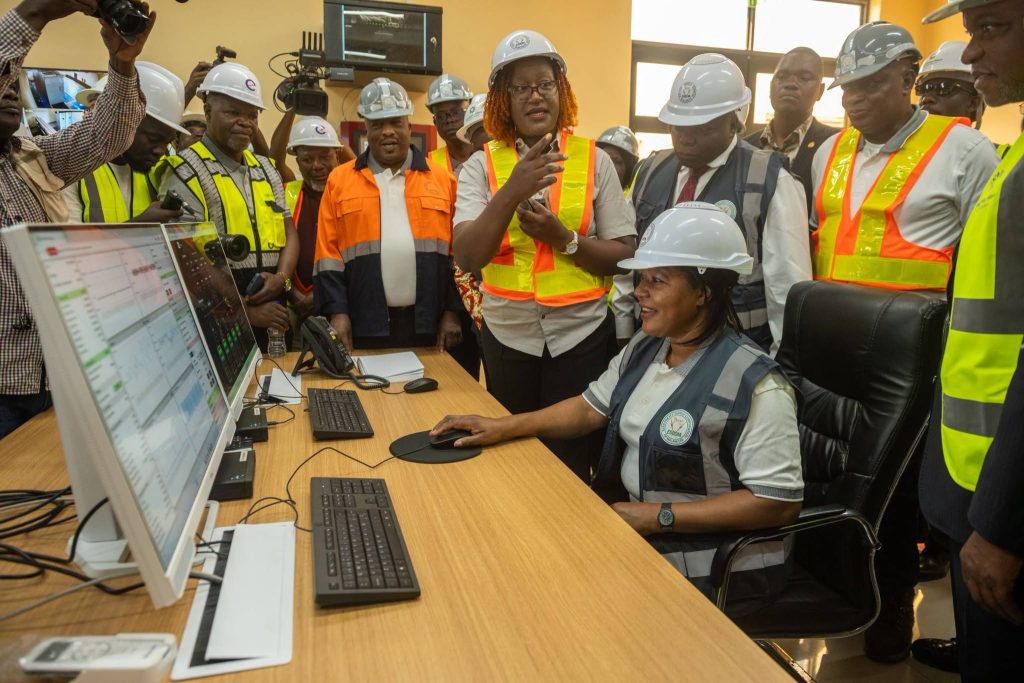
as other officials watch. | Wycliffe Njiragoma
She said: “The facility at Kanengo sub-station will provide instant frequency control, making it possible for the grid to withstand sudden changes in electricity generation and demand.
“Bess is the shock absorber our national grid has desperately needed.”
Mathanga said stable and affordable electricity is critical to achieving industrialisation under the country’s long-term development plan Malawi 2063, that seeks to turn the country into a lower middle income economy by 2030 and an upper middle income economy by 2063.
She challenged the sole power supplier to improve customer response times, reduce technical losses and speed up new electricity connections, saying the benefits of investments in the power sector must translate into improved services for consumers.
Electricity Supply Corporation of Malawi (Escom) Limited board member Welford Sabola said the facility will support the utility’s ambition of achieving zero load shedding.
“With this Bess facility, Escom will capture excess solar energy during the day and bank it for the peak evening hours and discharge that power into the system, which will create an energy shift,” he said.
Sabola said the system will also provide instant grid stability by responding within milliseconds to balance the network and provide frequency regulation required to prevent widespread blackouts.
Developed by Escom with $20 million (about K35 billion) support from the Global Energy Alliance for People and Planet (Geapp), the project is expected to strengthen energy demand management and support Malawi’s transition towards a more resilient electricity system.
Geapp Africa vice-president Carol Koech said Malawi’s project was conceived as a demonstration facility that could provide lessons for other African countries seeking to deploy grid-connected battery storage systems.
“Malawi is one of the countries that sought our support at a time it was facing significant challenges after Cyclone Ana put down a significant part of the grid and diesel power generation had been decommissioned,” she said.
Koech said the project generated important lessons from design, procurement and construction, which would be shared through the Southern Africa Battery Energy Storage System Centre of Excellence at Mzuzu University.
He said that Geapp will continue to support Escom under its Grids of the Future programme, which will help modernise the utility through grid digitisation to improve planning and service delivery.
“Grid digitisation means we take the national energy utility grid and map the network to create what we call a digital twin,” she said.
The technology, according to Koech, will enable Escom to have better visibility of its network, identify where investments are needed and improve customer service through data-driven planning.